history
Major moments in the history of the stock market, from the birth of stock exchanges to catastrophic market crashes and more.
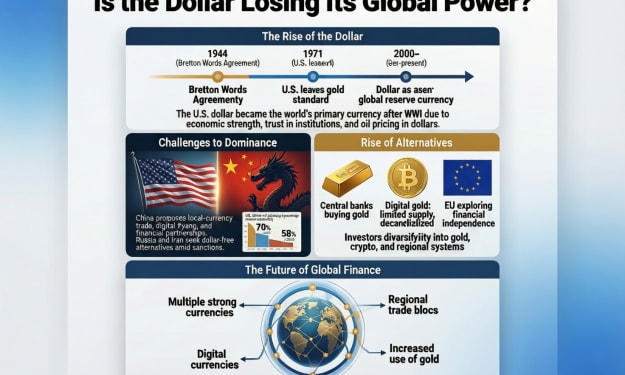
Is the Dollar Losing Its Global Power?
Is the Dollar Losing Its Global Power? For many decades, the U.S. dollar has been the most powerful currency in the world. It has been used for global trade, oil sales, international loans, and foreign reserves. Countries trusted the dollar as a safe store of value. But today, many experts are asking an important question: Is the dollar entering its last strong phase?
By Wings of Time 9 months ago in Trader
Bitcoin Price: A Complete Guide to Understanding Market Movements
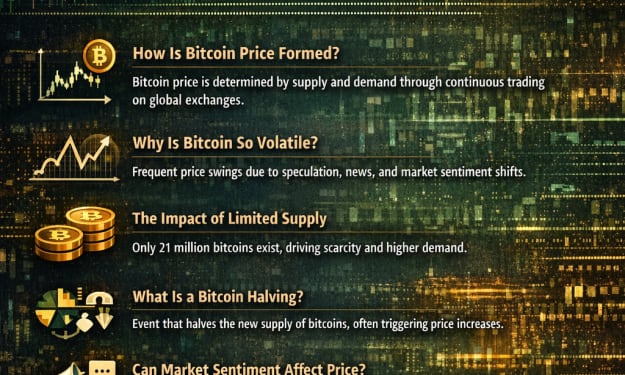
**Bitcoin Price: A Complete Guide to Understanding Market Movements** Bitcoin is the most widely recognized digital currency in the world and one of the most actively discussed financial assets in modern markets. Since its creation, Bitcoin price has attracted massive attention due to its rapid growth, sharp volatility, and decentralized nature. Unlike traditional currencies issued by governments, Bitcoin operates on a peer-to-peer network, which means its price is determined entirely by market forces rather than central authority decisions. **How Is Bitcoin Price Formed in Global Markets?** Bitcoin price is established through continuous trading between buyers and sellers on cryptocurrency exchanges worldwide. Every transaction represents an agreement between supply and demand at a specific moment. Because trading never stops, Bitcoin price changes constantly, reflecting real-time market conditions across different regions. **Why Does Bitcoin Price Experience Frequent Fluctuations?** Bitcoin price fluctuates frequently because it is traded in a highly speculative and fast-moving environment. Market participants react instantly to news, price trends, and changes in investor sentiment. Since Bitcoin has a limited supply, even modest changes in demand can lead to noticeable price movements within a short period. **What Role Does Limited Supply Play in Bitcoin Price?** One of the most important factors influencing Bitcoin price is its fixed supply. Only 21 million bitcoins will ever exist, creating a strong sense of scarcity. As adoption grows and more investors seek exposure, demand increases while supply remains unchanged, which can place upward pressure on price over time. **How Do Bitcoin Halving Events Affect Price Direction?** Bitcoin halving events reduce the number of new coins entering circulation by cutting mining rewards in half. This process slows supply growth and can tighten market conditions. When demand remains steady or increases after a halving, Bitcoin price may experience long-term upward momentum. **Can Market Psychology Influence Bitcoin Price Trends?** Investor psychology has a powerful impact on Bitcoin price. Optimism about adoption, technology, or broader acceptance often drives buying activity. Conversely, fear and uncertainty can trigger rapid sell-offs. Because Bitcoin markets operate globally and continuously, emotional reactions can spread quickly and intensify volatility. **How Do Economic Conditions Shape Bitcoin Price Behavior?** Global economic factors such as inflation levels, interest rate policies, and financial market stability influence Bitcoin demand. During periods of economic uncertainty, some investors view Bitcoin as an alternative asset. In stronger economic environments, interest may temporarily shift toward traditional investments. **Is Bitcoin Price Easy to Predict Accurately?** Accurately predicting Bitcoin price remains extremely challenging. Although analysts use historical data, technical analysis, and trend models, Bitcoin is influenced by many unpredictable variables. As a result, price forecasts should be viewed as speculative rather than guaranteed outcomes. **What Historical Patterns Exist in Bitcoin Price Movements?** Bitcoin price history shows repeated cycles of growth, correction, and consolidation. These cycles often reflect shifts in investor behavior, from accumulation phases to profit-taking periods. Despite sharp downturns, Bitcoin has historically demonstrated the ability to recover over longer timeframes. **How Do Investors Handle Bitcoin Price Volatility?** Because Bitcoin price can change rapidly, investors often adopt strategies to manage risk. Some focus on long-term holding, while others spread purchases over time to reduce exposure to sudden price swings. Understanding volatility is essential for making informed investment decisions. **Why Can Bitcoin Price Vary Across Trading Platforms?** Slight price differences between platforms can occur due to variations in liquidity, trading volume, and regional demand. These differences are usually temporary, as active trading helps align prices across the global market. **Conclusion: The Core Forces Behind Bitcoin Price** Bitcoin price is shaped by a unique combination of limited supply, global demand, investor psychology, and economic conditions. Its decentralized structure sets it apart from traditional financial assets and contributes to its dynamic behavior. Understanding these forces provides a clearer view of why Bitcoin remains one of the most influential and closely watched assets in the financial world. ---
By America today 9 months ago in Trader
Best 10 Stocks to Buy Now: A Professional Investment Guide
**Best 10 Stocks to Buy Now: A Professional Investment Guide** Investing in stocks at the right time can significantly impact long-term wealth building. As global markets evolve and new economic trends shape investor behavior, many people are asking the same question: what are the best stocks to buy right now? This professional guide highlights ten stocks that are widely viewed as strong candidates based on growth potential, market leadership, innovation, and long-term demand. The companies mentioned span technology, healthcare, finance, energy, and industrial sectors, offering diversification for investors seeking balanced opportunities. **Why Are These Stocks Considered Attractive Right Now?** The stocks selected stand out because they operate in industries with strong future demand. Artificial intelligence, cloud computing, digital finance, healthcare innovation, and energy infrastructure are all sectors expected to grow steadily. These companies also show solid fundamentals, competitive advantages, and the ability to adapt to changing market conditions, which makes them appealing to both long-term and growth-focused investors. **Nvidia and the Continued Expansion of Artificial Intelligence** Nvidia is widely regarded as a cornerstone of the artificial intelligence revolution. Its advanced processors are essential for AI training, data centers, and high-performance computing. As businesses, governments, and research institutions invest heavily in AI, demand for Nvidia’s technology continues to grow. This long-term trend positions the company as a potential leader for years to come. **Is AMD a Strong Alternative in the Semiconductor Market?** Advanced Micro Devices has emerged as a powerful competitor in the semiconductor industry. The company has gained market share in processors used for data centers, gaming, and AI-related applications. Investors often see AMD as a growth-oriented stock with room to expand as demand for computing power increases globally. **How Alphabet Maintains Its Market Leadership** Alphabet, the parent company of Google, benefits from diversified revenue streams including search advertising, cloud services, and artificial intelligence development. Its dominance in digital advertising and continued investment in emerging technologies make it a strong candidate for investors seeking exposure to both stability and innovation. **Why Amazon Remains a Long-Term Growth Stock** Amazon combines global e-commerce leadership with one of the strongest cloud computing platforms in the world. Its cloud division supports businesses across multiple industries, while its retail operations continue to benefit from changing consumer behavior. The company’s focus on automation and AI integration further strengthens its growth outlook. **Is Eli Lilly a Safe Choice in the Healthcare Sector?** Eli Lilly represents stability and growth within healthcare. The company is known for its innovative treatments in areas such as diabetes and weight management. Healthcare demand tends to remain strong regardless of economic cycles, which makes pharmaceutical companies like Eli Lilly attractive to investors seeking defensive yet growth-oriented stocks. **Why Investors Are Watching SoFi Technologies** SoFi Technologies is a digital financial services company that targets modern consumers with online banking, lending, and investment products. As more people shift away from traditional banking, fintech platforms like SoFi are gaining popularity. Its expanding customer base and product ecosystem make it a stock to watch in the financial technology space. **What Makes TSMC Critical to the Global Economy?** Taiwan Semiconductor Manufacturing Company plays a crucial role in producing advanced chips for major technology firms. As the backbone of the global semiconductor supply chain, TSMC benefits from rising demand for electronics, AI systems, and advanced computing. Its technological leadership gives it a strong competitive position. **Can Commodity Stocks Like Freeport-McMoRan Perform Well?** Freeport-McMoRan is a major producer of copper, a metal essential for electric vehicles, renewable energy, and infrastructure projects. As countries invest in electrification and green energy, demand for copper is expected to increase, making this stock appealing to investors seeking exposure to commodities tied to long-term trends. **Is Valaris a Smart Choice in the Energy Sector?** Valaris operates in offshore drilling services and benefits from global energy demand. While energy stocks can be cyclical, companies with improving earnings and operational efficiency may offer strong opportunities during periods of increased energy investment. **Why General Motors Still Attracts Investors** General Motors continues to evolve as an automotive leader with a focus on profitability, dividends, and shareholder returns. Its efforts to balance traditional vehicle production with innovation and efficiency make it appealing to investors looking for value and income potential. **How Should Investors Choose the Best Stocks for Their Goals?** Choosing the right stocks depends on individual risk tolerance, investment horizon, and financial goals. Diversification across sectors helps reduce risk, while focusing on companies with strong fundamentals can improve long-term outcomes. Monitoring market trends and understanding the business behind each stock is essential for informed decision-making. **Final Thoughts** The ten stocks discussed represent a mix of growth, stability, and future-focused industries. While no investment is without risk, companies that lead innovation, adapt to change, and operate in high-demand sectors often provide strong long-term opportunities. This article serves as a professional overview for investors exploring potential stock purchases in the current market environment.
By America today 9 months ago in Trader
Silver and Gold Prices Are Surging: A Clear Summary of What’s Really Happening
Silver and Gold Prices Are Surging: A Clear Summary of What’s Really Happening The recent surge in silver and gold prices has captured global attention, raising serious questions among investors and everyday observers alike. This movement is not accidental or temporary. It reflects deeper changes in the global economic system, investor psychology, and long-term supply and demand dynamics. Understanding why silver and gold are rising together, and why silver in particular is showing sharp volatility, requires looking beyond headlines and short-term speculation. Gold has always been viewed as a safe haven asset. In times of economic uncertainty, inflation, geopolitical conflict, or currency weakness, investors historically turn to gold to preserve value. What makes the current rise in gold prices notable is the scale and persistence of global risks. Inflation remains higher than expected in many economies, while interest rates have struggled to stay meaningfully above inflation. This situation weakens the appeal of holding cash and strengthens demand for assets that can protect purchasing power. Another powerful driver behind gold’s rise is central bank behavior. Many countries have been increasing their gold reserves as a strategic decision. This reflects concerns about overreliance on major currencies, rising government debt, and geopolitical tensions. Central bank buying provides strong long-term support for gold prices and reinforces gold’s role as a monetary asset rather than just a commodity. Silver, however, tells a more complex and explosive story. Unlike gold, silver is not only a store of value but also a critical industrial metal. It plays a vital role in solar panels, electric vehicles, electronics, medical technology, and advanced manufacturing. As the global economy shifts toward renewable energy and digital infrastructure, demand for silver has surged dramatically. At the same time, silver supply has struggled to keep pace. Many silver mines are secondary operations tied to other metals, limiting how quickly production can increase. This has created a structural supply deficit, pushing prices higher. When investment demand increases on top of already tight industrial demand, silver prices tend to move sharply, which explains its strong volatility. Inflation is a key factor affecting both metals, but it is not acting alone. Currency devaluation, expanding global debt, and declining confidence in traditional financial systems all play important roles. When money loses value, real assets like gold and silver naturally become more attractive. This effect is amplified when inflation is global rather than localized, as is the case today. Interest rates also influence precious metals, but the relationship is more nuanced than many assume. While higher interest rates can pressure gold and silver, this only holds when rates exceed inflation. In environments where real interest rates remain low or negative, precious metals continue to perform well. Uncertainty around future rate decisions further increases their appeal as stabilizing assets. Silver’s volatility compared to gold comes from its smaller market size and its dual role as both an industrial and investment metal. Economic growth expectations, technological expansion, and speculative trading all impact silver more intensely. This means silver often outperforms gold during strong bull markets, but with greater risk and sharper corrections. Geopolitical tensions also play a critical role. Conflicts, sanctions, and political instability increase demand for universally trusted assets. Gold and silver benefit from this environment because they are globally recognized, liquid, and independent of any single government. The current movement in silver and gold prices appears to be more than a short-term rally. High global debt, long-term inflation pressures, energy transition demand, and shifting investor behavior suggest the foundations of a longer bull market. While prices will fluctuate, the underlying forces supporting precious metals remain strong. In essence, rising silver and gold prices are signaling stress within the global financial system. Silver reflects industrial transformation and supply strain, while gold reflects monetary uncertainty and the search for stability. Together, they highlight a world in transition, where real value is becoming more important than financial promises.
By America today 9 months ago in Trader
Who Benefits Most If the Dollar Declines?
Who Benefits Most If the Dollar Declines? The US dollar has been the backbone of the global financial system for decades. It is used in international trade, energy markets, foreign reserves, and global lending. But if the dollar slowly loses its dominance, the effects will not be equal. Some countries and groups could benefit significantly, while others may face serious challenges.
By Wings of Time 9 months ago in Trader
What Replaces the Dollar If It Falls?
What Replaces the Dollar If It Falls? For nearly a century, the US dollar has been the world’s most powerful currency. It dominates global trade, oil markets, foreign reserves, and international finance. But as trust in the dollar is questioned by geopolitics, debt, and global power shifts, a serious debate has emerged: if the dollar ever loses its central role, what could replace it?
By Wings of Time 9 months ago in Trader
Is the Dollar Entering Its Final Era?
Is the Dollar Entering Its Final Era? For decades, the US dollar has been the backbone of the global financial system. It has been the main currency for international trade, oil sales, debt, and foreign reserves. When countries traded with each other, they usually settled payments in dollars. When crises happened, investors rushed toward the dollar as a safe haven. But today, a growing number of experts and governments are asking an uncomfortable question: are these the last dominant days of the dollar?
By Wings of Time 9 months ago in Trader
Intel stock drop 17%
On January 23, 2026, Intel Corporation (ticker: INTC) saw its share price tumble by roughly 17% in a single trading session — one of the steepest daily declines in recent years and its worst trading day since 2024. The sharp drop wiped out billions in market value and came even though the company beat expectations on fourth-quarter earnings. Investors instead zeroed in on a soft outlook and manufacturing challenges, shifting sentiment from optimism about Intel’s turnaround to deep concerns about near-term execution.
By USA daily update 9 months ago in Trader
Global economy trump Greenland
1. Market Volatility: Sharp Swings Amid Geopolitical Risk Global financial markets have been swinging sharply as investors react to renewed geopolitical tensions sparked by President Donald Trump’s continued push for U.S. control over Greenland, a semi-autonomous territory of Denmark.
By USA daily update 9 months ago in Trader
The $7.4 Million Wire The Big Banks Hoped You'd Ignore. AI-Generated.
For twenty years the corporate media has fed us a fairy tale and hoped we wouldn't notice. Said Jeffrey Epstein was a "lone wolf" pervert who somehow tricked the world’s smartest bankers. They want you to believe compliance departments at JPMorgan and Deutsche Bank were just asleep at the wheel.
By Radical Left Scum9 months ago in Trader