
Rubber Just Hit a Nine-Year High. The Reason Starts With a Tree That Takes 15 Years to Grow.
Tire factories are raising prices. Glove makers are eating costs. And in Yunnan, the tappers who left for city jobs are coming back.
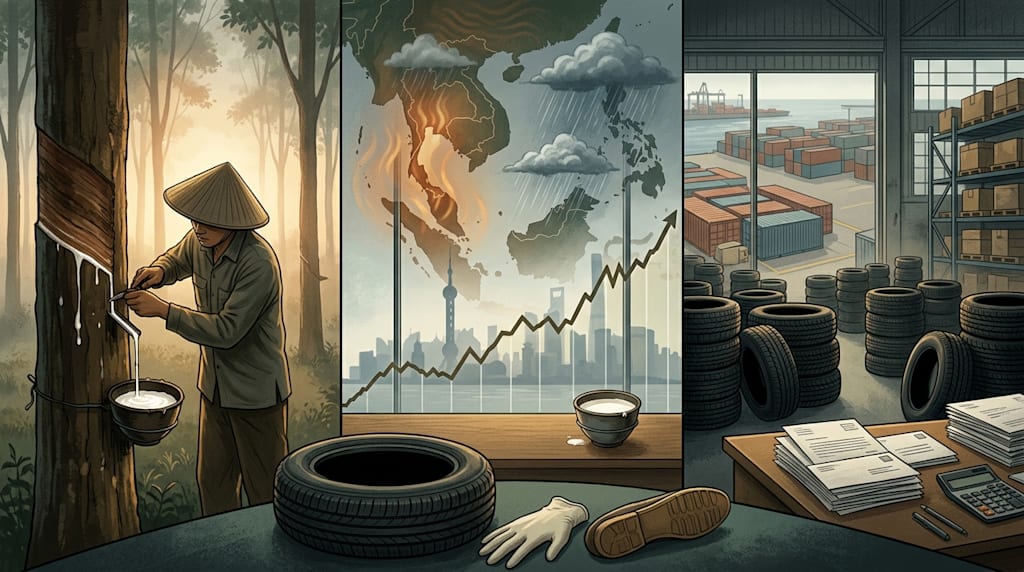
On October 8, the Shanghai Futures Exchange's rubber main contract closed at 20,145 yuan per ton. On October 9, it rose to 20,645 and touched 20,775 during the session. Rubber is at its highest level in nine years. The year-to-date gain moved from more than 28% to more than 32%.
In Xishuangbanna, Yunnan, Yang Qinghua starts before dawn. He taps about 600 trees a day. The latex dries into roughly 35 kilograms of dry rubber. A few years ago, that work paid 300-plus yuan a day. Now it pays more than 500. "The people who went out to work have mostly come back to tap rubber," he said.
The price move starts in the white latex in a cup. It runs through traders in Qingdao, into tire factories, and out to drivers, automakers, glove makers, and shoe factories.
Upstream: the trees are old, and no one planted new ones
Three things constrain supply.
First, the trees. In southern Thailand, more than 40% of rubber trees are over 35 years old. Yield per tree is 30% to 40% below peak. In Malaysia, 44% of trees are over 25 years old. In Indonesia, 47%. Older trees produce less latex.
Indonesia's output shows the trend. The country produced 3.19 million tons in 2023. By 2025, output had fallen to 2.04 million tons. Many growers switched to oil palm.
Second, planting. Rubber fell from its 2011 high for more than a decade. Growers could not make money. Some cut rubber and planted oil palm. New planting area peaked around 2011 to 2012 and shrank after. A rubber tree needs six to eight years before tapping, 13 to 15 years to reach full production, and has an economic life of about 30 years. If someone plants today, the first latex comes in 2032. Peak output comes in 2039.
The Association of Natural Rubber Producing Countries expects 2026 global natural rubber production at about 15.32 million tons. Consumption is expected at about 15.60 million tons. The gap is about 280,000 tons, wider than in 2025. In August, ANRPC members produced 1.073 million tons, down 40,000 tons year on year. Cumulative output growth has slowed for 13 straight months.
Weather: El Niño prices in a harvest that has not failed yet
China's National Climate Center says sea surface temperatures in the equatorial central and eastern Pacific are rising. A super El Niño is expected to peak around November to December 2026. The World Meteorological Organization puts the probability of it lasting through February 2027 near 100%.
El Niño hits rubber across seasons. Heat slows the tree's metabolism. Drought limits latex flow from the ducts. In the 2015 to 2016 super El Niño, Thailand's yield fell 5% to 10%. Indonesia's fell 5% to 12%. In Thailand's main areas, tapping days fell 15% to 20% during the drought peak.
The loss often shows up late in the year and into the next. Even if the weather improves next year, the reduced output carries forward.
The market is buying this expected loss now. Imports and domestic output have not fallen materially. The price contains a weather premium.
Synthetic rubber and money
Synthetic rubber comes from butadiene, a petrochemical product. Geopolitical tension has tightened butadiene. Synthetic rubber prices hit record highs. Tire makers can switch part of their formula to natural rubber. The substitution threshold is usually a 2,000 to 2,500 yuan per ton spread. With synthetic rubber expensive, natural rubber gets extra demand.
Global liquidity expectations feed into the price too. Rubber is an agricultural product, an industrial input, and a financial asset. It trades on the Shanghai Futures Exchange as RU, NR, and BR. Money moves in and out easily. That amplifies price swings.
Middle: Qingdao inventory says the chain is tight
Qingdao is China's largest natural rubber trading hub. Fu Xinxiang, who runs a futures delivery warehouse, said inventory turnover has gone from about six months to three. "In past years, total rubber inventory in Qingdao was around 150,000 tons. Now it is about 90,000 tons," he said.
As of September 27, bonded and general trade rubber inventory in Qingdao was 575,200 tons, down 10,100 tons week on week. Bonded inventory fell to 58,700 tons.
Low inventory makes price more sensitive. A small supply problem can move the market.
Tire factories still buy what they need. Some lock in orders early because they expect prices to rise.
Downstream: tire factories send price letters
Tires are the largest downstream product for natural rubber. Raw materials are more than 70% of tire production cost. The three core materials are natural rubber, synthetic rubber, and carbon black.
Wang Xiaocai, sales director at Shandong Huasheng Rubber, said natural rubber is up about 15% since the start of the year. Carbon black is up more than 75%. Synthetic rubber and chemical additives, tied to oil prices, are up 15% to 20%.
Since September, more than 60 tire companies have issued more than 70 price increase letters. They cover all-steel, semi-steel, and engineering tires. Increases are mostly 2% to 5%. This is the fourth round of collective price increases this year. Some companies say the increases still do not cover the cost increase.
The response differs by company size. Larger firms have long-term contracts and can hedge in the futures market. They also shift to higher-value tires. Smaller firms have little bargaining power. They follow the price increases, but costs rise faster than they can pass through. With weak demand, the industry is consolidating. Head firms gain share.
New energy vehicles are the growth spot. They are heavier, have high torque, and wear tires faster. A single tire uses about 15% more natural rubber than a tire for a gasoline car. Chinese EV exports have grown. Tire makers are focusing on high-end original equipment tires to build technical barriers.
Replacement tires are more than 70% of tire demand. That is consumer spending. Cars on the road need new tires regardless of the macro cycle. Original equipment tires track new car sales and are more volatile.
Other downstream industries
Medical gloves, condoms, and shoes use natural rubber. Demand is rigid. When raw material prices rise, they still have to buy. But they have limited room to raise retail prices.
Automakers face higher tire costs. The auto industry is already in a cost-driven pricing cycle. Tire inflation adds pressure to margins.
Who benefits, who feels the squeeze
Upstream planters and traders have the most elasticity. Their costs are relatively fixed. A one-yuan rise in rubber price is close to a one-yuan rise in gross profit.
Hainan's domestic rubber cost is about 14,000 to 14,500 yuan per ton. Thailand's raw material cost is around 11,000 yuan. China's planting cost is higher, but the price rise still improves margins.
Midstream processors look at processing spreads and niche markets. They follow tire demand but with less cyclicality.
Downstream tire makers depend on whether price increases stick. Tire making is manufacturing. Raw material inflation is a cost shock.
Head tire makers with overseas plants and hedging tools are in a better position. Small tire makers are squeezed. The price-letter wave is also a shakeout.
What to watch
Short term: Thai Hat Yai latex and cup lump quotes, rainfall in Southeast Asian rubber areas, ANRPC monthly output, Qingdao inventory. China's tire output growth has fallen below 10%. All-steel tire finished inventory is slow to clear. Downstream buyers purchase on demand. There is no large restocking. If synthetic rubber is relatively cheap, tire makers will change their formula and use more synthetic rubber.
Long term: tree age and reduced planting. Earlier rubber rallies were weather pulses. They rose and fell quickly. This one adds a structural supply contraction. The next decade points to a shrinking supply cycle. Rubber trees have a biological clock. Plant now, tap in six to eight years. If supply falls, expansion takes too long. Natural rubber has three main uses: tires, condoms, and shoes. All are rigid demand. Upstream price increases have to be absorbed.
Price has a direction and a speed. The direction is the first derivative. The speed is the second derivative. The market watches the speed more. When the market stops reacting to upstream price increases, and the bad news is digested, a left-side position may appear.
In Xishuangbanna, the morning fog lifts. Yang Qinghua finishes the last tree in his block. The cup is full. He checks the futures price on his phone. He says nothing. He pours the latex into a bucket and walks to the next tree.
About the Creator
Jin
Writer of reamstories
https://reamstories.com/jin
Enjoyed the story? Support the Creator.
Subscribe for free to receive all their stories in your feed. You could also become a paid subscriber, letting them know you appreciate their work.
Comments
There are no comments for this story
Be the first to respond and start the conversation.