
Pop Mart fell 45%. Store traffic didn’t.
The LABUBU boom made last year’s quarter impossible to match. The harder question is whether Pop Mart can sell toys without another blockbuster.
1. Which part fell
In the third quarter of 2026, Pop Mart’s revenue fell 45% to 50% year on year. Asia-Pacific fell 65% to 70%. The Americas fell 70% to 75%. Domestic online revenue fell 45% to 50%.
Domestic offline channels fell only 5% to 10%. Management said store traffic still grew. New brand customers grew at a double-digit rate. Roboshop revenue also grew at a double-digit rate. The pressure sat in platform e-commerce, which had carried the biggest surge last year. Domestic registered members rose from 72.58 million at the end of 2025 to 82.44 million. Members accounted for 92.9% of sales, with a 51.6% repurchase rate.
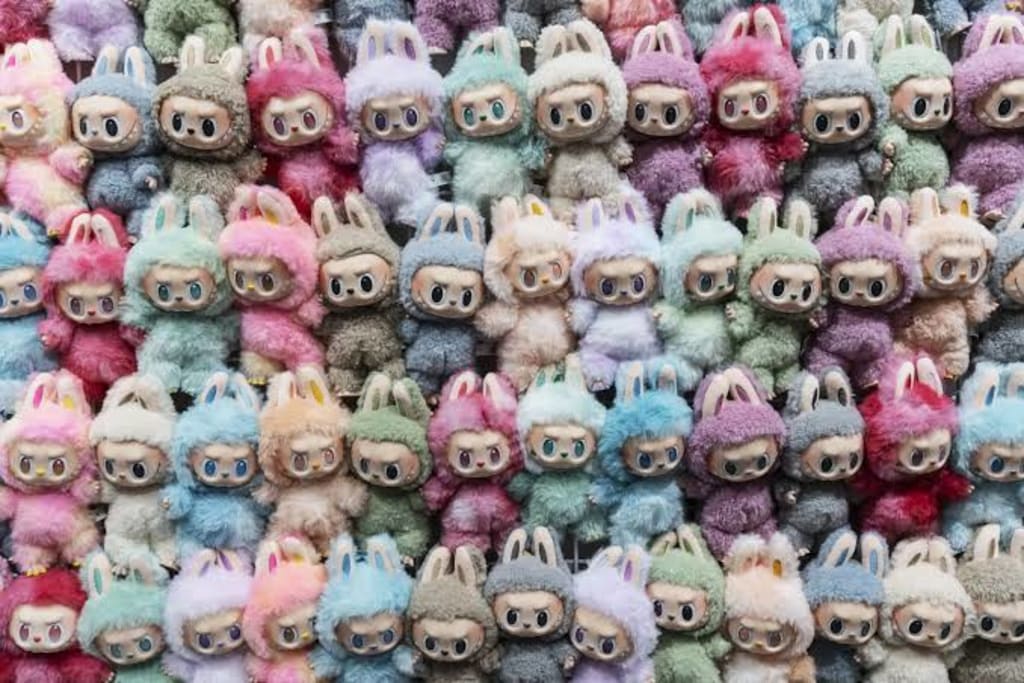
Q3 2025 was Pop Mart’s highest-revenue quarter ever, with growth of 245% to 250%. LABUBU plush products pushed online impulse buying to a level the company could not repeat. What fell was mostly speculative online demand. The offline store base and the membership system did not collapse.
The market had priced Pop Mart as if another LABUBU was likely. When that expectation slipped, the stock derated faster than earnings fell. Duan Yongping’s cost basis of roughly HK$150 and his paper loss of more than HK$1.8 billion sit inside that repricing.
2. The IP matrix got wider, not steadier
In the first half of 2026, THE MONSTERS, the series that includes LABUBU, fell from 34.7% of revenue to 26.0%. Twinkle Twinkle generated RMB 2.65 billion, up 580.6%, and rose to 15.4% of revenue. CRYBABY, DIMOO, SKULLPANDA, and HIRONO each passed RMB 1 billion. The matrix is wider than it was a year ago.
Twinkle Twinkle’s 580% growth came off a low base. It was a small IP in the first half of 2025, at 2.8% of revenue. A single growth rate does not prove it can survive a full heat cycle. Pop Mart’s new IPs this year, Supertutu and Merodi, sold only a few thousand units on Tmall. LABUBU collaborations sold out in seconds. Those are different outcomes.
An IP can have revenue and still lack stable repurchases, cross-category reach, and demand that survives without platform traffic. The value of a multi-IP matrix is not proof that Pop Mart can manufacture the next LABUBU. The test is whether a group of IPs, each holding a RMB 1 billion to RMB 3 billion revenue base, can support cash flow when no single blockbuster carries the quarter. THE MONSTERS falling to 26% is a start. The second-tier IPs still need to show they can stabilize after their own heat cycles fade.
3. The overseas switch costs money before it pays
Overseas revenue fell harder than domestic revenue. Much of 2025’s overseas growth came from online sales and a few hot IPs. The overseas store network was thin. Explosive demand landed in e-commerce. When online traffic fell, local stores, membership systems, and brand recognition were not mature enough to catch the drop.
Pop Mart is cutting back. It now cares more about store quality than store count. It is closing inefficient small platforms, building local e-commerce fulfillment in the United States, and adding warehousing in Europe. As of mid-September, it had 257 overseas stores, more than 100 of them in the United States. Flagship stores opened in Paris and London.
Those stores bring rent, labor, and amortization. In a declining revenue quarter, those costs hurt. Management guided China to stable or slight growth in Q4. It expects overseas revenue to stabilize with the Christmas season. It expects the second-half gross margin decline to stay within 2 percentage points, while the expense ratio runs well above the first half. Profit will stay under pressure in the short term. The company is paying that price to build a retail network with local brand assets and member repurchases.
4. What can grow without another LABUBU
If growth means another LABUBU-level explosion, the answer is probably no. The part that hits an emotional moment and spreads through social sharing is hard to reproduce. A faster launch schedule does not create blockbusters on demand.
A toy company’s long-term value depends on whether it can make money, generate repurchases, and control channels when no blockbuster carries the quarter.
The first path is IP tiering. The test is not whether one IP’s share falls while another rises. The test is whether second-tier IPs can hold a revenue floor through their own full cycles.
The second path is overseas brand building. The cost is a higher expense ratio and weaker profit now. The return depends on store quality, membership systems, and local fulfillment catching up with mature domestic markets within two to three years.
The third path is category and scenario extension. POP LAND, POP BAKERY, and POPOP accessories sit in the “wholesale and other” segment. That segment grew 111.7% in the first half of 2026 to RMB 553 million. It is still small against more than RMB 10 billion in revenue. Its value is a test: can Pop Mart turn IP from a one-time blind-box purchase into repeatable space and extended consumer goods? It is not a growth engine yet.
All three paths depend on operations. Wang Ning called 2026 a year in the “pit stop.” Overseas store operations lag domestic ones. The supply chain is overstocked in some places and out of stock in others. Global buying and cross-region allocation are still weak. If those problems remain, a wider IP matrix and more stores will not lift store efficiency or repurchase rates enough to support the valuation.
5. Duan Yongping’s anchor
Duan said Pop Mart still needs capable people to run it. He did not say the business has a moat. He put the anchor on management. That differs from his view of Apple and Moutai, where he treats the business model itself as strong enough.
On fundamentals, remove the LABUBU premium and compare Pop Mart with traditional consumer companies after growth slows. The market value can fall further. The market had priced in too much hope for the next LABUBU. When that hope is disproven or postponed, the derating hurts more than the earnings decline. Duan can wait ten years. Most followers cannot.
The Q3 report makes the split clear. Blockbusters are luck. After the tide goes out, the business is what remains: store traffic, member repurchases, and products that do not depend on one IP. That part needs more than one quarter to prove itself.
About the Creator
Jin
Writer of reamstories
https://reamstories.com/jin
Enjoyed the story? Support the Creator.
Subscribe for free to receive all their stories in your feed. You could also become a paid subscriber, letting them know you appreciate their work.
Comments
There are no comments for this story
Be the first to respond and start the conversation.