
Oil Prices Crash Below $100: Can America's Midterm Elections Bring Stability to the Middle East?
Democrats' victory in the US midterm elections has shaken global energy markets, pushing oil prices sharply lower and raising hopes of an end to the US-Israeli conflict with Iran. But does a change in Washington's political balance really mean peace for the Middle East?

A Political Shock Sends Oil Prices Tumbling
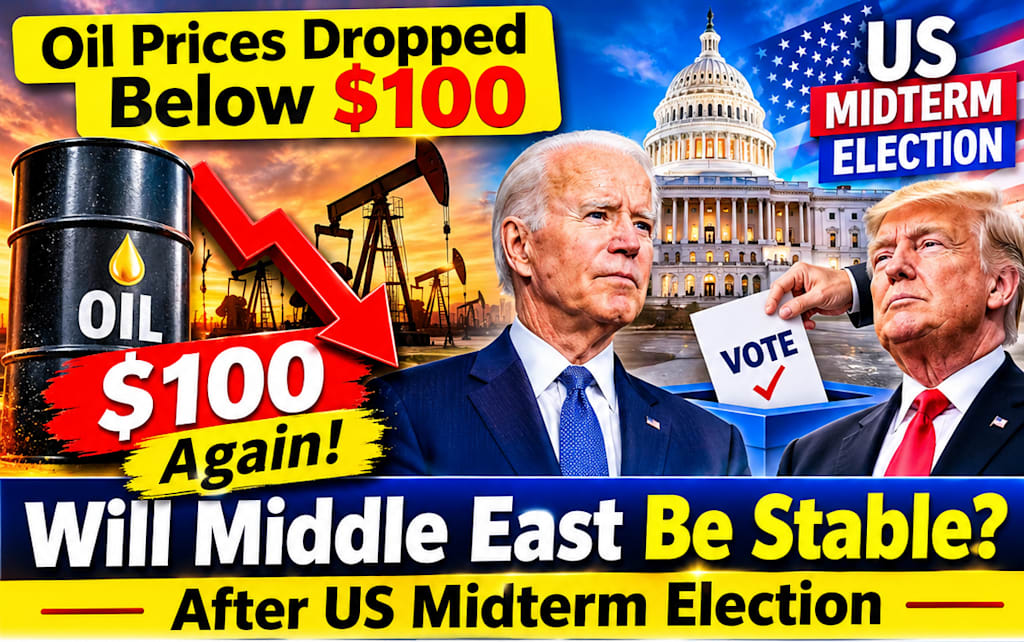
Global oil markets have experienced a dramatic shift following the US midterm elections, with crude oil prices falling below the psychologically important $100-per-barrel level.
On November 4, Brent crude plunged approximately 8.7%, settling at $94.62 per barrel, while US West Texas Intermediate (WTI) dropped 8.3% to $88.12.
The sharp decline followed a major political setback for President Donald Trump, whose Republican Party lost control of both chambers of Congress as Democrats secured victories in the House of Representatives and the Senate.
For financial markets, the election result represented more than a domestic political change. It raised expectations that Washington could reconsider its military strategy towards Iran and potentially pursue diplomatic negotiations to end the ongoing conflict.
However, falling oil prices do not necessarily mean that peace is approaching.
Why Did Oil Prices Fall Below $100?
Several interconnected developments explain the sudden decline in global crude prices.
1. Political pressure on the Trump administration
The Republican electoral defeat has increased pressure on the White House to reconsider its approach to the Middle East. Rising fuel prices and the economic consequences of the Iran conflict became important political issues during the election campaign.
Investors increasingly believe that a divided government could make further military escalation more politically difficult.
2. Growing expectations of diplomatic negotiations
Markets are responding to the possibility that the United States could seek a negotiated settlement with Iran rather than continue an expensive military confrontation.
Qatar has also intensified its diplomatic efforts to prevent further escalation and encourage dialogue between Washington and Tehran.
3. Recovery in Gulf oil supplies
Oil exports from the Gulf have begun recovering from earlier disruptions. Improved shipping flows through the strategically important Strait of Hormuz have helped reduce fears of a prolonged global energy shortage.
4. Changing expectations about future supply
Traders are increasingly pricing in the possibility that a reduction in military tensions could allow more oil to reach international markets.
If exports continue recovering and diplomatic negotiations make progress, additional supply could put further downward pressure on prices.
Will the US Midterm Elections Change Middle East Policy?
The most important question is whether the election results will translate into a meaningful change in American foreign policy.
Democrats now have greater influence over Congress, potentially increasing scrutiny of military spending, foreign policy decisions and the administration's approach to Iran.
This could create political incentives for President Trump to pursue negotiations.
However, there is an important distinction between political pressure and actual control over foreign policy.
The president retains significant executive authority over military operations and diplomatic decisions. A Democratic-controlled Congress can influence funding, legislation and political accountability, but it cannot automatically force an immediate end to the conflict.
The election has changed the political environment, not necessarily the military situation.
Iran Remains the Biggest Test for Regional Stability
Iran is central to the future of Middle Eastern stability.
Any successful diplomatic agreement would need to address several difficult issues, including:
- Iran's nuclear programme and international security concerns.
- US and Israeli security demands.
- Sanctions and Iran's economic future.
- Maritime security in the Persian Gulf.
- The future of regional armed groups and their activities.
- Guarantees against renewed military escalation.
These issues cannot be resolved simply because one political party has gained control of Congress.
Iran may see the election results as an opportunity to negotiate from a stronger position. Washington, meanwhile, will want an agreement that it can present as a diplomatic and strategic success.
Finding common ground will be difficult.
The Strait of Hormuz: The World's Energy Lifeline
One of the most important factors in the oil market is the Strait of Hormuz.
This narrow maritime passage connects the Persian Gulf with international shipping routes and is essential for global energy transportation.
Any serious disruption could affect oil exports from major producers, including Saudi Arabia, Iraq, Kuwait, Qatar and the United Arab Emirates.
Even if the current conflict moves towards a ceasefire, shipping companies and energy producers will need confidence that the waterway is safe.
A sustainable recovery in oil supplies depends not only on political announcements but also on secure maritime operations.
For this reason, the Strait of Hormuz will remain one of the most important indicators of whether the Middle East is moving towards stability.
Who Benefits From Falling Oil Prices?
A sustained decline in oil prices could have significant economic consequences around the world.
Consumers: Lower crude prices could eventually reduce petrol, diesel and transportation costs, although retail prices depend on taxes, refining costs and currency movements.
European economies: Countries that depend heavily on imported energy could benefit from reduced inflationary pressure and lower energy costs.
Asian economies: Major oil-importing economies such as India, Japan and South Korea could experience relief if cheaper energy continues.
Oil-producing countries: Saudi Arabia, Iraq, Kuwait and other exporters could face lower government revenues if prices remain depressed.
Financial markets: Lower energy prices could improve investor confidence by reducing fears of another inflationary shock.
However, the benefits will depend on whether the decline is sustained or simply a temporary reaction to political developments.
Three Possible Scenarios for the Middle East
Scenario 1: Diplomatic breakthrough
The most optimistic outcome would involve Washington and Tehran returning to meaningful negotiations.
A ceasefire, improved maritime security and an agreement addressing nuclear and regional security concerns could gradually reduce tensions.
Oil prices could remain below $100 if global supplies recover and geopolitical risk premiums decline.
This would offer the strongest opportunity for regional stability.
Scenario 2: Temporary calm, continued uncertainty
A second possibility is that military operations decrease without a comprehensive political agreement.
Oil shipments could recover, and markets might remain relatively optimistic, but unresolved disputes would continue threatening regional security.
This scenario could produce lower oil prices alongside persistent geopolitical uncertainty.
Scenario 3: Renewed military escalation
The most dangerous possibility is the collapse of negotiations.
If either side believes that diplomacy is failing, military action could intensify again.
Disruptions around the Strait of Hormuz could send oil prices sharply higher. Analysts have warned that a renewed escalation could push Brent crude towards $110–$125 per barrel.
Such an outcome would reverse much of the recent market optimism.
What Happens Next? The Markets Are Watching Washington and Tehran
The immediate reaction to the election results has been optimistic, but the situation remains complicated.
On November 5, Brent crude recovered to approximately $96.15 per barrel, while WTI traded around $88.64, showing that investors are still uncertain about the future of the conflict.
This recovery is a reminder that oil prices can move rapidly when geopolitical risks remain unresolved.
Investors will be watching several developments closely:
- Whether Washington and Tehran restart meaningful negotiations.
- Whether Israel supports diplomatic de-escalation.
- Whether Gulf oil exports continue recovering.
- Whether shipping through the Strait of Hormuz remains secure.
- Whether the Trump administration changes its military strategy.
The answers to these questions will matter more to long-term oil prices than the initial market reaction to the election.
Final Verdict: A Chance for Peace, Not a Guarantee
The US midterm elections have created a new political reality in Washington, and global oil markets have reacted immediately.
The fall in crude prices below $100 reflects growing expectations that the United States could move towards diplomatic negotiations and reduce the risk of a prolonged conflict with Iran.
But markets trade expectations, not guarantees.
A genuine improvement in Middle Eastern stability will require more than an election victory. It will require diplomatic compromise, credible security guarantees, cooperation among regional powers and a lasting reduction in military tensions.
For now, the world has reasons to be cautiously optimistic.
The biggest question is no longer simply whether oil can remain below $100.
It is whether Washington and Tehran can turn this political opportunity into a lasting peace.
The coming weeks could determine whether this oil-price decline marks the beginning of a more stable Middle East—or merely a temporary pause before another geopolitical crisis.
About the Creator
Junaid Ali (Official)
Start writing...forex Trader | Market Analyst | Risk Manager 5+ yrs of exp
Technical & Fundamental Analysis
Risk Management Strategies
Day & Swing Trading
Discipline. Patience. Consistency
💬 DM for collab
📊 “Trade with logic, not emotion
Enjoyed the story? Support the Creator.
Subscribe for free to receive all their stories in your feed.
Comments
There are no comments for this story
Be the first to respond and start the conversation.