
Inducement: Mastering Structural Manipulation & Institutional Traps
The Smart Money Trap 🪤

In previous articles, we established that institutional market participants cannot simply execute massive buy or sell orders at any price. They require counter-liquidity. If they need to buy thousands of contracts, they must find thousands of sell orders to fill that position.
The "liquidity pool" isn't a magical reservoir; it is simply a heavy concentration of retail orders, particularly stop-loss orders, resting just beyond obvious structural points.
Inducement is the deliberate process where institutional order flow engineers price action specifically to attract (induce) retail participation in one direction, only to trap them and move price in the opposite, intended direction. The goal is simple: capture your stop-loss and use it as their entry liquidity.
1. Defining Inducement (IDM) in Market Structure
In institutional concepts, Inducement (IDM) is defined as the first internal valid pullback before a true, major structural high or low is confirmed.
In an uptrend (HH, HL):
The market makes a new High.
It then pulls back, creating an internal structure.
Retail traders observe this internal low and, believing the trend is resuming, place orders. Many place stop-losses just below this internal pullback (Liquidity).
Before making the true new Higher Low, the market wicks through this internal low (a Liquidity Sweep), grabbing the stops, and then explodes higher to confirm the BOS.
The point where that sweep occurred is the Inducement Point. If you do not wait for this inducement to occur, you are essentially trading a minor structural point and placing your stop-loss right in the path of smart money absorption.
2. Anatomy of the Smart Money Trap
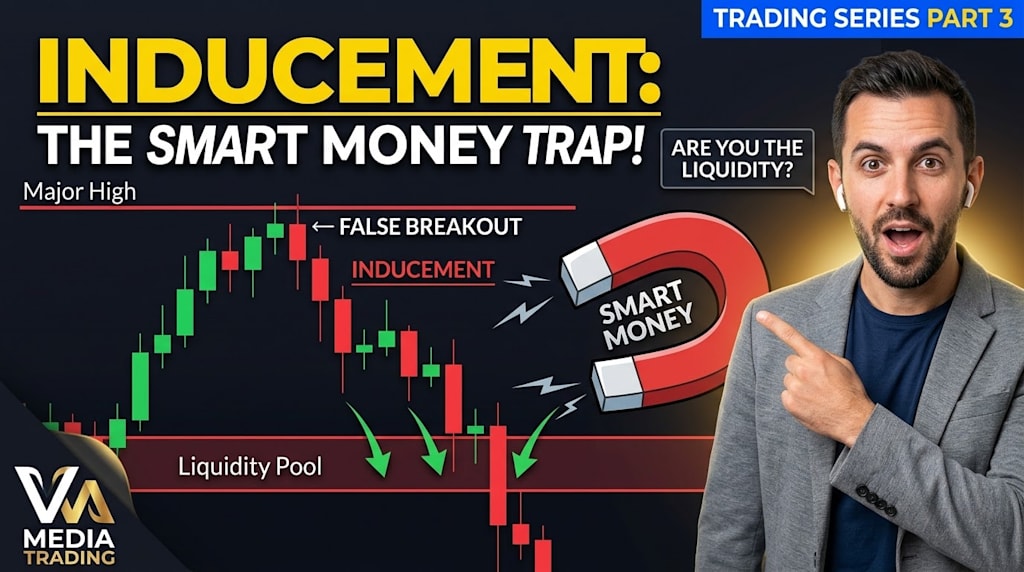
Look closely at the example in our thumbnail.
The Blueprint: Price has approached a highly visible Major High or 'Old High.' Retail traders are watching this. Breakout traders expect price to smash through. Reversal traders expect it to hold.
The Inducement (Trap 1): Price moves up, slightly wicks through the level, and then aggressively pulls back. A 'False Breakout.'
Retail Reaction: Breakout longs just got stopped out. Aggressive reversal shorts see this rejection and immediately enter short, placing their stops just above that new wick high. They feel vindicated.
The Second Trap (Inducement): But the market isn't done. The institutional participants still need more liquidity to make a real move (either a sustained break higher or a true reversal). Price moves sideways, maybe forming another small shelf (creating a double top), building more liquidity.
Smart Money Magnet (The Move): The actual, intended directional move only occurs after the pool of new retail short stops above that high has been swept (or captured by the "Smart Money Magnet").
The original 'False Breakout' was the Inducement. It induced the shorts, creating the required liquidity for the real institutional move.
3. High-Probability Trading Zones (The Premium vs. Discount Array)
To avoid getting induced, professionals understand where institutional interest actually resides. They do not trade at random structure; they trade in high-value institutional zones: Supply & Demand, which are often found in context with Discount and Premium.
In an uptrend (looking to BUY):
After a new BOS is confirmed, the entire trading range (from the previous Higher Low to the new Higher High) is mapped using Fibonacci.
Premium Zone (Above 50%): This is where institutional sellers are active. As a buyer, this zone is high-risk. You do not want to buy at "expensive" prices.
Discount Zone (Below 50%): This is where institutional buyers want to execute their orders. High-probability buy entries (Order Blocks, FvGs) are located here.
The market must retrace into the Discount Zone (sweeping through Inducement points) before the true trend continuation is likely. If you buy in the Premium zone, you are the inducement.
4. Failed Breaches: Analyzing Liquidity Sweeps
One of the most valuable aspects of understanding Inducement is identifying a failed breakout versus a true structural shift. This connects back to our CHoCH analysis in Part 2.
Crucial Rule: If price breaks a major high but only leaves a wick (a Liquidity Sweep), and then aggressively rejects back inside the structure, it was not a BOS (continuation), nor was it a true CHoCH (reversal signal). It was an Inducement.
Until you see a confirmed candle body close beyond a structural point, you should view any breach as potential Inducement.
Conclusion: Trading With, Not Against, the Inducement
If you see a "perfect" technical setup—a clean double top, a textbook trendline retest, or a classic triangle breakout—your immediate thought must be: Where is the liquidity?
Once you map market structure (Part 1), you know where the protected levels are. The levels between those points are just liquidity traps. To avoid getting induced:
Trade only high-timeframe points of interest (4H, Daily).
Require a candle body close for any structural confirmation (BOS/CHoCH).
Use Premium and Discount zones to align your entries with institutional logic. Buy cheap; sell expensive.
Learn to anticipate the sweep: If you see a major level about to be touched, expect an institutional interaction. Do not enter at the level; enter after the level has interacted and the smart money has shown its hand.
You must stop being the liquidity and start using it.
About the Creator
Junaid Ali (Official)
Start writing...forex Trader | Market Analyst | Risk Manager 5+ yrs of exp
Technical & Fundamental Analysis
Risk Management Strategies
Day & Swing Trading
Discipline. Patience. Consistency
💬 DM for collab
📊 “Trade with logic, not emotion
Enjoyed the story? Support the Creator.
Subscribe for free to receive all their stories in your feed.
Comments
There are no comments for this story
Be the first to respond and start the conversation.