
🌍 Global GDP Ranking (Country-wise Analysis 2026)
How Major Economies Shape Growth, Power, and the Future

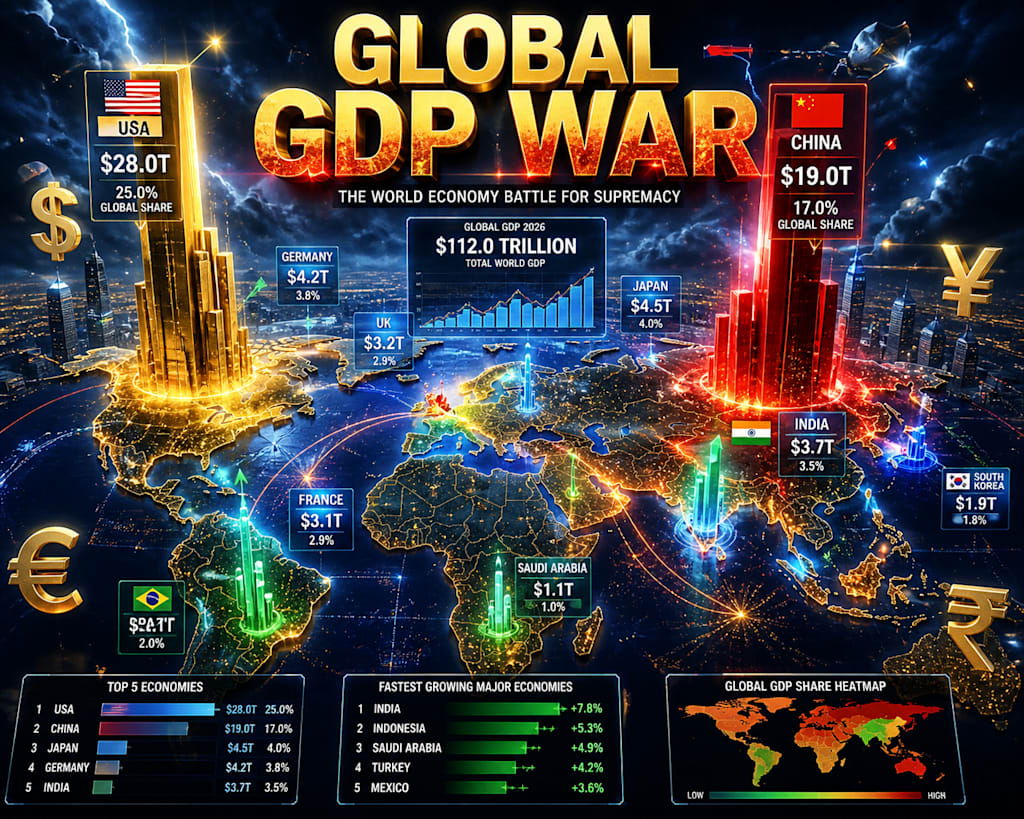
🌍 Global GDP Ranking (Country-wise Analysis 2026)
1. United States
GDP: ~$28 Trillion
Global Share: ~25%
Trend: 📈 Increasing (stable growth)
The U.S. remains the world’s economic leader due to technology, finance, and consumer demand. AI, tech giants, and defense spending continue to push growth upward.
2. China
GDP: ~$19 Trillion
Global Share: ~17%
Trend: ⚖️ Slowing but growing
China is still expanding but at a slower pace due to real estate crisis and aging population. Manufacturing and exports remain strong.
3. Japan
GDP: ~$4.5 Trillion
Global Share: ~4%
Trend: 📉 Slight decline
Japan faces stagnation due to low birth rates and aging population, though technology and exports keep it stable.
4. Germany
GDP: ~$4.2 Trillion
Global Share: ~3.8%
Trend: 📉 Slowing
Germany’s export-based economy is under pressure due to energy costs and global demand slowdown.
5. India
GDP: ~$3.7 Trillion
Global Share: ~3.5%
Trend: 🚀 Strong Increase
India is the fastest-growing major economy with strong population advantage, digital growth, and rising investments.
6. United Kingdom
GDP: ~$3.2 Trillion
Global Share: ~3%
Trend: ⚖️ Moderate
UK growth is steady but impacted by post-Brexit trade challenges.
7. France
GDP: ~$3.1 Trillion
Global Share: ~2.9%
Trend: 📈 Stable growth
Tourism, agriculture, and industry support France’s balanced economy.
8. Italy
GDP: ~$2.3 Trillion
Global Share: ~2.2%
Trend: ⚖️ Slow growth
Italy struggles with debt but remains strong in exports and luxury goods.
9. Canada
GDP: ~$2.2 Trillion
Global Share: ~2%
Trend: 📈 Increasing
Canada benefits from oil, natural resources, and stable banking.
10. Brazil
GDP: ~$2.1 Trillion
Global Share: ~2%
Trend: 📈 Recovering
Agriculture and exports are boosting Brazil after economic slowdowns.
11. South Korea
GDP: ~$1.9 Trillion
Global Share: ~1.8%
Trend: 📈 Growing
Driven by electronics, semiconductors, and global brands.
12. Russia
GDP: ~$1.8 Trillion
Global Share: ~1.7%
Trend: ⚖️ Unstable
Growth depends heavily on oil prices and geopolitical factors.
13. Saudi Arabia
GDP: ~$1.1 Trillion
Global Share: ~1%
Trend: 📈 Increasing
Oil revenues and Vision 2030 reforms are driving diversification.
14. Indonesia
GDP: ~$1.4 Trillion
Global Share: ~1.3%
Trend: 🚀 Strong growth
Population growth and industrialization support expansion.
15. Mexico
GDP: ~$1.3 Trillion
Global Share: ~1.2%
Trend: 📈 Increasing
Close ties with the U.S. boost manufacturing and exports.
📊 Global Insight (Simple Ratio Understanding)
Top 2 economies (USA + China) = ~42% of world GDP
Top 5 economies = ~54% of world GDP
Emerging economies are growing faster than developed ones
📉 Trend Summary
🚀 Fast Growing Countries:
India
Indonesia
Saudi Arabia
📉 Slowing Economies:
Japan
Germany
⚖️ Stable Economies:
United States
United Kingdom
🎯 Conclusion
The global economy is clearly shifting:
- Developed countries are stable but slower
- Emerging countries are growing faster
- Asia is becoming the future economic center
If current trends continue, India may enter Top 3, and emerging economies will take a larger share of global GDP.
Global GDP Rankings 2026: The World Economy by Country
The global economy in 2026 continues to evolve rapidly, with shifting power balances, emerging markets rising, and traditional economic giants maintaining strong influence. Gross Domestic Product (GDP) remains the most widely used measure to compare the economic strength of countries. It reflects the total value of goods and services produced within a nation and offers insight into global financial leadership.
At the top of the global GDP rankings stands United States, maintaining its position as the world’s largest economy. With a GDP exceeding $28 trillion, the U.S. benefits from a powerful combination of technological innovation, financial markets, consumer spending, and global influence. Companies in Silicon Valley, Wall Street institutions, and a strong services sector continue to drive American economic dominance.
Closely following is China, whose GDP has crossed approximately $19 trillion. China’s rapid industrial growth, massive manufacturing base, and expanding global trade partnerships—especially through initiatives like the Belt and Road—have solidified its role as a major economic powerhouse. Despite challenges such as real estate debt and demographic shifts, China remains a central engine of global growth.
In third place is Japan, with a GDP of around $4.5 trillion. Japan’s economy is driven by high-tech manufacturing, automotive exports, and strong infrastructure. However, its aging population and slow growth rates present long-term economic concerns.
Next comes Germany, Europe’s economic leader with a GDP exceeding $4 trillion. Germany’s strength lies in engineering, automobile production, and exports. It acts as the industrial backbone of the European Union.
India has emerged as one of the most dynamic economies, now ranking among the top five globally with a GDP surpassing $3.7 trillion. India’s growth is fueled by a young population, digital transformation, and expansion in services and manufacturing sectors. It is widely expected to climb even higher in the coming years.
The United Kingdom and France follow, each with GDPs around $3 trillion. The UK’s economy thrives on finance, particularly in London, while France combines industrial strength with tourism and agriculture.
Italy and Canada also rank among the top 10 economies globally. Italy’s economy is supported by manufacturing and exports, while Canada benefits from natural resources like oil, minerals, and timber.
Another key player is Brazil, which leads South America with a GDP driven by agriculture, mining, and energy exports. Similarly, South Korea stands out for its innovation in electronics, automobiles, and global brands.
Meanwhile, countries like Russia and Saudi Arabia depend heavily on energy exports, making them influential in global oil markets. Their GDP fluctuates based on oil prices and geopolitical conditions.
Emerging economies are becoming increasingly important. Nations such as Indonesia, Mexico, and Turkey are experiencing steady growth due to industrial expansion and favorable demographics.
In Africa, Nigeria and South Africa lead the continent, though challenges like inflation, unemployment, and infrastructure gaps remain.
It is important to note that GDP does not always reflect living standards or income equality. Smaller countries like Luxembourg or Switzerland may have smaller total GDP but significantly higher GDP per capita, meaning their citizens enjoy higher average incomes.
Looking ahead, the global GDP landscape is expected to shift further. India may overtake Germany and Japan in the next decade, while African economies could rise due to population growth and urbanization. Technological innovation, climate change policies, and geopolitical tensions will also play crucial roles in shaping economic rankings.
In conclusion, the global GDP rankings highlight a complex and interconnected economic system where both developed and developing nations contribute to growth. While traditional powers like the United States and China dominate, emerging economies are steadily reshaping the future of the global economy. Understanding these trends is essential for businesses, policymakers, and individuals navigating an increasingly globalized world.
About the Creator
Wings of Time
I'm Wings of Time—a storyteller from Swat, Pakistan. I write immersive, researched tales of war, aviation, and history that bring the past roaring back to life
Enjoyed the story? Support the Creator.
Subscribe for free to receive all their stories in your feed.
Comments
There are no comments for this story
Be the first to respond and start the conversation.