
Global Fintech Companies Revolutionizing Business Banking
Leading Global Fintech Companies Transforming Financial Services

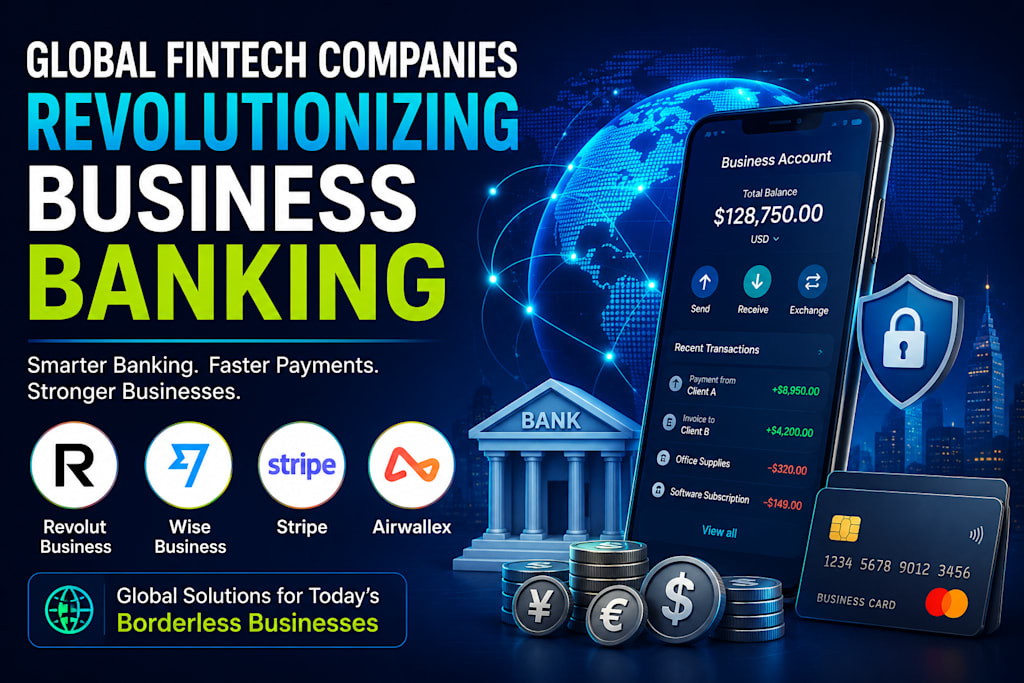
The Rise of Fintech in Modern Business Banking
The world of business banking has experienced a dramatic transformation over the past decade, and fintech companies are at the center of this revolution. Traditional banking systems were often criticized for slow processes, excessive paperwork, high transaction fees, and limited flexibility for growing businesses. Today, fintech firms are changing that reality by offering digital-first solutions that allow businesses to manage finances faster, smarter, and more efficiently.
Recent industry reports show that global fintech revenues surpassed $500 billion in 2026, growing significantly faster than traditional financial institutions. The fintech sector has become a major force in financial services, driven by technological innovation, artificial intelligence, open banking frameworks, and the increasing demand for seamless digital experiences. Businesses of all sizes, from startups to multinational corporations, are now embracing fintech platforms to streamline payments, manage expenses, access funding, and conduct cross-border transactions with unprecedented ease.
The appeal of fintech lies in its ability to solve real-world business challenges. Instead of waiting days for international payments to clear, companies can transfer funds almost instantly. Rather than maintaining multiple banking relationships across different countries, businesses can operate from a single platform that supports multiple currencies and payment methods. This convenience has made fintech an essential component of modern business operations.
As digital transformation continues to accelerate worldwide, fintech companies are no longer viewed as alternatives to traditional banks. They are increasingly becoming primary financial partners for businesses seeking agility, scalability, and cost efficiency in a highly competitive global marketplace.
Leading Global Fintech Companies Transforming Financial Services
Several Fintech Companies have emerged as global leaders by delivering innovative solutions that challenge traditional banking models. These organizations have built comprehensive ecosystems that combine payments, banking, expense management, foreign exchange services, and financial analytics into unified digital platforms.
Revolut Business
Revolut Business has established itself as one of the most recognized names in digital business banking. The platform offers multi-currency accounts, international payments, corporate cards, expense management tools, and foreign exchange services. Businesses operating across multiple countries particularly benefit from Revolut's ability to manage various currencies through a single dashboard.
One of Revolut's biggest strengths is its commitment to simplifying international commerce. Companies can hold, exchange, and transfer money across numerous currencies without the excessive fees traditionally associated with international banking. This has made the platform especially attractive for e-commerce companies, remote-first organizations, and globally distributed teams.
Wise Business
Wise Business has become synonymous with transparent international payments. Unlike traditional banks that often add hidden markups to exchange rates, Wise focuses on providing businesses with real exchange rates and clear pricing structures. This transparency has helped thousands of businesses reduce operational costs while improving financial visibility.
For organizations working with international suppliers, freelancers, or remote employees, Wise Business offers an efficient solution for cross-border transactions. The platform's ability to maintain local bank details in multiple countries enables businesses to operate globally while maintaining a local presence.
Stripe
Stripe has evolved far beyond a simple payment processor. Today, it serves as a comprehensive financial infrastructure platform for internet businesses. Companies use Stripe to accept payments, manage subscriptions, automate invoicing, and facilitate global commerce.
Stripe's developer-friendly ecosystem has made it particularly popular among technology startups and digital businesses. Its extensive APIs allow organizations to build customized payment experiences while maintaining high levels of security and compliance. As digital commerce continues to expand globally, Stripe remains a critical enabler of online business growth.
Airwallex
Airwallex has rapidly emerged as a leading player in global business finance. The company specializes in cross-border payment solutions, multi-currency accounts, and embedded financial services. Businesses use Airwallex to simplify international operations while reducing transaction costs and foreign exchange expenses.
Its focus on global commerce has made it particularly valuable for companies engaged in international trade. By providing access to local payment networks and banking infrastructure worldwide, Airwallex helps businesses expand into new markets without facing the complexities typically associated with international banking.
How Fintech Innovation Is Reshaping Business Banking
Fintech companies are not simply digitizing existing banking processes; they are fundamentally redesigning how businesses interact with financial services. Through the use of artificial intelligence, machine learning, cloud computing, and automation, fintech platforms are creating faster and more intelligent financial ecosystems.
One of the most significant innovations is the introduction of real-time payments. Businesses can now move money across borders more quickly than ever before, improving cash flow management and operational efficiency. According to recent industry data, digital payment volumes continue to rise globally, while real-time payment systems have become one of the fastest-growing segments within financial services.
Another major advancement is automated financial management. Fintech platforms now provide businesses with automated bookkeeping, expense tracking, invoice management, and financial reporting tools. These capabilities reduce administrative burdens and allow finance teams to focus on strategic decision-making rather than routine tasks.
Artificial intelligence is also transforming business banking. Financial institutions and fintech providers increasingly use AI to improve fraud detection, enhance customer support, automate compliance monitoring, and optimize risk management. Industry reports indicate that AI adoption across financial services continues to accelerate as organizations seek greater efficiency and operational resilience.
The emergence of embedded finance represents another powerful trend. Businesses can now integrate financial services directly into their products and platforms, creating seamless customer experiences. Whether offering instant payments, financing options, or digital wallets, embedded finance is expanding the boundaries of traditional banking and opening new revenue opportunities for businesses across industries.
Future Trends and Opportunities in Global Business Banking
The future of business banking will be shaped by a combination of technological innovation, regulatory evolution, and changing customer expectations. Fintech companies are expected to continue driving this transformation by introducing more sophisticated solutions that address the increasingly complex needs of global businesses.
One notable trend is the growing convergence between fintech companies and traditional banks. Rather than competing directly, many institutions are forming partnerships that combine banking licenses, regulatory expertise, and financial infrastructure with fintech innovation and digital user experiences. This collaborative approach is creating more comprehensive solutions for businesses while accelerating digital transformation across the financial sector.
Another important development is the increasing adoption of banking-as-a-service and open banking models. These frameworks enable businesses to access banking functionality through APIs, allowing greater flexibility and customization. As regulatory environments become more supportive of innovation, businesses will gain access to an even broader range of financial products and services.
The role of artificial intelligence is also expected to expand significantly. Future business banking platforms will likely feature predictive analytics, intelligent cash flow forecasting, automated financial planning, and personalized financial recommendations. These capabilities will help businesses make better decisions while reducing financial risk.
Market research indicates that digital business banking adoption among small and medium-sized enterprises continues to grow rapidly. Companies are increasingly prioritizing platforms that offer speed, transparency, scalability, and global accessibility. As fintech providers continue to innovate, the gap between traditional banking expectations and modern business requirements will continue to narrow.
The fintech revolution is far from over. As technology continues to evolve and businesses become increasingly global, fintech companies will remain at the forefront of innovation, reshaping how organizations manage money, access financial services, and compete in the digital economy.
Conclusion
Global fintech companies have fundamentally changed the landscape of business banking. By delivering faster payments, multi-currency capabilities, AI-powered automation, and seamless digital experiences, fintech firms are helping businesses operate more efficiently in an increasingly connected world. Companies such as Revolut Business, Wise Business, Stripe, and Airwallex demonstrate how innovation can simplify complex financial operations while reducing costs and improving scalability. As AI, open banking, and embedded finance continue to evolve, fintech companies will play an even greater role in shaping the future of global business banking.
FAQs
1. What is fintech in business banking?
Fintech refers to technology-driven financial services that help businesses manage banking, payments, lending, and financial operations digitally.
2. Why are businesses switching to fintech platforms?
Businesses benefit from lower costs, faster transactions, better automation, improved user experiences, and global accessibility.
3. Which fintech companies are leading business banking innovation?
Major leaders include Revolut Business, Wise Business, Stripe, Airwallex, and several emerging digital banking platforms.
4. How does AI improve business banking?
AI enhances fraud detection, automates compliance processes, improves customer service, and provides predictive financial insights.
5. What is the future of fintech business banking?
The future includes AI-powered financial management, embedded finance, real-time payments, open banking, and deeper integration between fintech firms and traditional banks.
About the Creator
Talha Mazhar
Hi, I am Talha Mazhar. writing is my passion. I mostly write about trending business informative articles just to enhance the knowledge with others.
Enjoyed the story? Support the Creator.
Subscribe for free to receive all their stories in your feed.
Comments
There are no comments for this story
Be the first to respond and start the conversation.