
Geely Buys 30% of NIO Energy: What the Battery-Swap Deal Means for EV Drivers
Two carmakers now control 4,500 swap stations. Geely swap models could arrive by 2027, and ultra-fast charging is closing in.
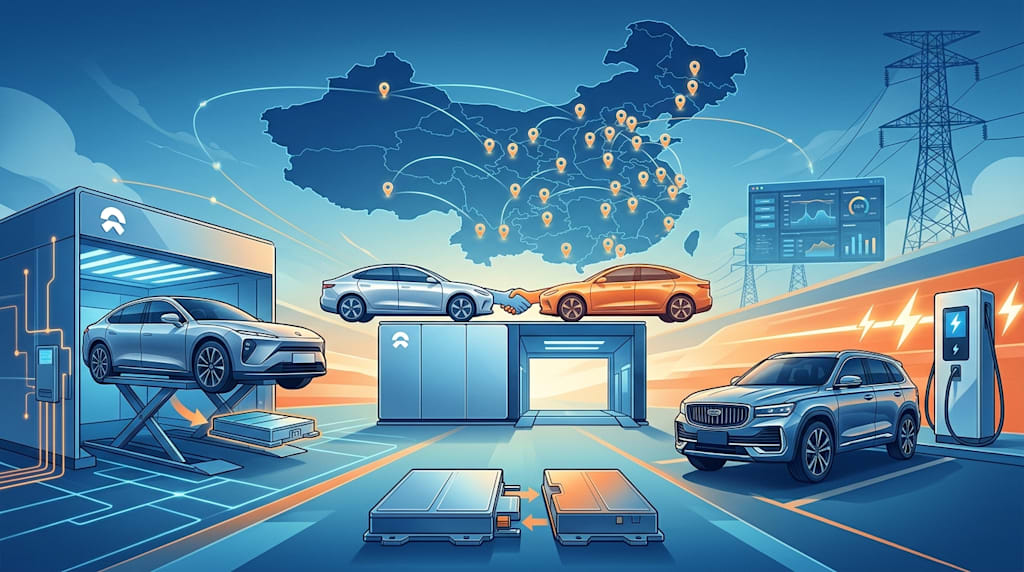
On September 28, 2026, in Hangzhou, NIO and Geely Holding signed an agreement. Geely gave NIO Energy 100% equity in Yiyi Interconnect and RMB 640 million in cash in exchange for newly issued shares. After the deal, Geely holds 30%, NIO China holds 63.6%, and NIO Energy’s post-money valuation is about RMB 16 billion. NIO also received a 10% stake in Haohan Energy. Haohan Energy will use the funds to buy some charging assets from NIO.
Deal structure: cross-shareholding and performance options
Geely is not a pure financial investor. The agreement has two clauses. Within two years, Geely can invest another RMB 640 million to raise its stake to 34%. The 30% stake is tied to operating milestones. If operations fall short, the stake may be adjusted downward, but not below 20%. The option is valid until NIO Energy signs a binding agreement for a new round of financing. This design ties Geely’s returns to NIO Energy’s operating data.
In November 2023, the two sides signed a battery-swapping strategic cooperation agreement covering battery standards, swap technology, network construction, vehicle model development, and battery asset management. William Li said the cooperation was three years in the making. Three years later, technical collaboration became equity binding.
Valuation: what does RMB 16 billion buy?
Pre-money valuation is about RMB 11.2 billion. Yiyi Interconnect’s 100% equity is valued at about RMB 4.16 billion, plus RMB 640 million cash. In June 2024, Wuhan Guangchuang Fund took 10% for RMB 1.5 billion, valuing it at RMB 15 billion. That is a 6.7% increase in one year.
NIO has about 4,126 battery-swap stations in operation, with cumulative swaps exceeding 125 million. The landed cost of a single fourth-generation swap station is about RMB 2 million. CFO Qu Yu said a station needs 60 to 70 swaps per day on average to break even. A fifth-generation station can lower that to 45. Currently, the average is about 32 swaps per station per day. The RMB 16 billion valuation reflects swap standards, battery assets, and network scheduling capability more than station hardware.
B-end integration first, C-end waits for models
Yiyi Interconnect serves operating vehicles. As of June 2025, it covered 44 cities and 436 swap stations, with more than 45,000 swaps per day and more than 100,000 swap-enabled vehicles sold. After being merged into NIO Energy, NIO will operate both C-end and B-end networks. The B-end network will be based on Yiyi Interconnect and connect with Cao Cao Mobility and future Robotaxi. Qin Lihong expects that once integration is complete, the B-end swap business will increase revenue per station by 15% to 20% and reduce operating costs by 40%.
The C-end path is slower. The two sides will jointly build unified swap technology and standards. Geely will develop C-end swap models, and NIO Energy will provide swap services. The list of the first Geely-family swap models has not been announced. Based on industry R&D cycles, the earliest they could appear is mid-2027. Existing Geely models cannot gain swap capability through OTA. Swapping requires a battery pack and locking structure fixed at the factory. Zeekr, with its higher positioning, is a likely candidate.
Two strong players side by side, and ultra-fast charging catching up
By September 29, 2026, CATL’s Chocolate battery swapping had built 2,520 stations, covering 31 provinces and 200 cities, with nearly 20,000 batteries warehoused. From 2026 to 2027, it plans to deploy 1,000 highway swap stations, forming an 11-vertical, 9-horizontal backbone network, averaging one pair every 100 km. By the end of 2026, total swap stations are expected to exceed 3,000, serving 216 cities.
After NIO and Geely merge Yiyi Interconnect, they will have about 4,500 swap stations, accounting for more than 60% of the national total of 6,680. The two routes differ. CATL pursues standardized batteries and an open platform. NIO plus Geely pursues vehicle brands plus a swap network.
Fast charging is catching up too. On September 23, Geely launched AI smart charging, with a single-gun peak of 2,250 kW. The Lynk & Co 10 charges from 10% to 70% in 4 minutes 30 seconds at room temperature, and from 10% to 97% in 8 minutes 40 seconds. BYD flash charging takes about 9 minutes from 10% to 97%. CATL’s third-generation Shenxing battery takes just over 3 minutes from 10% to 80%. Ultra-fast charging is eroding swapping’s speed advantage. Competition now turns on scale, speed, and openness.
Another ledger for swap stations
A swap station has batteries, so it is an energy storage station. It stores green power at night and participates in peak shaving and frequency regulation during peak hours. William Li said swap stations can serve as adjustable grid load and participate in peak shaving, frequency regulation, and demand response. GCL Energy Technology and NIO retrofitted six V2G swap stations in Nanjing. In a Jiangsu evening peak test, maximum discharge reached 1,539.85 kW, accounting for 15% of the province’s total. State Grid Suzhou and NIO are cooperating on virtual power plants, vehicle-grid interactive microgrids, and solar-storage-charge-swap demonstration stations.
NIO plans to build 10,000 swap stations by 2030, with annual electricity use exceeding 10 billion kWh. That scale makes the swap network a participant in the power market. Geely’s stake also makes an independent listing for NIO Energy more plausible. Wuhan NIO Energy Co., Ltd. raises funds and is valued independently. Geely’s 30% stake comes with an option to increase to 34%, valid until a binding agreement for a new financing round. Industrial capital sets a valuation reference.
Conclusion: the second stage
Ten years ago, NIO built stations alone, laid out the network alone, and bore the heavy-asset skepticism alone. Ten years later, 4,126 swap stations, 125 million swaps, Geely’s RMB 640 million in cash, and Yiyi Interconnect’s assets are on the table. But the swap network as a whole has not reached break-even. The average of 32 swaps per station per day is still far from 60 to 70. Ultra-fast charging has pushed replenishment time into single-digit minutes. Geely’s C-end swap model brand and timing remain undecided. The 2030 goal of 10,000 stations means nearly 6,000 more must be built in the next four years. The network still has to prove it can pay for itself.
About the Creator
Jin
Writer of reamstories
https://reamstories.com/jin
Enjoyed the story? Support the Creator.
Subscribe for free to receive all their stories in your feed. You could also become a paid subscriber, letting them know you appreciate their work.
Comments
There are no comments for this story
Be the first to respond and start the conversation.