
DeepSeek Is About to Face the One Question Its Models Can’t Answer
CITIC Securities is already inside the books. Zhejiang’s regulator hasn’t seen the name. The IPO waiting game has begun, and the real test starts after the bell.
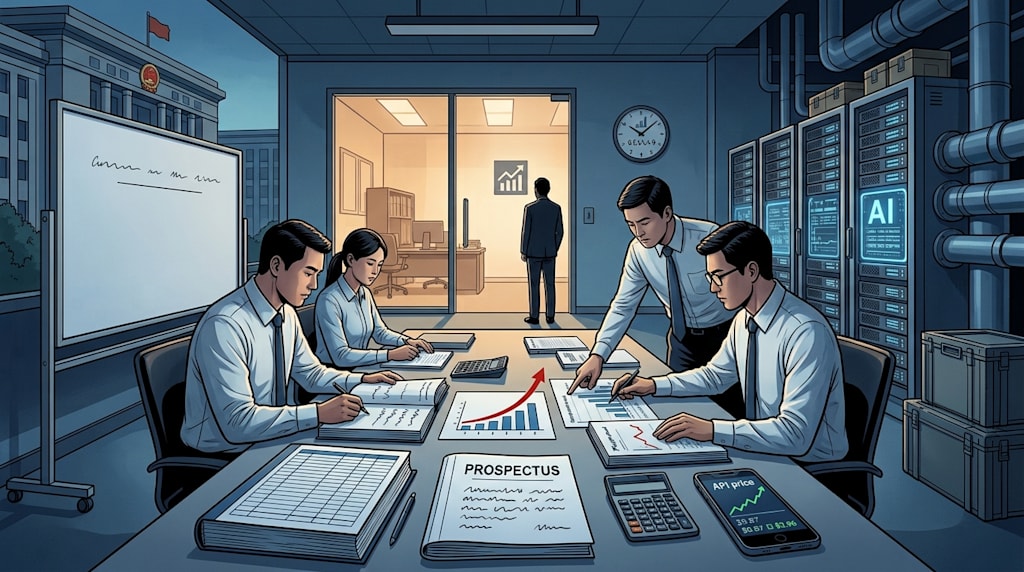
On September 9, market rumors said DeepSeek had entrusted CITIC Securities with preparing for a STAR Market IPO. 21st Century Business Herald learned from people familiar with the matter that the news is true. CITIC Securities has contacted DeepSeek and entered due diligence, but the two sides have not signed a formal pre-IPO tutoring agreement.
DeepSeek is not on the Zhejiang Securities Regulatory Bureau’s official list of companies under pre-IPO tutoring.
It has entered the waiting area but has not taken the stage.
Policy opens the door first
On June 17, CSRC Chairman Wu Qing said at the Lujiazui Forum that the scope of the STAR Market’s fifth set of listing standards would expand to the AI large-model industry. On the same day, the Shanghai Stock Exchange issued Guidelines No. 10, the first special review rules for AI large-model companies applying to list under the STAR Market’s fifth set of standards.
These standards set no hard requirements for profit or revenue. An estimated market cap of no less than RMB 4 billion is enough to apply. They were originally designed for innovative drug companies, to solve the financing gap at the stage of no product, no revenue, no profit. Now they have been extended to AI large models.
The threshold is not low. Guidelines No. 10 has fifteen articles and eight detailed requirements: hard-tech attributes, clear technological advantages, milestone achievements, a prominent industry position, clear commercialization plans, and compliance requirements such as data security and intellectual property protection. One key requirement is that at the time of application, at least one large-model product has already been launched and achieved scaled application.
DeepSeek’s V4 series, especially the lightweight V4-Flash, is already widely used among global developers. That usage meets the requirement.
The policy window has opened. DeepSeek’s capital moves have become more intensive.
Four months, a hundred billion
DeepSeek launched its first external funding round in April and closed it in June. The financing scale was about RMB 50 billion, with a post-money valuation of about RMB 350 billion.
Liang Wenfeng personally contributed about RMB 20 billion, making him the largest single contributor. Tencent contributed about RMB 10 billion, and the CATL system about RMB 5 billion. NetEase, JD.com, and IDG Capital each contributed about RMB 3 billion. Loyal Valley Capital and Shixiang Technology each contributed about RMB 1.5 billion. The National Artificial Intelligence Industry Investment Fund entered as the only direct corporate investor in the first round.
DeepSeek launched the second round just six weeks after the first closed. The pre-money valuation was RMB 500 billion, and the financing scale was also about RMB 50 billion. The two rounds raised more than RMB 100 billion in total. New investors included Zhongxin Juyuan, Boyu Capital, CPE Yuanfeng, and Hefei state-owned capital. Old shareholders such as Tencent and CATL continued to follow on.
The financing structure has one design: except for the national big fund, all external investors hold shares indirectly through Ningbo Cheng’en Enterprise Management Consulting Partnership, in which Liang Wenfeng is general partner. They do not have direct voting rights, and their shares have a five-year lock-up. Through direct and indirect holdings, Liang Wenfeng controls about 84.29% of equity and nearly 100% of voting rights.
RMB 500 billion is equivalent to about USD 74 billion. For comparison: Zhipu, after listing in Hong Kong, once saw its market cap exceed HK$1 trillion; as of early September it closed at about HK$557.3 billion. MiniMax’s market cap is about HK$123.3 billion. OpenAI’s expected market valuation is about USD 850 billion, while some Anthropic investors expect up to USD 2 trillion.
The jump from RMB 350 billion to RMB 500 billion happened in a month and a half.
Revenue rises, but investment rises faster
Because DeepSeek is not yet listed, the following data comes from media reports and is not audited official financial statements.
In the first seven months of 2026, DeepSeek generated revenue of about RMB 475 million, roughly 10 times its full-year 2025 revenue. Full-year 2025 revenue was about RMB 47.5 million. In the same period, its net loss was about RMB 715 million; full-year 2025 net loss was RMB 935 million.
Gross margin structure: overall gross margin was 44.6%, while API model invocation services had a gross margin of 82.9%. For comparison, OpenAI’s first-quarter gross margin was 39%, and Anthropic is expected to raise its 2026 gross margin from 40% to 63%. DeepSeek’s API gross margin is higher than both.
The overall gross margin was 44.6%, so non-API business pulled it down. The net loss of RMB 715 million, against revenue of RMB 475 million, is a loss ratio above 150%.
The main source of losses is investment in computing infrastructure. Computing investment rose from RMB 1.2 billion for all of 2025 to RMB 11 billion in the first seven months of 2026, for server leasing and AI chip procurement.
Starting August 17, API interfaces adopted peak/off-peak pricing. The flagship V4-Pro model’s output price during peak hours was raised to USD 3.96 per million tokens, and to USD 1.98 during off-peak hours, up from USD 0.87 previously. Users report paying more than before the change.
The price increase shifts the company from low price for scale to scale for revenue. For a company about to IPO, the slope of the revenue curve matters more than its rank on a technology leaderboard.
Whether the public market accepts the private market’s RMB 500 billion
Financing valuation and IPO issue valuation are two different things.
Primary-market private financing involves few participants, complex deal terms, and long share lock-ups. Investors willing to invest at RMB 500 billion include a scarcity premium, trust in the founder’s ability, and bets on the sector’s prospects. These cannot be directly equated with the price all public-market investors are willing to accept.
The STAR Market lacks a pure large-model leader. When DeepSeek lists, the market may give it a scarcity premium even higher than its private financing valuation. There are reports that the market expects DeepSeek’s post-listing market cap to reach RMB 2 trillion to RMB 2.5 trillion.
But before shares are fully circulating, the price contains scarcity and sentiment. The mature pricing after a large lock-up expiration is another set of numbers. ChangXin Memory Technologies’ issue pricing, early-trading pricing, and mature pricing after a large lock-up expiration are three different things. You cannot use early-trading numbers to directly calculate the founder’s net worth.
There is no prospectus. Revenue, costs, customer structure, and trends still have no audited public version. Without a denominator, discussing multiples ends up as expressions of faith.
After listing, the income statement gets new watchers
If DeepSeek successfully lists, it will face several structural changes.
Quarterly report cards. The old rhythm was release a model, shake the industry, wait for the next release. After listing, it must report revenue, profit, and cash flow to public shareholders every quarter. Large-model R&D cycles are irregular; a major breakthrough may require a six-month investment period, and quarterly reports will not wait.
Talent competition. The war for talent in the large-model industry is intense. According to media reports, DeepSeek recently suffered core talent attrition, with some researchers poached by competitors such as ByteDance and Xiaomi. The company then announced it would hire 150 more people. After listing, employee options will have a liquid price, making retention easier. But equity incentives also mean share dilution and cost recognition.
Control and governance. Liang Wenfeng controls the company through a complex structure, and the national big fund is the only shareholder with direct voting rights. These will be questioned in detail during the IPO review. DeepSeek’s historical relationship with High-Flyer Quant will also need to be disclosed in the prospectus.
Open source and commercialization. DeepSeek’s biggest labels are open source and low price. Open source helped it build a global developer ecosystem; low price made it one of the most-called domestic models. Public-market investors need to see profit. Price increases have already begun. The open-source strategy may adjust under commercial pressure. API pricing may rise further. Model release cadence may tilt toward products that are easier to monetize. Those are the variables the IPO brings.
Wait for the tutoring filing, don’t count limit-ups
CITIC Securities entering due diligence means the IPO process has started. Before final listing, there are still multiple gates: tutoring filing, tutoring acceptance, application acceptance, review inquiry, listing committee review, registration and issuance.
The tutoring period is no less than three months. The company needs to submit filing materials in September to have a chance of filing its IPO application within the year. After tutoring is completed, the regulatory bureau issues a Letter of Completion of Tutoring within a statutory 20 working days; the document is valid for 12 months, and the company must submit application materials within the validity period.
The first hard signal: CITIC Securities and DeepSeek sign a formal tutoring agreement, and the Zhejiang Securities Regulatory Bureau shows a filing.
Before that, discussions about valuation, timetable, and first-day gains lack sufficient factual basis.
CITIC Securities is going through the books. The Zhejiang regulator’s list is blank. The players have not taken the stage.
The audience need not rush to count limit-ups. The more useful question is what DeepSeek becomes when faith in technology collides with quarterly earnings.
About the Creator
Jin
Writer of reamstories
https://reamstories.com/jin
Enjoyed the story? Support the Creator.
Subscribe for free to receive all their stories in your feed. You could also become a paid subscriber, letting them know you appreciate their work.
Comments
There are no comments for this story
Be the first to respond and start the conversation.