
Count the downside first, then the upside
How to spot asymmetric odds in a market that confuses uncertainty with risk
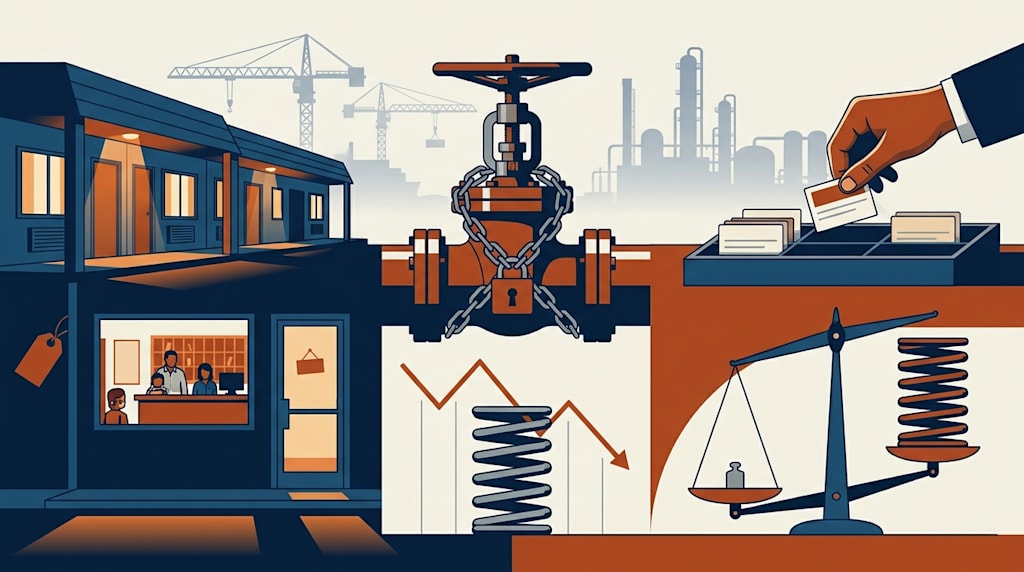
In the 1970s, an Indian family in the United States bought a motel that was about to be foreclosed. The price was 30 percent of construction cost. The whole family moved into the first floor. They worked the front desk, washed the sheets, and fixed the plumbing themselves. If occupancy fell to 20 or 30 percent, they did not lose money. When the economy recovered, they made back their principal in two or three years.
The order of that calculation matters. Count the downside first, then the upside.
Most people enter the stock market in the opposite order. They look at how much they can make, then reassure themselves that the risk is under control. When they see a stock down 70 percent, they think, “If it doubles, I double,” and only then go looking for reasons. The Patel family first calculated: purchase price at 30 cents on the dollar, the whole family living on site, near-zero labor cost. What is the worst case? How much can we lose? Only after calculating that they could not lose much did they enter.
That is asymmetric odds: limited downside, elastic upside. Lock down the downside first, then keep an upside option.
1. The market mistakes uncertainty for risk
In investing, risk and uncertainty are often mixed together.
Risk is the probability of permanent loss of principal. Buying too expensive, a company becoming insolvent, the industry logic being overturned, existing shareholders being wiped out in bankruptcy reorganization. These are risks.
Uncertainty is not being able to see clearly right now. You do not know which month the industry will recover. You do not know how ugly next quarter’s earnings will be. It makes people anxious, but by itself it does not kill.
The market does something odd here. Higher uncertainty pushes prices lower. Lower prices can reduce the risk of permanent loss.
When a company hits a cyclical winter, or a large institution is forced to liquidate because of redemptions, earnings over the next quarter or two are highly uncertain. Institutions that hate volatility, in order to protect their rankings, sell at any cost. The stock gets smashed below net cash on the balance sheet, then below 30 percent of the replacement cost of plant and equipment. Everyone says, “Too uncertain, you cannot touch it.” But because everyone wants to run, the purchase price gets smashed through the floor. Near liquidation value, uncertainty remains, while the risk of permanent loss has come down.
That is the first source of asymmetric odds. The market hates uncertainty and drives the price into a low-risk zone.
2. The Patel motel: buy at 30 cents on the dollar, live in the lobby
The Patel family’s approach breaks into three actions.
First, they did not go to prime locations during booms and pay high prices to buy land and build new hotels. They waited for recessions, when old motel owners could no longer pay their bank loans and were forced to sell under foreclosure. Then they bought old motels at 30 to 40 percent of construction cost.
Second, after buying, the whole family moved into the first floor. They worked the front desk, washed the sheets, and fixed the plumbing themselves. Fixed labor and rent expenses were pressed close to zero.
Third, they calculated the worst case. The purchase price was only 30 percent of replacement cost. The whole family lived and ate at the motel with no extra expenses. Even if occupancy fell to 20 or 30 percent, they would not lose money or go bankrupt. When the economy recovered and highway traffic returned, this hard asset bought at 30 cents on the dollar could pay back the entire principal in two or three years.
Mohnish Pabrai summarized this way of calculating in one sentence: Heads I win; tails I don’t lose much.
Richard Branson founding Virgin Atlantic used the same calculation. Aviation is a business that has lost money for a century. If you start by borrowing billions of dollars to buy a fleet, and traffic disappoints, you are doomed. Branson started by negotiating only one leased 747 from Boeing, and added a clause to the contract: if the business could not continue after one year, he could return the plane directly to Boeing. Outsiders saw him betting his life on a cross-industry gamble. In reality, he had locked the maximum loss on the downside to one year’s rent, while the upside was an entire multinational airline group.
The common point of these two cases is not “being bold.” It is counting the losing side first. Only after the losing side is calculated clearly does the winning side come into play.
3. A 70 percent drop does not equal asymmetric odds
At this point it is easy to form a misunderstanding: if a heavy-asset cyclical stock has fallen 70 percent, you can go bottom-fishing.
Lithium miners and photovoltaic polysilicon are counterexamples. Buying mining rights and building chemical plants costs tens of billions, so replacement cost is not low. Why was bottom-fishing after a 70 percent drop still a mess of cutthroat competition?
Because high replacement cost does not mean supply is locked down.
When product prices soar, fat profit margins themselves are the loudest expansion bugle. Mining and chemical equipment have no exclusive licensing barriers. Local government investment promotion and stock-market refinancing provide a steady stream of cheap capital. Dozens of new plants rush in within two years. More troublesome is the latecomer advantage in manufacturing: new production lines built two years later use less energy and are more efficient, pushing old plants to the brink. Even after prices halve, each company still grinds on to spread depreciation.
The “cheapness” you see at this point is a value trap. The supply tap has not been shut off; it is still gushing.
Edward Chancellor repeatedly emphasizes a capital-cycle iron law in Capital Returns: what determines the odds in a cyclical industry is not how moving today’s demand story is, but whether the supply tap will be completely shut off over the next two or three years.
The cyclical reversals that actually produce multi-bagger moves, such as the coal industry after a decade-long bear market washout, or the ocean shippers and shipyards in the last cycle when peers went through mass bankruptcy reorganization, have several features. Industry-wide capital expenditure has been below equipment depreciation for years. Banks have cut off credit completely. Environmental approvals for new mines have stopped. Global shipyard slots are locked for three to five years. Peers have gone through mass bankruptcy reorganization, and even if product prices rise tomorrow, no one is willing or able to immediately build new capacity.
Only when an industry has gone through brutal clearing and the supply side is completely locked down is the cheapness at the bottom a tightly compressed spring rather than a trap.
4. Operating leverage: a small price increase, a huge profit jump
After supply is locked down, why can profits and share prices multiply several times when downstream demand recovers even a little?
The answer lies in fixed costs and operating leverage in heavy-asset industries.
Normally investors dislike heavy-asset companies, thinking plant depreciation is large and maintenance costs are high. But at the moment a cyclical reversal crosses the breakeven point, huge fixed costs become the most violent profit amplifier.
Here is a simple calculation.
Suppose a heavy-asset manufacturer or shipping company with locked-down supply has fixed costs, including plant and equipment depreciation and headquarters salaries, of RMB 80 million a year. Variable cost per unit, including raw materials and energy, is RMB 60. Normal annual sales are 1 million units.
At the industry’s freezing point, the product price falls to RMB 140. Gross profit per unit is RMB 80. The RMB 80 million of gross profit from selling 1 million units exactly offsets the RMB 80 million of fixed costs. Pre-tax profit is zero. The company sits at the edge of thin profit or small loss, at breakeven, and the stock is pinned to the floor.
Downstream demand recovers moderately. The product price rises only 10 percent from the bottom, to RMB 154. The RMB 80 million of fixed costs does not increase by a single cent. The extra RMB 14 per unit almost entirely becomes pure profit. Company-wide pre-tax profit jumps from zero to RMB 14 million.
Capacity becomes tighter. The price rises 25 percent from the bottom, to RMB 175. Pre-tax profit explodes to RMB 35 million.
The price rises a little; profit jumps from zero to tens of millions. That is operating leverage.
The same logic has two variants.
First, the dividend from old equipment depreciation expiring. Large hydropower stations, telecom conduit networks, or mature wafer fabs invest tens of billions during construction. For the first ten years, they deduct billions of depreciation from the income statement every year, so book net profit looks thin. Once the depreciation period expires, the dam and equipment can physically run for decades more. The billions of depreciation that used to be deducted each year turn directly into a jump in free cash flow and dividends.
Second, recovering extra concessions made during the downturn. In real estate or durable goods, during a trough companies often have to offer buyer interest subsidies or concessions to close deals. In normal times the concession is 5 percent; in a downturn it is forced to 12 percent. The extra 7 percentage points are deducted directly from gross margin. Once mortgage rates fall or demand stabilizes, developers can see gross margin recover severalfold, even without raising home prices, merely by returning extra subsidies to normal levels.
Crossing breakeven, old depreciation expiring in a cluster, or recovering downturn concessions all use inconspicuous marginal improvements to lever up several times the profit re-rating.
5. For cyclicals, read P/E backward
Once you understand this mathematical mechanism, you can understand Peter Lynch’s counterintuitive principle: for cyclical stocks and turnaround stocks, the price-to-earnings ratio often has to be read backward.
Most retail investors lose big money in cyclicals because they see a cyclical company with a P/E of only 5x, think it is too cheap, and rush in with a heavy position. The lowest P/E for a cyclical stock appears precisely when product prices are at historical peaks and the whole industry is running at full capacity making windfall profits. Then new capacity comes online in a cluster, product prices halve, and the 5x P/E turns into a loss in the blink of an eye.
Lynch’s own Chrysler turnaround, a battle in which he made more than ten times his money, was bought in 1982, when the company had just suffered a huge loss and the static P/E was meaningless. Everyone on Wall Street feared Chrysler would go bankrupt, and the stock had fallen into the dust. Lynch did a detailed calculation. Chrysler still had USD 1 billion of net cash, so it would not die in the short term. The company had cut a lot of redundant costs. The new minivan was about to launch. Once sales crossed breakeven, earnings per share could recover to several dollars at any time.
Looking for low P/E at the top of a cycle with a magnifying glass is walking into a trap. At the bottom of industry clearing, buying surviving leaders at a fraction of replacement cost while they are at thin profit or small loss is asymmetric offense.
6. Want operating leverage, not financial leverage
Going to cyclical troughs to look for asymmetric odds, you earn from operating leverage created by fixed depreciation. You must not bet on financial leverage created by high-interest debt.
Both look like costs on the financial statements, but in a winter their outcomes are separated by life and death.
Fixed depreciation is money already spent in the past on plants and ships. It does not require current cash outlay; it is a sunk cost. As long as the cash the company receives from selling goods currently covers raw materials and labor, it will not die even if book losses appear. High short-term interest-bearing debt, however, must be repaid in real cash, principal and interest. If a company’s cash flow is drained every year just to pay bank interest, then even if the industry truly has an epic reversal two years later, it will default or go through low-price bankruptcy reorganization before dawn and wipe existing shareholders out completely.
The precondition for asymmetric odds is survival. Net cash, debt maturities, and cash-flow coverage of interest matter more than any moving demand story. Want operating leverage, not financial leverage. Want a company that can last until spring, not one crushed by debt before spring arrives.
7. Odds decide the watchlist; discipline decides the trigger
Calculating high odds does not mean you buy today.
A stock that has fallen to 30 percent of replacement cost and whose supply has already cleared may still lie on the floor for another year if downstream demand never ignites, or if a large institution has not finished dumping its liquidation holdings. Firing all your bullets too early on the left side will drag down capital efficiency through the long wait.
Asymmetric odds only decide whether a stock can enter the watchlist. When to pull the trigger and how much to buy must strictly obey trading discipline.
One executable rule: confirm that reasonable upside repair space is at least three times the downside stop-loss space. Only then does the stock have asymmetric odds and qualify for the bottom watchlist. Then wait for evidence of supply clearing, for signals of marginal demand improvement, and for the ownership structure to stabilize, and scale in in tranches. Odds are responsible for stock selection; discipline is responsible for timing and position size.
8. No calculation is 100 percent certain
No matter how carefully we calculate replacement cost, supply cycles, and operating leverage, the business world never offers a 100 percent sure-win calculation.
Sometimes you think supply is completely locked down, and then a cross-industry giant arrives with a disruptive new technology. Sometimes a sudden macro black swan interrupts a demand recovery that had been improving gently. Even with hard assets as a cushion, the stock price may still fall another leg under a short-term liquidity shock.
Asymmetric odds do not mean “you will not lose.” They mean “you lose limited, and you win big.” They do not mean “you are right every time.” They mean “one right call can cover several wrong ones.” They require admitting you can be wrong, and then using price, position size, and discipline to leave room for being wrong.
Conclusion: back to the watchlist
Put a stock on the watchlist, then wait.
Wait for evidence that supply has cleared, wait for the selling to finish, wait for demand to ignite. If it does not come, do not buy.
Before the Patel family bought motels, they calculated the 30-cents-on-the-dollar purchase price and the cost of the whole family living on site. Before Branson leased the plane, he wrote the return clause into the contract. Before Lynch bought Chrysler, he calculated the USD 1 billion of net cash on the balance sheet.
Count the downside first, then the upside. Only after calculating the losing side and finding that you cannot lose much does the winning side come into play.
Asymmetric odds are not a slogan. They are an account calculated one line at a time.
About the Creator
Jin
Writer of reamstories
https://reamstories.com/jin
Enjoyed the story? Support the Creator.
Subscribe for free to receive all their stories in your feed. You could also become a paid subscriber, letting them know you appreciate their work.
Comments
There are no comments for this story
Be the first to respond and start the conversation.