
BOS vs. CHoCH: Decoding Institutional Confirmation and Reversal Signals
The Critical Shift

In Part 1, we learned that a trend remains intact until its structural framework is validated or broken. If you can define the major swing points (the external structure), your next task is to identify when those points are breached.
Institutional traders, operating with massive capital, cannot simply click 'buy' or 'sell' at any moment without drastically moving the price against themselves. They must engineer liquidity. The concepts of BOS and CHoCH are the digital footprints they leave when they engage with this liquidity.
Let's break down the definitions first, and then explore the critical context that separates a routine continuation from a violent reversal.
1. What is a Break of Structure (BOS)?
The Break of Structure (BOS) is your confirmation that the existing trend is healthy, strong, and likely to continue. It occurs when price action successfully expands beyond the most recent key structural peak or valley (a Major Swing High or Swing Low).
The Mechanics of an Uptrend BOS:
The market is making confirmed Higher Highs (HH) and Higher Lows (HL).
Institutional buying pressure overcomes resistance, pushing the price above the most recent confirmed Swing High (HH).
The candle body must close above this high to confirm structural validation. (We will address 'wick sweeps' in Part 4).
Conclusion: This breach is a BOS. The trend is confirmed. You now wait for the next pullback (Internal Structure) to find a high-probability entry to buy in alignment with this direction.
The Mechanics of a Downtrend BOS:
The market is making Lower Lows (LL) and Lower Highs (LH).
Institutional selling pressure drives price below the most recent confirmed Swing Low (LL).
A confirmed close below this low validates the structure.
Conclusion: This breach is a BOS. The downward trend is confirmed. You now look for pullbacks to short the market.
2. What is a Change of Character (CHoCH)?
A Change of Character (CHoCH) is fundamentally different. It is not a continuation; it is the first early signal of a trend's exhaustion and potential reversal.
While a BOS occurs in the direction of the trend, a CHoCH occurs when price reverses and breaks the protecting structure—the very foundation that defines the trend.
The Mechanics of a Bearish CHoCH (Trend Reversal DOWN):
The market is in an uptrend (HH, HL). The last Higher Low (HL) is the protecting structure; it is what keeps the uptrend valid.
Price attempts to make a new higher high but fails (forming a 'failure swing').
Price reverses violently and, for the first time, breaks and closes below that key protecting Higher Low.
Conclusion: This breach is a CHoCH. The character of the market has shifted from buying on dips to aggressive selling. The protected low is gone. Caution is advised for bulls; aggressive bears look for retests of newly formed supply zones.
The Mechanics of a Bullish CHoCH (Trend Reversal UP):
The market is in a downtrend (LH, LL). The last Lower High (LH) is the protecting structure.
Price fails to push to a new lower low (often a 'liquidity sweep'—see below).
Price reverses and closes aggressively above that key protecting Lower High.
Conclusion: This breach is a CHoCH. The structural character is now bullish. Bears must stop shorting; bulls are stepping in.
3. The Critical Shift: Recognizing Context and Invalidations
The difference between a high-probability CHoCH setup and a simple correction lies entirely in the context. A CHoCH is most powerful when it forms after a failed attempt to maintain the previous trend.
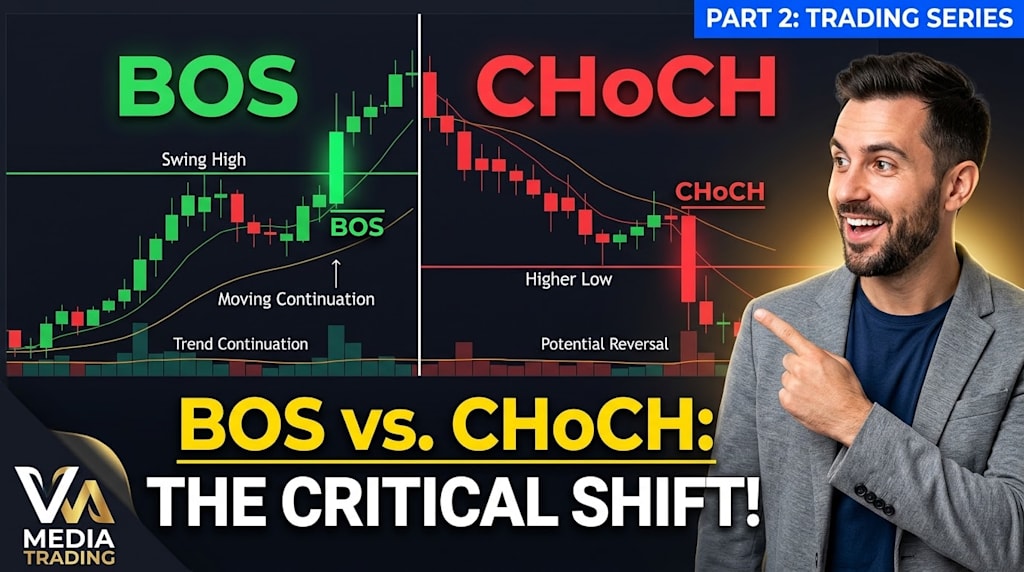
Look again at the comparison in our thumbnail image.
BOS (Left): You can see the sequential steps. Price forms a Swing High, pulls back, and then a strong green candle confirms the trend by creating a BOS. This is a continuation signal.
CHoCH (Right): Notice how price fails to make a new peak (it fails to form a new higher high). It then violently reverses through the protected Higher Low. This is a potential reversal signal. The first 'protected' level has failed.
Warning: Watch for the Liquidity Sweep Trap!
The biggest danger when identifying CHoCH is confusing it with a simple Liquidity Sweep (which we will explore in detail in Part 4).
Institutions know where retail stop-losses are clustered—just beyond previous highs and lows. If a market simply wicks past a structural low (a 'CHoCH' by definition if a body close isn't required) and immediately rejects back up into the trading range, that is a liquidity sweep, not a reversal.
Professional Confirmation Rule: A valid BOS or CHoCH requires a confirmed candle body close beyond the structural level on the timeframe you are analyzing. A mere wick breach is a 'sweep' until proven otherwise.
Conclusion: Trading the Structural Blueprint
Market structure is not chaotic; it is sequential. A BOS tells you where the market is going, while a CHoCH signals when the market is done going there.
Once you can cleanly distinguish these two events, your process simplifies. You cease fighting the dominant institutional flow.
Identify the Major Structure (Part 1).
Confirm Continuation: Look for body closes beyond highs/lows (BOS).
Alert for Reversal: Watch for failures and breaks of protected levels (CHoCH).
If you are just starting, your goal should be to trade exclusively with the confirmed trend (the BOS). As you advance, mastering the CHoCH allows you to catch new trends at their inception, significantly increasing your risk-to-reward potential.
About the Creator
Junaid Ali (Official)
Start writing...forex Trader | Market Analyst | Risk Manager 5+ yrs of exp
Technical & Fundamental Analysis
Risk Management Strategies
Day & Swing Trading
Discipline. Patience. Consistency
💬 DM for collab
📊 “Trade with logic, not emotion
Enjoyed the story? Support the Creator.
Subscribe for free to receive all their stories in your feed.
Comments
There are no comments for this story
Be the first to respond and start the conversation.