
Baby's First Investment
Fidelity beginner trials


(And by baby, I do mean my 32-year-old, Crypt Keeper self.)
Like most people, my parents and my 20+ years of schooling didn't teach me anything about investing.
And like most women, I was encouraged to save safely and not take risks. I believe this gendered approach to economics is a trickle-down apprehension from our grandparents.
Our grandmothers, at one point in time, weren't allowed to have bank accounts or own credit cards. Do to inequality, They were barred from building credit or substantial wealth. And so, money scarcity was a real fear. Women were economic dependents, unable to do anything more than make budgets with their husbands' money and pray that one income would stretch. (Considering my grandparents were in the boomer generation, their dollar had to stretch accross an overcrowded family.)
My parents are Gen-X and became young adults during the height of credit card excitement. New cards were sent in the mail every week for 'trials', and my mother, who was deeply uneducated about money, quickly racked up thousands of dollars in credit card debt, with the false belief that she was building 'good credit'.
This was a ruse from the credit card companies. Stay-at-home moms were being sent card after card, in hopes that their unknowing husbands would be forced to flip the bill. The immense and sudden debt was another wedge in my parents' marriage, which eventually led to divorce. I'm sure other boomers and Gen-Xers have similar family finance trauma.
Looking back at older generations, I envy those with parents who were financially educated. I suppose this envy helped me wake up and realize that I could take charge of my finances and become well educated, and financially independent for my future children and grand-babies.
I grew up under a wave of debt that haunted my parents.
They were so focused on whittling down the interest payments that they didn't have the means to invest or prioritise teaching their children the right way to view finances.
My father is a farmer, who, thanks to unions, has a secure 401K. But my mother's mental health problems and her lack of education prevent her from working at stable companies that might be able to provide her more future security. My siblings and I have a lot of lingering concerns over how we will provide for her.
I went to an American college, and later a Master's program. I racked up over 90,000 dollars of debt as a young adult. This number was so large to me that it didn't seem real, it was almost laughable.
For years, I pretended the loans didn't exist. I set automatic payments to the lowest amount and just sort of ignored the debt. My provider is Nelnet, so the interest rates (thank goodness) aren't terrible, averaging around 4.5% for each of the loans.
I was lucky enough to have a father who warned me that I should never take out a private loan, because their interest rates are incredibly predatory. Legally, the private companies can set them interest rates to whatever they like, which feels baffaling and immoral. (My friend has a private loan with an 18% interest rate. I honestly don't know how she makes those large payments on a teacher's salary.)
Thanks to my steady ESL teaching job, I've managed over the years to pay off a large chunk of my student loans. I am currently sitting at 54,800ish dollars left. This means I've paid over 35,200 dollars plus interest, which would put me anywhere above 65,000 in total payments.
It feels like a huge accomplishment, but at the same time I mourn all the money that I could have been saving or investing. Nelnet has taken tens of thousands of dollars from me, just because I wanted a higher education. No other country in the world demands its young adults to go into such crippling, predatory debt. American needs to reform its value on education.
My husband invests in day-trading stocks. He wins; he loses. And it all seems very stressful as he checks his phone at dinner to stare at a stock line jumping like a heartbeat. It reminds me of those Wolf of Wall Street clips.
I assumed investing in the stock market meant I too had to be on guard and constantly gambling. Seeing my husband's unwavering interest had me worried at first, but we've talked openly about the money he invests, and to my relief, he never invests over a grand at a time.
When I asked him if I should be investing, too. He at first told me that saving was enough and he would handle the investments. But, thinking of my future children, I wasn't satisfied in that role. SO, we continued to talk and my partner reassured me that there were lots of different avenues of investment and I only needed to research a bit to find my own way. (We love a supportive king.)
I thought that I couldn't enter the stock market if I had loans to pay off. I had watched finance videos on YouTube before, and nearly all the advice said to pay off your loans as aggressively as possible, make an emergency fund, then invest when everything is tight and settled.
I think this is still solid advice. But I'm already in my thirties with only a high-interest savings account. Also, I have no credit card debt (which is a blessing) so I was advised to get involved in the stock market as soon as possible to start building shares.
I am a freelancer. I live and work abroad. So sending a large chunk of money back to my American bank account is quite difficult. The exchange rate is TERRIBLE. Recently, I sent 6 Million Won from my Korean account and got less than 4,000 USD dollars in my American account :(. This is a huge cut from my income. I freelance, too. But my writing income is erratic and makes me less than 2 thousand dollars a year on average. Luckily, though, Stripe pays directly into the US bank account, so that's a huge relief. I treat my writing income as 'buffer' money rather than calculating it into my investment/loan budget, so I never accidentally overdraw and I always have enough for my egregious freelancing taxes.
So, with my meager income and looming debt in mind, I ventured deeper into YouTube's offerings of financial advice. I found a handful of knowledgeable YouTubers who gave clear explanations on what the stock market is, how to invest, and definitions of the complicated new vocabulary that I had never seen before.
I learned about dividend payments and how to reinvest them. I learned about the difference between individual stocks and ETFs (bundles of popular stocks). In the end, after about two weeks of watching hours of economic content, I decided that I should open a Roth IRA on Fidelity.
I made a strict budget with what was currently in my bank account. Since I am still making student loan payments, I calculated that I can afford to start with a $120 investment and put in another $80 a month into my ROTH IRA, so that's what I will do for now.
I picked the ETFs that were most commonly recommended, including the FSMDX and FSKAX (Total Market Index Funds), as well as FITLX, which has companies that are focused on reducing their environmental impact. I will later invest in KO (Coca-Cola) and perhaps some other individual stocks down the road.
It is going to be a slow uphill climb, since there is no way I will be able to max out my total amount of 7,500 just yet. BUT I am so excited to be getting started and feel very proud of taking this first baby step.
Here is a screenshot I took of a simple investment calculator. Of course it isn't completely accurate, since it doesn't consider the exact ETFs and stocks I'm going to buy. But it gave me a huge boost of inspiration all the same!
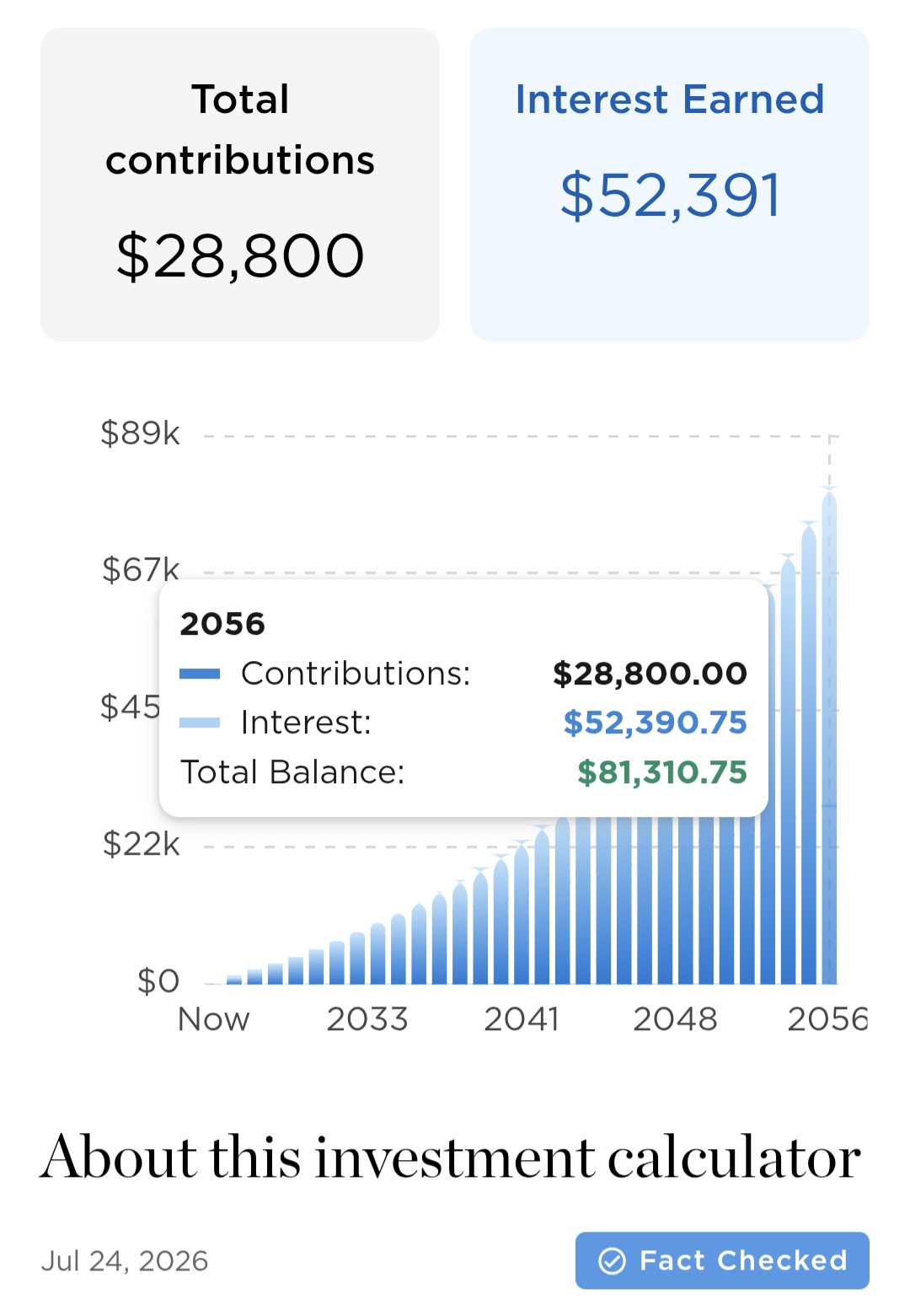
Even though 80 dollars doesn't seem like a massive chunk of money, it will still build me wealth as long as I invest smartly and continue to listen to the advice of people far more experienced than I am. Plus, I am confident that in the future I will be able to build a higher income so that I can invest even more.
I bet my grandma would be surprised and proud of how economically independent her granddaughter is becoming. I hope that if I'm lucky enough to have a daughter, she will be able to get an even bigger leg up in the future.
I apologize because I am so new to investing that I cannot offer any solid advice to anyone else looking to get started. The YouTuber who was most helpful to me was the Author of I Will Teach You How to Be Rich, Ramit Sethi. His videos are funny and approachable. He also hosts a podcast where he helps couples tackle their finances. He has a lot of compassion for newbies like me.
If you are a finance pro and have any advice for me, I'd also love to hear it!
Thank you for reading. <3
About the Creator
Enjoyed the story? Support the Creator.
Subscribe for free to receive all their stories in your feed. You could also become a paid subscriber, letting them know you appreciate their work.
Comments
There are no comments for this story
Be the first to respond and start the conversation.