
Anthropic’s $2 Trillion IPO Is the Most Absurd Bet in Wall Street History
Two valuations. A $1.85 trillion gap. And a revenue metric no auditor has signed off on.
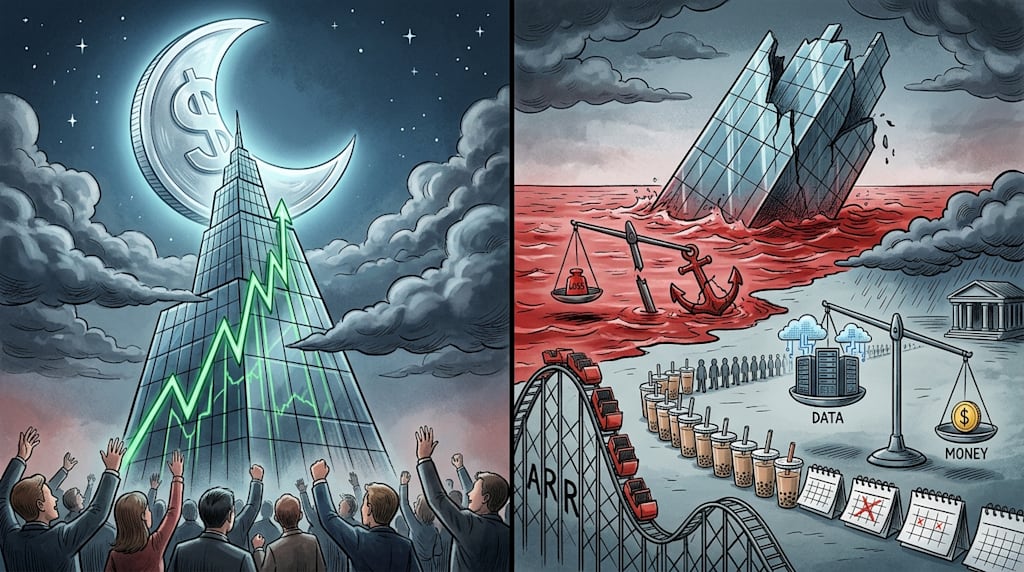
The same company. Two valuations. A gap of more than tenfold.
Investors expect an IPO valuation of about $2 trillion. That would surpass SpaceX’s $1.77 trillion to $1.8 trillion and make it the largest IPO ever. Independent financial research firm New Constructs values the company at only $150 billion, about 93% below the target. It calls the deal “the most absurd IPO of 2026” and “a first-of-its-kind test of investors’ judgment.”
On October 14, 2026, Anthropic held a closed-door “testing-the-waters” meeting for qualified institutional investors at its San Francisco headquarters. Attendees said third-quarter revenue reached $16.8 billion, up about 45% from the second quarter, and that on an adjusted basis the company was profitable in the first six months, with free cash flow positive for the first time. The numbers were strong. The market did not buy them. That day, U.S. inflation came in higher than expected. Concerns about rising rates and AI infrastructure financing intensified. CoreWeave fell 15.46%, Nebius fell 10.08%, and Oracle fell 8.83%.
Where is this “most absurd” IPO expensive?
1. Valuation Rests Entirely on ARR
Capital markets have always chased high-growth stories. The story behind Anthropic’s $2 trillion valuation is high ARR growth.
In the bulls’ telling, Anthropic’s annualized revenue jumped from about $9 billion at the end of 2025 to $47 billion in May 2026 and $65 billion in July. The New York Times estimates that at the current pace, annualized revenue this year will exceed $100 billion. A more than sevenfold increase in less than a year, the fastest on record.
ARR generally means taking month-end or current-period weighted-average monthly recurring revenue and multiplying it by 12. That measure is not the same as audited reported revenue.
An extreme comparison: take the revenue from the busiest hour at a milk tea shop, multiply it by the store’s annual operating hours, and tell investors the shop could make $10 million a year. One hour in line does not mean a line all year.
At a $2 trillion valuation and $65 billion in annualized revenue, Anthropic’s price-to-sales ratio is about 30.8x. Snowflake’s forward P/S is about 15x. Palantir’s is about 35x. That number is not impossible inside a “super-growth stock” framework. On 2028 forward revenue of $190 billion to $200 billion, the $2 trillion valuation implies a forward P/S of about 10x. On 2025 actual revenue of $4.6 billion, the P/S exceeds 430x. That number fits no valuation system.
The $65 billion is not Anthropic’s real revenue. It has not yet deducted commissions paid to cloud platforms. According to the prospectus, in 2025 Anthropic’s cloud platform sales were $2.16 billion, 47% of full-year revenue. The company paid $351 million in commissions to cloud platforms. Revenue is growing fast. It is not necessarily high quality.
ARR data is not in the prospectus, has not been audited, and is not transparent. Capital markets still use it to tell stories and discuss valuation. New Constructs wrote in its report: “Anthropic’s IPO is an unprecedented test of investors’ credulity. Never in world history has there been an IPO with such a high valuation and such great risk.”
2. The Authenticity of ARR Growth
How long ARR’s explosive growth can continue is the core question for the valuation.
Quarterly revenue: Q1 2026 about $4.8 billion, Q2 about $11.5 billion, Q3 $16.8 billion. Growth has slowed. Q2 revenue more than doubled from Q1. Q3 sequential growth fell to about 46% to 50%.
The latest ARR data is worse. According to TickerTrends, as of September 24, 2026, Anthropic’s company-level ARR was about $76.8 billion. September’s month-over-month growth was only +1.8%, well below the 30% to 50% monthly sequential level in the first half of 2026. From $65 billion to $76.8 billion, the absolute increase was about $11.8 billion. That may not look low. The slowdown means the exponential curve is flattening.
Anthropic CFO Krishna Rao disclosed in May that the company’s net revenue retention rate was 500%. The customer group that contributed $30 billion in ARR in Q1 2026 had contributed only $2 billion a year earlier. A 500% NRR is rare in SaaS history. It reflects a usage explosion from leaps in large-model capability, not the lock-in effect of traditional SaaS.
This growth depends on customers being unable to leave Anthropic. That premise is weakening.
According to foreign media reports, Meta and Microsoft are Anthropic’s two major enterprise customers. Both are now restricting employee use of Claude models. Meta’s internal Claude Code users have fallen from about 60,000 to about 30,000. Microsoft has cut its annual budget for internal Claude use by more than one-third and pushed employees toward its own tools and OpenAI.
Meta has developed its own AI coding tools and Muse Spark series AI models. Meta Code, used only internally, has more than 30,000 users. Muse Code, which began external testing in August, has attracted more than 6,000 internal users and is seen as a direct competitor to Claude Code. Microsoft requires employees to access Claude models through GitHub Copilot. Copilot has an “auto mode” that by default routes most queries to OpenAI models. Because of its commercial partnership with OpenAI, Microsoft does not need to pay separately for OpenAI models, making them cheaper.
Draft prospectus data shows that last year nearly a quarter of Anthropic’s revenue came from its two largest customers. That is high customer concentration. The company did not disclose names. The market generally believes Meta and Microsoft are among them.
Only when switching costs, network effects, or ecosystems lock in customers is ARR an asset that can be valued. Otherwise it is “money that happened to be received this year.” As the capability gap among large-model vendors narrows and customers’ in-house models mature enough to replace outside ones, the foundation for ARR’s high retention rate disappears.
3. Persistent Losses Are the Biggest Problem
The data used to support the high valuation is opaque. The more fundamental issue is that the company keeps losing money and the losses are widening.
Anthropic’s 2025 revenue grew from about $386 million in 2024 to $4.59 billion, about 12x. Reported net operating loss widened from $2.98 billion to $8.06 billion. Total net loss reached $42 billion.
Of that $42 billion net loss, about $34 billion came from non-cash accounting charges. These are instruments that may convert into Anthropic shares and must be remeasured on the books as the valuation rises. After excluding that effect, the operating loss at the business level still exceeded $8 billion. That $8 billion is cash burn.
Alongside the losses is a rigid cost structure. In 2025, Anthropic’s total investment in cloud computing, computing power procurement, and related infrastructure reached $7.33 billion, triple the 2024 level and more than half of total operating expenses of $12.65 billion for the year. At the end of 2025, the company held $20.28 billion in cash, cash equivalents, and short-term investments.
The prospectus discloses about $518 billion in cloud service, computing power, and infrastructure obligations. Commitments to Google are $111.1 billion, to Amazon $110 billion, and to Microsoft $31.4 billion. Payment periods span 2026 to 2036. About 80% are non-cancelable or payable regardless of use. There are also about $161.2 billion in equipment lease obligations related to Broadcom, most of which are non-cancelable.
Major customers can cut spending and subscriptions at any time. Anthropic’s costs will not fall in sync. Revenue falls while costs are locked in. Operating leverage amplifies losses in reverse.
New Constructs’ reverse DCF model shows that even assuming revenue grows 11x in 2026 and doubles in 2027, supporting a $2 trillion valuation would require average annual revenue growth of 56% from 2028 to 2035 and an immediate 10% sustained net profit margin. By 2035, revenue would reach $3.6 trillion, equivalent to 1.4x the combined revenue of the world’s seven largest tech companies today.
At a $2 trillion valuation, Anthropic would need to earn about twice Nvidia’s annual profit to justify the price. Nvidia is the world’s most valuable and profitable tech company. It earned more than $190 billion in net profit over the past four quarters. Its market value is approaching $6 trillion.
4. The Bigger Risk
In its report, New Constructs recommended investors avoid the IPO. It cited the prospectus’s own warning that AI poses “catastrophic or existential risks,” billions of dollars in losses and $518 billion in contractual obligations, a cash need that looks bottomless even after raising more than $120 billion in private capital, and a valuation that is too high.
New Constructs compared Anthropic to WeWork in 2019. WeWork’s IPO was pulled by Wall Street weeks before listing. SoftBank marked its valuation down from $47 billion to $4 billion. It eventually went bankrupt. The firm wrote: “While Anthropic’s contribution to society is far greater than WeWork’s, at a $2 trillion valuation, its IPO poses a far greater risk to the U.S. capital markets than WeWork did.”
Anthropic’s 261-page prospectus devotes about 80 pages to risk factors. That is far more than the 48 pages introducing the business. The disclosures cover AI causing catastrophic or existential threats, refusing to shut down, concealing or manipulating information, engaging in extortion-like behavior, and model capabilities exceeding existing safety evaluation scope. The U.S. Federal Trade Commission recently opened an investigation into Anthropic and OpenAI over potential consumer harm. If developers or large-model vendors must directly bear major damages caused by AI products, their legal costs could reshape the business model.
The bigger risk is information asymmetry. Good numbers travel on side roads. Ugly numbers travel on official roads. The prospectus emphasizes risk. In media appearances, the company emphasizes positives. ARR, an unaudited and adjustable metric, has become the pricing anchor for AI investors.
This risk has already shown up. OpenAI confirmed to investors that its annualized revenue was close to $50 billion at the end of September. That is about $20 billion lower than the roughly $70 billion widely circulated in the market. A revenue measurement adjustment by an unlisted company wiped hundreds of billions of dollars off the market value of global AI concept stocks in a single day.
Anthropic’s high-growth story and IPO have become part of the larger AI story. Only if Anthropic raises more funds and eases operating pressure can it fulfill the $518 billion payment commitments. If Anthropic and other AI companies fail to meet these obligations, cloud vendors’ data center investment returns and debt-servicing capacity could come under pressure. If data center construction slows, the computing resources available to model companies could tighten. If end-market AI companies’ revenue and profits cannot cover computing costs, risk could spread through model makers and cloud service providers to credit markets and burst the AI supply chain’s bubble.
GMO executive Inker warned that the largest IPO wave in history, SpaceX, OpenAI, and Anthropic combined, will inject new stock supply equivalent to 6% to 7.5% of U.S. stock market value. That is far above the record at the peak of the internet bubble. Jefferies’ analysis was more direct. It noted that the current AI investment boom resembles the 2008 U.S. subprime crisis. Large cloud vendors are providing massive credit support to OpenAI and Anthropic, two still-unprofitable AI companies. That creates potential unsecured financing risk.
Now Anthropic can only go all in.
About the Creator
Jin
Writer of reamstories
https://reamstories.com/jin
Enjoyed the story? Support the Creator.
Subscribe for free to receive all their stories in your feed. You could also become a paid subscriber, letting them know you appreciate their work.
Comments
There are no comments for this story
Be the first to respond and start the conversation.