
13 Baijiu Companies Changed Leaders This Year. The Problem Is Bigger Than Sales.
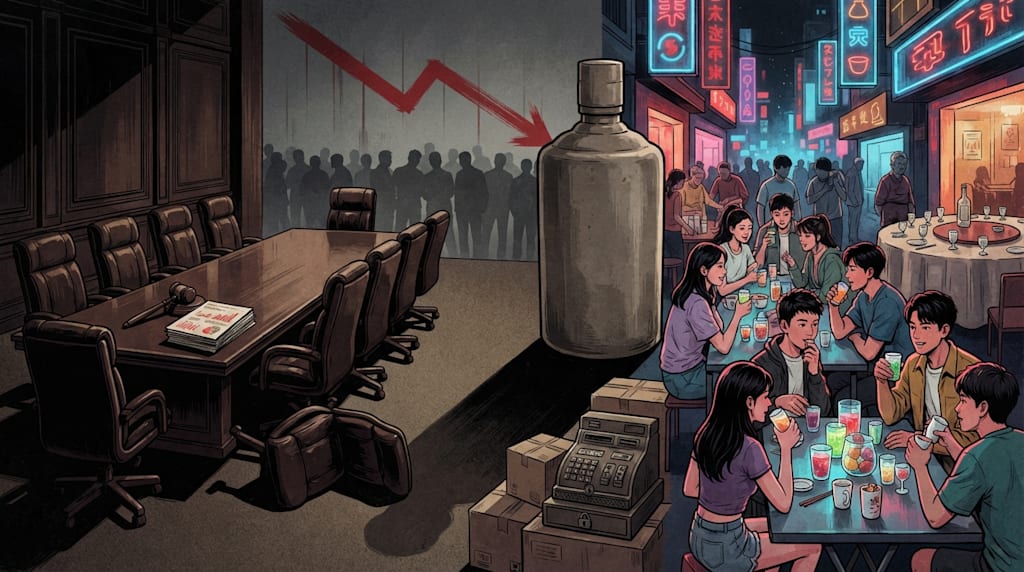
China’s white liquor industry is losing the drinkers it spent decades depending on.
1. Thirteen Chairs Change Hands
On September 28, 2026, Jinshengzi Liquor announced a new chairman. Shede Spirits followed the next day. According to incomplete counts, 13 liquor companies have changed chairman or general manager this year. Yanghe’s former president Gu Yu became chairman. Hengshui Laobaigan’s former chairman Liu Yanlong stepped down. ZJLD’s former vice chairman Yan Tao left. Liu Yanlong spent 26 years as general manager and chairman of Laobaigan. His exit closed a long chapter.
Why now? The change is not only about personnel. It is about a growth model that stopped working.
2. Performance Forced the Change
In 2025, 20 A-share listed baijiu companies reported total revenue of RMB 365.461 billion, down RMB 83.548 billion from a year earlier. In 2026, the decline continued. National Bureau of Statistics data showed industrial baijiu output above designated size fell 4.7% in January to June, extending a drop that started in 2017. In the first half of 2026, 21 listed baijiu companies saw revenue fall 18.03% and net profit attributable to shareholders fall 22.48%.
The China Alcoholic Drinks Association’s 2026 mid-year report found that 86.7% of surveyed liquor companies had lower operating profit than a year earlier. 74.1% saw average transaction value fall.
Swellfun shows what the pressure looks like. Revenue fell 41.77% in 2025. Net profit attributable to shareholders fell 69.73%. In the first half of 2026, net profit turned into a loss. Former general manager Hu Tingzhou pushed a “Swellfun + First Fang” dual-brand strategy. He kept moving into the sub-high-end and the above RMB 800 price band. The direction was not unreasonable. The market did not give him time.
Under this pressure, liquor companies changed who they hire. In the past, the top leader often came from brewing or production. Now shareholders pick people who know terminals, consumers, and sell-through.
Shede’s new chairman Tang Hui came from P&G marketing. Swellfun’s new general manager Gan Xiaofeng spent years in beer channels. Jinshengzi Liquor’s new chairman Jin Jian and general manager Xie Jinming have local government backgrounds in Fuyang. National Business Daily reported that by June 2026, more than 10 listed liquor companies, including Kweichow Moutai, Swellfun, Yingjia Gongjiu, and Laobaigan, had senior management changes. Sales and fast-moving consumer goods executives are in demand.
Cai Xuefei, a liquor industry analyst, said the growth model has shifted from channel-driven to consumption-driven. Companies must move from making money by pushing inventory to surviving on sell-through.
Xiao Zhuqing, another industry analyst, put it directly. The leadership change works only if the new leader moves the company from “channel is king” to “consumer is king” and drops the old playbook of pushing inventory for volume.
The new leaders are acting. Wang Zhangang, new chairman of Hengshui Laobaigan, proposed a dual-product push at the 2026 marketing meeting. High-end and low-end products both matter. The company wants to hold the mass-market base while pushing upscale. Gu Yu at Yanghe started a reform that removed brand companies such as Mingjiu, Shuanggou, and Guijiu. He cut 26 marketing centers to 14 cross-brand war zones. He compressed 73 business divisions to 47. The changes go after Yanghe’s long reliance on channel inventory pushing.
3. “Rigid Demand” Is the Wrong Phrase
For years, baijiu was sold as a product with “rigid demand since ancient times.” The story went: Chinese ancestors drank baijiu for thousands of years, so the habit must continue.
Modern baijiu is a strong liquor made from sorghum and produced through distillation. Its history is at most about a century. Early humans made primitive brews. That is not the same drink. Calling both “baijiu” and then calling it rigid demand is a logical shortcut.
The seven daily necessities are firewood, rice, oil, salt, soy sauce, vinegar, and tea. Liquor is not on the list.
A Wuliangye survey of 1,000 people aged 20 to 35 found that baijiu was only 19% of the alcoholic drinks young people like. Beer was 52%. Foreign liquor and fruit wine were 29%. From 2020 to 2026, the share of baijiu consumption among Chinese people under 30 fell from 18% to 9.2%.
This generation drinks. They drink craft beer, whiskey, and plum wine. They avoid high-proof baijiu and the identity game at the dinner table.
Baijiu output has fallen since 2017. In January to June 2026, output above designated size was 1.679 million kiloliters, down 4.7% from a year earlier. In 2025, national output above designated size was about 3.548 million kiloliters, down 12.1%. The long decline makes “rigid demand” hard to defend.
What baijiu relied on was never beverage-level rigid demand. It relied on social functions: banquets, gifts, and business entertaining.
The data shows the shift. Traditional government and business baijiu consumption fell from above 35% to around 25%. Business scenes tied to real estate, infrastructure, and finance shrank. Household gatherings and self-drinking rose to 62% of consumption. Business banquets fell by 30%.
Zheshang Securities expects dual-festival sell-through in 2026 to be stable or slightly down after a 20% drop in 2025. The main reason is the continued contraction of government and business consumption. Self-drinking and family banquets are becoming the main scenes.
This is not a short-term swing. A China Newsweek survey found that 84.8% of young people said they strongly dislike the previous generation’s drinking-table culture. They reject the power symbols and the obedience rules attached to baijiu.
4. Distributors Lose Money. Consumers Get Older.
Business needs someone to keep paying. Baijiu is now dealing with the fact that the people who pay are leaving.
The China Alcoholic Drinks Association’s 2026 mid-year report found that in the first half of the year, 57% of surveyed liquor companies had fewer distributors. 61.9% of terminal stores shrank. 56.6% of distributors and terminal retailers said price inversion got worse from a year earlier.
Many distributors hold more than six months of inventory. The healthy standard is two to three months. To get cash back, they sell at low prices. Price inversion is worst in the sub-high-end band.
A baijiu distributor in Henan said: “We still have RMB 20 million worth of liquor in the warehouse that hasn’t sold, and the bank is already pressing us for loan repayment.” Wholesale prices fall below ex-factory prices. Many distributors lose more the more they sell.
Channel players are cutting back. One distributor said: “This year I took the initiative to cut a batch of cooperative brands. I used to represent nearly 10, now I only keep standard products from five brands, including Fenjiu and Jianzhuang.”
When distributors lose money, the consumer side has already pulled back. Inventory sitting in warehouses means the liquor did not reach dinner tables.
The consumer base is also aging. China Alcoholic Drinks Association data shows people born in the 1970s and 1980s drink baijiu 17.5 times a year on average. People born in the 1990s and 2000s drink it fewer than 5 times a year. The gap is 70%. Young workplace people born after 1995 are only 19.9% of baijiu consumers. Business and corporate management people are 81.5%.
Taste is the first barrier. A Ries survey found that 62% of consumers under 35 call traditional baijiu “spicy and irritating.” 83% of young people prefer low-alcohol or fruit-flavored drinks below 20 degrees. “Tipsy without hurting the body” is a core demand. Wuliangye’s survey found that young people generally reject the burn of high-proof baijiu. More than 60% prefer low-alcohol options.
The door is not closed. China Alcoholic Drinks Association research found that 46.94% of people aged 18 to 40 would still choose baijiu. That is second only to craft beer. These potential drinkers are waiting for the industry to change.
5. Toward the Consumer. Which Consumer?
The industry faces three problems at once: fewer drinkers because of demographics, fewer scenes because of changing habits, and less purchasing power because of the economy. A Zhongjing Think Tank report said this adjustment comes from those three forces. The industry is entering a new round of value reconstruction.
Leading companies are moving in the same direction. They are leaving the model built on factories and channel leverage. They are trying to build a model built on consumers and sell-through.
Moutai calls 2026 a key year for market-oriented change. It wants its channel, marketing, and supply chain to move toward consumers. On January 1, 2026, 53% vol 500ml Feitian Moutai went on iMoutai at the official price of RMB 1,499. By May 31, iMoutai added about 16.67 million registered users in 2026. Total registered users reached 96.15 million. Average monthly active users were about 9.56 million. iMoutai revenue in the first half was RMB 40.264 billion, up 274%, nearly 44% of total revenue.
Products are changing too. Low-alcohol, small-bottle, and youth-oriented products are growing. In May 2026, nine leading baijiu brands, including Moutai, Wuliangye, Fenjiu, and Luzhou Laojiao, launched a 50ml “small sip bottle” series on Meituan Instashopping. Meituan data shows that in 2025, more than 70% of liquor orders through instant retail went to residential communities. Night orders were 70%. Small-capacity baijiu grew more than 140% from a year earlier. Wuliangye’s 29-degree “Yi Jian Qing Xin” passed RMB 100 million in sales two months after launch.
These moves are defensive. Moutai management said the youth strategy is “by no means youth-oriented in a narrow sense, and we will not pursue youth-oriented for the sake of being youth-oriented.” Even leading companies are not sure they can pull young people back into baijiu scenes.
Xiao Zhuqing is cautious. Positive growth at Yingjia Gongjiu and ZJLD and a second-quarter rebound at Jinshiyuan are structural highlights. They do not mean the whole industry has recovered. China Merchants Securities said dual-festival growth now comes from scene operation and inventory turnover, not pre-festival inventory pushing. The industry is in deep stock competition. Nanjing Securities said baijiu is still in a deep adjustment. The trends are top-brand concentration, consumer-facing moves, and low alcohol. Demand may have passed its freeze point in the first half of 2026. Inventory and reporting still need to clear.
6. The Blue-Chip Story Is Under Pressure
The capital market is repricing baijiu.
In the summer of 2026, Moutai looked split. Duan Yongping made a RMB 100 million bet on Moutai with a ten-year horizon. At the same time, Moutai’s fundamentals got worse.
Institutions moved. Zhang Kun’s E Fund Blue Chip Select Mixed Fund cut its Moutai holdings by 863,500 shares in the second quarter. Xiao Nan’s E Fund Consumer Industry cut its Moutai holdings by 66,600 shares. E Fund, once nicknamed “the world’s third-largest winery” for its baijiu bets, had no baijiu in its top holdings in the second quarter.
In the first half of 2026, Kweichow Moutai revenue was RMB 92.278 billion, up only 1.3%. Net profit attributable to shareholders was RMB 44.517 billion, down 1.95% from a year earlier. This was Moutai’s first year-on-year net profit decline since 2015. Moutai raised the ex-factory price of Feitian Moutai from RMB 1,169 to RMB 1,269 in March. It was the first change in eight years. The market reaction was muted. Gross margin did not rise. It fell. Moutai’s pricing power failed for the first time.
The debate over whether baijiu stocks are blue chips is getting louder. Gui Haoming of Financial Investment News wrote that baijiu listed companies still look strong in absolute terms. They can still be called a high-performance sector. But when growth weakens, they attract fewer investors. He also said baijiu capacity is excessive. The excess will spread from mid-range to high-end baijiu. Moutai’s financial attribute is fading. Demand is shrinking as consumption downgrades. Strict limits on public-fund spending also constrain growth.
Yanghe was included in the CSI Dividend Low Volatility 50 Index in 2025. It was removed in 2026. A brokerage note said: “The baijiu sector’s stock price volatility has risen sharply, and after the 2025 net profit decline, the dividend yield has fallen sharply, failing to meet the dual-factor requirements of ‘high dividend + low volatility.’”
A true blue chip has rigid demand that means “you cannot do without it.” Baijiu’s “rigid demand” means “there is no substitute in this scene for now.” When the scene fades and substitutes appear, the weakness shows.
7. After the Leadership Changes
The leadership shake-up at 13 liquor companies is an organizational response to fewer patrons. Changing leaders changes business cards. It is not a cure.
The new leaders face three problems: repair prices, clear channel inventory, and rebuild consumption scenes. The first two can show results in one to two sales cycles through volume control, price stability, and channel reform. Rebuilding scenes is harder. It depends on whether young consumers change how they see baijiu. Management cannot reverse that through internal reform alone.
21st Century Business Herald said baijiu faces more than an inventory cycle. It faces long-term changes in consumption structure and channel models. The companies under the most pressure have high inventory, severe price inversion, weak brand recognition, and heavy reliance on channel pushing. To judge which company will recover first, look at real sell-through of core products, channel profit, market price, cash collection, and operating cash flow.
The industry will not see one moment when every brand clears inventory. More likely, some brands, regions, and price bands will stabilize first.
Investors may still find baijiu leaders that survive and make profit. But the idea that the whole sector is a blue-chip asset is being repriced.
If baijiu wants to grow again, it must solve the patronage problem. It must reconnect with a new generation of consumers and turn baijiu from a drink of power into a drink of life.
That work has just started.
About the Creator
Jin
Writer of reamstories
https://reamstories.com/jin
Enjoyed the story? Support the Creator.
Subscribe for free to receive all their stories in your feed. You could also become a paid subscriber, letting them know you appreciate their work.
Comments
There are no comments for this story
Be the first to respond and start the conversation.