tv review
Reviews of politics-centered TV series about White House politicians, cybersecurity, history, controversies and more.
Moral Law and False Witness
When Truth Is Not Optional Moral systems do not begin with outcomes. They begin with constraints. Certain acts are treated as wrong not because they fail, but because performing them already constitutes the failure. Bearing false witness has always occupied that category. It is not condemned because it sometimes produces injustice. It is condemned because it corrupts the very process by which justice is discerned. Once falsehood is introduced deliberately, the pathway to truth is no longer reliable, even if it occasionally arrives at a correct destination.
By Peter Thwing - Host of the FST Podcast6 months ago in The Swamp
WHY IRAN WAR CONTINUES
In an era defined by rapid information flow and constant media coverage, the credibility of sources has become increasingly questionable. The margin for confidently claiming that information is backed by reliable sources has narrowed significantly. Even when narratives emerge from prominent platforms—particularly within American media—they often lack verification. Reports suggesting that former U.S. President Donald Trump has been directly communicating with key actors may or may not be accurate. So far, many such claims have failed to materialize into confirmed realities, raising doubts about their authenticity.
By Ibrahim Shah 6 months ago in The Swamp
Created Risk, Inherited Risk, and the Moral Line We Keep Erasing (A Society That Tells the Truth: Chapter 3)
The Distinction Modern Rules Refuse to Make One of the quiet failures of modern rule making is the refusal to clearly distinguish between risk created by choice and risk inherited by existence. When this distinction collapses, responsibility becomes confused, guilt spreads outward indiscriminately, and ordinary behavior is treated as morally suspect. This is not a minor philosophical oversight. It is the foundation beneath many of the injustices people now experience in public life, from transportation and health policy to everyday regulation and enforcement. When systems fail to differentiate between what someone causes and what simply exists, moral clarity erodes at every level.
By Peter Thwing - Host of the FST Podcast6 months ago in The Swamp
Trump’s Record in Full Context (Part 2). AI-Generated.
(Continued from Part 1...) --- Building on first-term foundations, the second administration (2025– ) prioritized rapid executive action on border control, bureaucracy reduction, and cultural/policy reversals. This section records key executed actions and claimed outcomes through April 2026.)
By Peter Thwing - Host of the FST Podcast6 months ago in The Swamp
Trump’s Record in Full Context (Part 3). AI-Generated.
(Continued from Part 2...) --- The Other Side of the Ledger Parts 1 and 2 documented what actually happened on the accomplishment side: laws signed, executive actions taken, policies reversed, agencies redirected, courts reshaped, enforcement priorities changed, and measurable outcomes claimed or recorded. Part 3 completes the record by looking at the other side of the ledger: promises that were not fully delivered, policies that were blocked, outcomes that fell short of public expectation, legal battles that shaped the presidency, and cultural events that cannot honestly be ignored.
By Peter Thwing - Host of the FST Podcast6 months ago in The Swamp
Fuel on Fire: How Rising Petrol Prices Are Crushing the Public in 2026
Fuel on Fire: How Rising Petrol Prices Are Crushing the Public in 2026 The Introduction The price of gasoline is continuing to rise in Pakistan, which is having an impact on every sector of society. From daily wage earners to salaried professionals, the rising cost of fuel has become more than just an economic issue—it is a national crisis impacting livelihoods, mobility, and overall quality of life.
By Farida Kabir6 months ago in The Swamp
Pakistan's Strategic Importance and Global Impact in US-Iran Relations A Silent Power in a Dangerous Conflict
Pakistan's Strategic Importance and Global Impact in US-Iran Relations A Silent Power in a Dangerous Conflict An Introduction In the complex world of global politics, not every influential country dominates headlines.
By Farida Kabir6 months ago in The Swamp
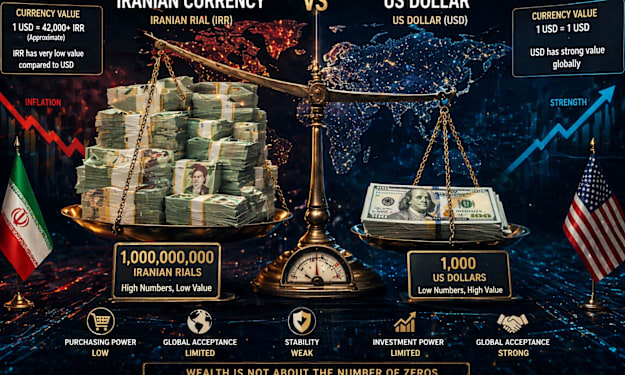
Iranian Currency vs US Dollar
Iranian Currency vs US Dollar The comparison between the Iranian Rial and the US Dollar presents one of the most striking examples of how currency value affects wealth perception. At first glance, earning millions or even billions in Iranian currency may appear to represent significant financial success. However, when compared with the US Dollar, the reality becomes very different. This comparative analysis examines whether becoming a millionaire in Iranian currency truly reflects financial wealth.
By Wings of Time 6 months ago in The Swamp
Talks in Islamabad: Can Pakistan Resolve the US-Iran Conflict? A World Holding Its Breath in the Beginning
Talks in Islamabad: Can Pakistan Resolve the US-Iran Conflict? A World Holding Its Breath in the Beginning In April 2026, the world witnessed a rare and historic diplomatic moment: high-level talks between the United States and Iran held in Islamabad, Pakistan. The Islamabad Talks, or these talks, were the first time the two countries had spoken directly to each other at such a high level in decades.
By Farida Kabir6 months ago in The Swamp
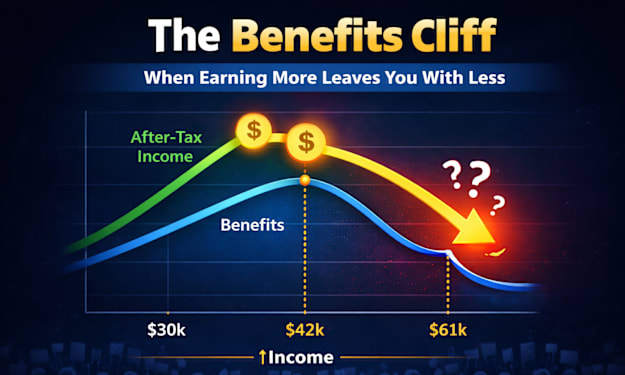
The "Benefits Cliff"
The System Is Not Cash, It Is Replacement For a family of five in Salem, Oregon, the low-income support system is not built primarily on direct cash transfers. It is built on a small number of high-impact programs that function as after-tax purchasing power, replacing major expenses rather than adding to pre-tax income. This distinction matters because it changes how the system must be evaluated. Income is taxed before it becomes usable, while benefits replace costs that would otherwise require after-tax dollars. That means these programs effectively operate as a parallel income structure, but one that is locked into specific categories such as food, housing, childcare, and healthcare rather than flexible cash.
By Peter Thwing - Host of the FST Podcast7 months ago in The Swamp