
Signed While Tariffs Stayed: The 20-Year China-U.S. LNG Deal, Explained Without the Hype
A 500,000-tonne annual contract, a 2.5 million-tonne total, and a 15% duty that never went away. Here is what the two companies actually agreed to.
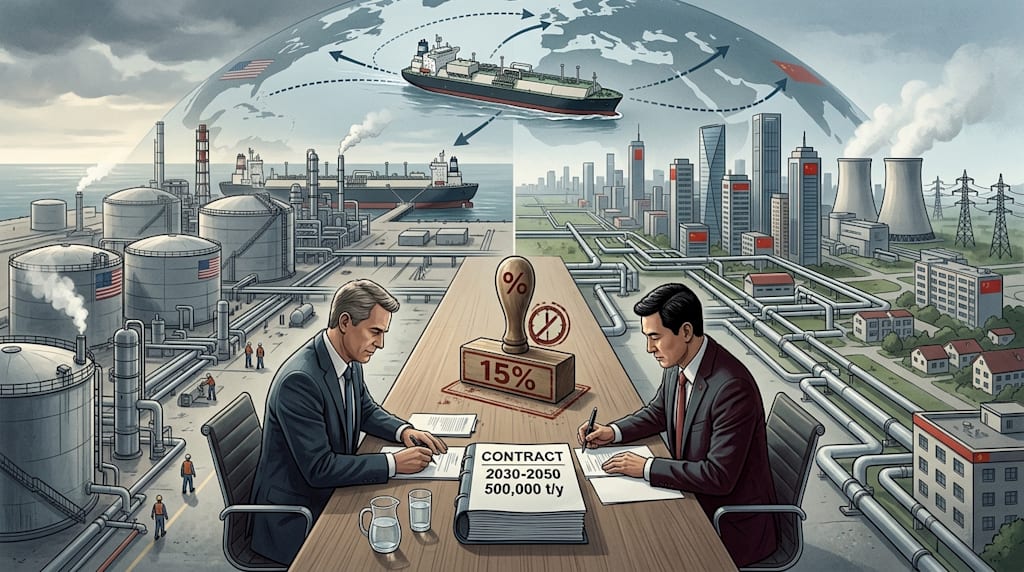
On September 14, 2026, Venture Global issued an announcement. The announcement confirmed that China Gas Holdings had signed a new liquefied natural gas sale and purchase agreement with Venture Global. Under the agreement, China Gas Holdings will purchase 500,000 tonnes of U.S. LNG per year beginning in 2030, for a term of 20 years. The same announcement stated that the new agreement brings the total long-term purchase arrangement between Venture Global and China Gas Holdings to 2.5 million tonnes per year, supplied from Venture Global’s project portfolio.
On the same day, Reuters reported another set of facts. China stopped importing U.S. LNG in March 2025, after tariff measures targeting U.S. energy products had taken effect. The report also noted that importers had redirected U.S.-origin cargoes to buyers in other regions. The 15% duty on U.S. LNG remained in place. A separate additional tariff suspension arrangement was also in effect.
Place these sentences side by side, and a question appears. The tariff is still there. Imports were stopped. So why can two companies still sign a contract that starts in 2030 and runs for another 20 years?
Political slogans do not answer that question. Contract terms and commercial calculations do.
The signatories are companies, not two countries
The signatories are Venture Global and China Gas Holdings. They are not the Chinese and U.S. governments. The announcement describes a sale and purchase agreement. It does not describe an intergovernmental energy agreement. To write it up as “China and the United States reached a new natural gas agreement” is to upgrade a corporate act into a state act. To write it up as “China-U.S. energy relations have fully thawed” is to read a contract as a diplomatic communiqué.
When companies sign contracts, they look at future supply and demand, price formulas, delivery methods, and financing conditions. When governments discuss tariffs, they look at trade deficits, industrial policy, and election cycles. The two timetables are different. A company can plan to 2050. A government often watches the next vote.
So the fact that this contract was signed does not mean tariffs will be canceled. The fact that tariffs are not canceled does not mean companies cannot find a way to do business.
500,000 tonnes and 2.5 million tonnes are not the same number
The announcement contains two numbers. The new contract is 500,000 tonnes per year. The combined long-term purchase arrangement between the two sides is 2.5 million tonnes per year. The 2.5 million tonnes figure is the total of existing cooperation plus the new contract. The new portion is only 500,000 tonnes.
Multiply 500,000 tonnes by 20 years, and you get 10 million tonnes of nominal contract volume. The multiplication is correct. But that number is not the volume arriving this year. It is not a total payment that has already been made. It is a possible scale of trade over the next two decades. It is an arrangement, not a cargo already loaded onto a ship.
The announcement did not disclose the price formula. So no one can calculate the total contract value. No one can conclude that a 20-year term has locked in a low price for two decades. A long-term contract establishes a cooperation framework. How much each cargo costs, how it is delivered, and who bears which changes depend on specific terms. To declare a sure profit just because the term is long is to read the contract as a wish list.
Delivery starts in 2030, and the price is not public
The contract begins delivery in 2030. That timing matters.
It means there are still about four years between signature and actual performance. In those four years, tariff schedules can change. Receiving terminals can be built. Shipping prices can rise. A U.S. election can change the administration. Chinese natural gas demand can rise or fall. Companies are making arrangements now. They will still face the market and policy conditions of the future.
The price formula has not been made public. In LNG long-term contracts, a common approach is to link the price to the Henry Hub benchmark and add a fixed liquefaction fee. But that is industry practice, not a disclosure in this contract. Without the formula, the cost cannot be calculated. Without the cost, it is impossible to judge whether the deal makes financial sense.
The announcement also states that the new agreement brings the two sides’ total long-term purchase arrangement to 2.5 million tonnes per year. Within that total, how much is free on board, or FOB, and how much is delivered ex ship, or DES, the announcement does not say. FOB and DES assign different rights. Under FOB, the buyer takes the cargo at the loading port and can decide the destination. Under DES, the seller is responsible for delivering the cargo to a designated port. The destination rights differ. The party bearing tariff costs differs. The flexibility for resale differs.
The buyer's goal
China Gas Holdings emphasized in the announcement its resource portfolio and its international energy trading platform.
The company wants another source, another channel, and another option that can be allocated in the global market. The natural gas market is not a vegetable market where a shortage today can be filled tomorrow. LNG involves liquefaction plants, LNG carriers, receiving terminals, long-term agreements, destination clauses, and price formulas. If a company relies on a single source, it becomes vulnerable to price swings, route changes, and policy adjustments.
Signing another long-term contract is like placing an additional piece on the supply board for years to come. That piece is not free. A long-term contract reduces some uncertainty. It can also commit the company to longer obligations. If future sales fall short of expectations, or if cheaper supply appears on the market, the original arrangement will need to be recalculated.
So “supply security” and “always cheap” are two different things. A long-term contract can increase a sense of security. It does not lock in the best possible price.
The seller's goal
For Venture Global, the meaning of this contract is more direct: long-term sales expectations.
LNG projects are heavy assets. Building liquefaction plants, buying equipment, laying pipelines, and arranging transportation can cost billions or tens of billions of dollars. What banks and investors fear most is not a temporary high or low price. They fear whether there will be stable buyers in the future. A 20-year sale and purchase agreement is a long-term meal ticket that can be shown to financial markets.
The seller is willing to sign under the shadow of tariffs. It does not ignore politics. It needs a basis for production and investment planning. A 20-year contract gives the buyer a resource, the seller credit, and the project a stronger case for financing.
Corporate contracts often pass through political noise. Politicians look at the next election. Companies look at the next decade.
Tariffs cannot be avoided, but cargoes can be resold
The tariff issue cannot be avoided.
Reuters reported that China stopped importing U.S. LNG in March 2025. Before that, tariff measures targeting U.S. energy products had already taken effect. The report also noted that importers had redirected U.S.-origin cargoes to buyers in other regions.
This reveals a distinction that is easy to overlook. A Chinese company purchasing U.S. resources and those resources all ultimately arriving in China are two different things.
In international LNG trade, cargoes can be resold, transferred, and redirected. A Chinese company can take delivery at a U.S. port and then sell the cargo to Europe, Asia, or another region depending on market conditions. As long as the contract terms allow it, the resource does not necessarily have to be shipped back to China. In that way, the tariff impact is not a single, uniform blow.
However, terms cannot be added on behalf of the two sides. The public announcement did not disclose the destination restrictions or related rights in this new contract. The fact that importers have adjusted cargo flows in the past does not mean this contract can be freely resold. Seeing the buyer’s nationality does not mean seeing the final destination.
25% is not the whole story
The statement that “China-U.S. tariffs remain at 25%” is too broad.
Reuters reported that the 15% duty on U.S. LNG remains in place, while a separate additional tariff suspension arrangement is also in effect. One number cannot summarize all goods, all tax items, and the next 20 years.
The questions are: when will the cargo be delivered, which market will it enter, which taxes and fees will apply, and under which terms will additional costs be borne? These conditions have not been fully disclosed. So at this point, one cannot say the company is completely unaffected by tariffs. One also cannot conclude that it is knowingly buying at a loss.
Delivery beginning in 2030 means there is still time between signature and actual performance. The contract will not cancel tariffs. The existence of tariffs does not automatically prove that all long-term transactions lack commercial rationale.
A long-term contract is not a wish list
A 20-year contract can easily create an illusion: the next two decades are settled.
A long-term contract writes part of the uncertainty into the terms. It leaves another part for the future. It may specify volume, term, delivery method, and price formula. It cannot specify the political conditions 20 years from now, the path of technology, climate change, the global economic cycle, or every buyer’s choice tomorrow.
For China Gas Holdings, signing this contract means it will bear corresponding purchase obligations in the future. For Venture Global, signing this contract means it will need to guarantee corresponding supply capacity in the future. Both sides get something they want. Both give up part of their flexibility.
The quality of this contract cannot be judged only by the smiles at the signing ceremony. It depends on how delivery conditions are disclosed, how resources are ultimately allocated, and whether the costs can still be calculated when performance begins.
What to watch next
The more informative questions after “signed” are three.
First, will delivery conditions be disclosed further? FOB or DES, what destination restrictions apply, and how are resale rights defined? These terms determine who bears the tariff cost and whether cargoes can be flexibly allocated.
Second, where will these resources ultimately flow? Will they be shipped to China, or sold to Europe, Asia, or other markets? Different flows have different effects on the China-U.S. trade ledger and on the global LNG spot market.
Third, when 2030 arrives, will the numbers still add up? Tariff schedules, receiving terminal capacity, Henry Hub prices, shipping costs, and Chinese natural gas demand will all be back on the table.
What can be confirmed now is narrow. The contract has been signed. The terms have not been fully disclosed. Two companies are willing to reserve a position for supply and purchase after 2030.
The contract does not prove that relations have fully warmed. It does not prove that all long-term transactions lack commercial rationale. It shows something narrower. Even with tariffs still in place, imports having been stopped, and friction unresolved, companies can still find a length of overlap.
When the first 500,000 tonnes is loaded in 2030, people will pull out this announcement again. They will compare it with the tariff schedule and price formula of that day. Only then will the answer be known: whether the contract made money or lost it.
About the Creator
Jin
Writer of reamstories
https://reamstories.com/jin
Enjoyed the story? Support the Creator.
Subscribe for free to receive all their stories in your feed. You could also become a paid subscriber, letting them know you appreciate their work.
Comments
There are no comments for this story
Be the first to respond and start the conversation.