
Jeff Bezos is right
We SHOULD lower income taxes for the poor... but we should also increase his.

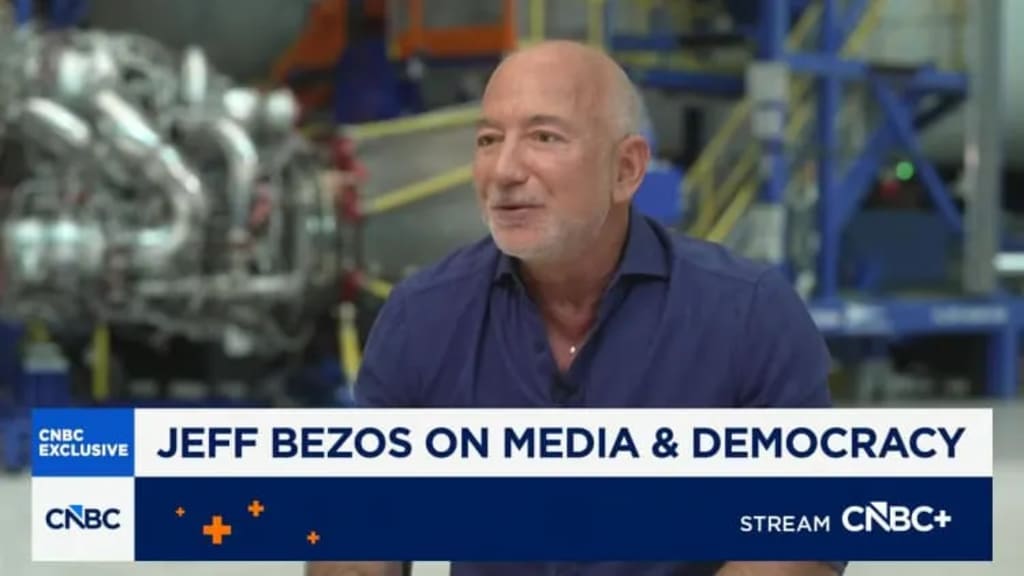
Jeff recently crawled out of the depths of hell once again, to do a press junket, probably to remind people that he runs a space program as well, in the form of Blue Origin. Bezos said a lot in that interview, but the thing that actually got people talking is when he stated that a nurse in Queens making $75,000 a year, shouldn't be paying taxes, and that what they need is a tax cut and "an apology" from the government.
I agree, she shouldn't be paying the taxes they currently do. But that's not the reason why Bezos said what he did. He's not genuinely saying that we should cut taxes on the poor and increase them on people like him, he's doing exactly what the right accused the left of doing many years ago, but didn't actually know what the phrase mean't. He's virtue signalling, so what is virtue signalling before this becomes a tangent?
Virtual Signalling is when someone makes a statement that is popular in often in order to gain or repair their social reputation or sometimes, for monetary gain (also called grifting). Much more specifically, what Bezos is doing is Rhetorical Deflection, He is saying something that many people agree with in hopes that they either argue about it, rather than argue about the $250 Billion that he's sitting on. Put yourself in his shoes, if you can see that Progressive Democrats are winning primaries across the country, and you know that the man you poured support into, Donald Trump is becoming catastrophically unpopular. You know that your taxes are gonna go up soon.
So you do a press junket and say something in the affirmative of progressive values in order to cause a debate, separate from the debate that you don't want the public to be having. So you say something vaguely progressive, to deflect from the progressive thing that was actually scaring you, which is higher taxes on people like you.
The Tax Question
So what does it actually mean to reduce/abolish taxes on those under $100,000 per year. Basically it would mean the abolition of the 10% on incomes between $0 to $12,400, the 12% on $12,401 to $50,400 and the 22% on $50,401 to $105,700, quick aside, speaking as a European, the fact that you don't have a tax allowance is absolutely nuts. A tax allowance is a fixed amount you can make as income where you pay zero tax on it for a fixed period, often a year or a financial year starting when you started making said income.
If you abolish those bands, the US Federal Government loses at least $1.1 Trillion of Income Tax Revenue, nearly half of all Income tax revenue. For sure, GDP would likely skyrocket for the first month or three, but the cost of having done that would likely become very obvious very quickly. As services would likely get cut in the process, meaning that lines at the DMV would get longer, welfare would become virtually non-existent, and debt would skyrocket for the Government, because they'd lose their counter-weight for military spending resulting in greater borrowing. Which on a macro level would result in increased interest rates at the fed, so you'd have a GDP jump and then crash a few months later as money dries up again for most households.
The Progressive counter-argument would be to increase the top rates of income tax, but optics wise, I don't think that's a great idea. You've basically shifted the tax burden from nurses to doctors, and also its mathematically impossible to do it without proving the Laffer curve correct. If you shifted the tax percentages from the lower brackets to the upper brackets, in order to make up for the $1.1-1.4 Trillion short fall, you'd have to increase the remaining 3 brackets until they had a cumulative rate of over 90% to 105%. This is where you get into the Laffer curve.
The Laffer Curve
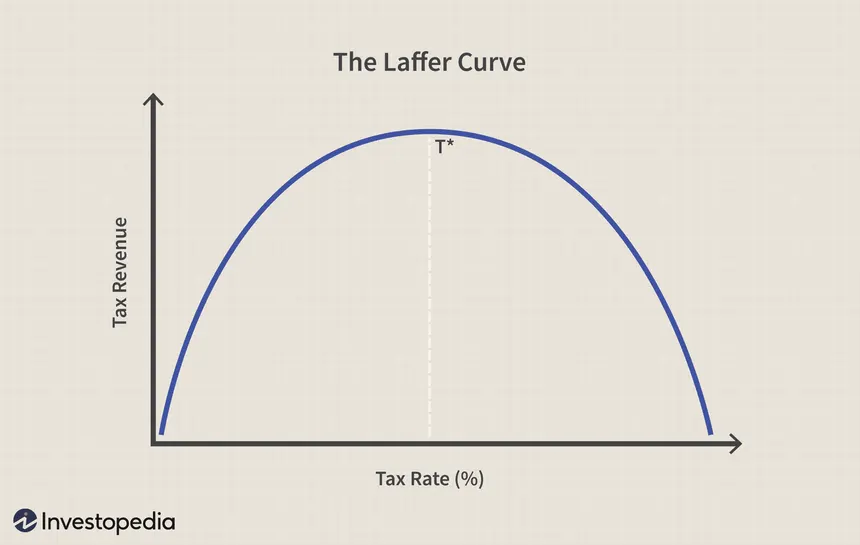
The Laffer Curve, coined by Arthur Laffer basically states that if the tax rate is 0% the government collects $0, makes sense, but if the tax rate is 100%, the government still only collects $0 because the incentive to work or report income drops off a a cliff. This is also partially why, even though I'm a socialist, I'm not particularly gun-ho about increasing income taxes because there is a optimal top rate of income tax that collects a decent chunk of change for government spending, but if you go past that you collect nothing and end up spending more to keep up with the drop in incentive to work.
Thus if you want to collect money for massive investments in the economy, you are better to take it from unrealized gains rather than from salary.
If you wanted to take Bezos at his word, and wanted to assume that he mean't increase his taxes and reduce everyone elses, then you could do that through wealth taxes, land value taxes (with agrarian exceptions), inheritance taxes, taxes on on equity-secured loans past a certain value, etc. Then that is a more doable solution, because you have the remember that in the mind of an economist, taxes serve two purposes;
- They raise revenue for spending
- They change economic behaviour
Wealth taxes aren't punitive-first, they don't just slap the wrist of the wealthy and take the money for government spending, they force the rich to re-consider which assets are better to buy into. If they know that the more they hold in hard assets like housing, etc the less likely they are to buy up new housing stock, and thus the cheaper housing will be in the long run (in a vaccuum).
Land Value taxes would also likely bring down the cost of housing through a process called de-commodification. This is when a asset or commodity becomes normalised to the point of being affordable for most people, it doesn't just refer to a asset becoming cheaper, but also free to most people. Because the asset is now characterised as a necessity, not just a aspirational want.
So should we abolish taxes on poorer people?
The Short answer is No, but we should absolutely lower them considerably. Based on current projections from various forms of wealth taxes, its unlikely that we'd ever be able to fill the hole from complete abolition of the lower brackets, but we could definitely fill the hole from a decent tax cut on the lowest income earners.
I did some back of an envelope maths, and basically, the United States could afford to;
- Cut bottom rate taxes by half, and even abolish the lowest rate turning the 10% rate into a de facto tax allowance, if you factor in the standard deduction, this meaning that the first $26,000 (or so) an American makes is practically invisible to the IRS
- Add a modest 2 points to the top rates of income tax, this would boost government revenue by around $50-60 billion per year.
- Create a fair Land Value tax of around 1% that is based on location value and not acreage (thus farmers will rarely pay anything) will bring in around $200 Billion. This does include an exception for primary residences meaning that you will not pay anything on your home, you may on any additional homes that are "prime real estate".
- Match Capital Gains to meet that of the top rate of income tax would likely increase revenue by $50 billion. Reduces Day-Trading but doesn't harm long-term trading via pension funds.
- Create a Financial Transactions tax of 0.05% which would raise around $35-40 Billion per year, FTT's only tax high value trades (0.05% for every $1,000 traded).
So to break it down, the tax gains amount to around $390 Billion, which would happily pay for a new income bracket that looks something like this;
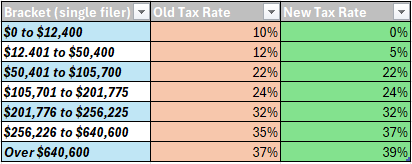
Under the new rate, a worker making around $50,000 per year would be around $300 a month better off, or around $3600 better off a year. And a retail worker making around $30,000 a year would save approximately $200 a month, or $2,450 a year. There is also a secondary benefit that housing would become cheaper, because as people start to realise the cost from the LVT of hoarding a bunch of housing, they'll sell the house and give preferential treatment to those with no prior assets.
New housing and accomodation's would likely start off in the market with a much more realistic value, and would see a modest climb in value, but no where near the astronomical values seen since 2008, and in hindsight, probably for the best... for everyone.
In conclusion,
Bezos may have been trying to signal the conversation away from wealth taxes, but he has infact brought more eyes on to the conversation he didn't want to have. Ironically, I agree with the sentiment of what he was saying, just not the intent, and i'm fairly certain with the way that the Democratic party is going at a grassroots level, any attempt to dissuade from wealth taxes in whatever form they'll end up taking will be completely fruitless, at least for Bezos and the only people who will benefit are basically everyone that isn't sitting on a $250 Billion net worth.
About the Creator
Ashyr H.
My name is Ash, I'm a 3rd year Business Economics student mainly specialising in Alternative Business structures like Co-operatives and Accessibility. I mainly write about Business, Politics, Sociology and some personal stuff.
They/them
Enjoyed the story? Support the Creator.
Subscribe for free to receive all their stories in your feed. You could also become a paid subscriber, letting them know you appreciate their work.
Comments
There are no comments for this story
Be the first to respond and start the conversation.