
Is Taiwan Becoming a Bargaining Chip in Trump’s Deal With Xi?
A delayed $14 billion arms package raises a bigger question about how far Washington is willing to trade Taiwan policy for a deal with Beijing.
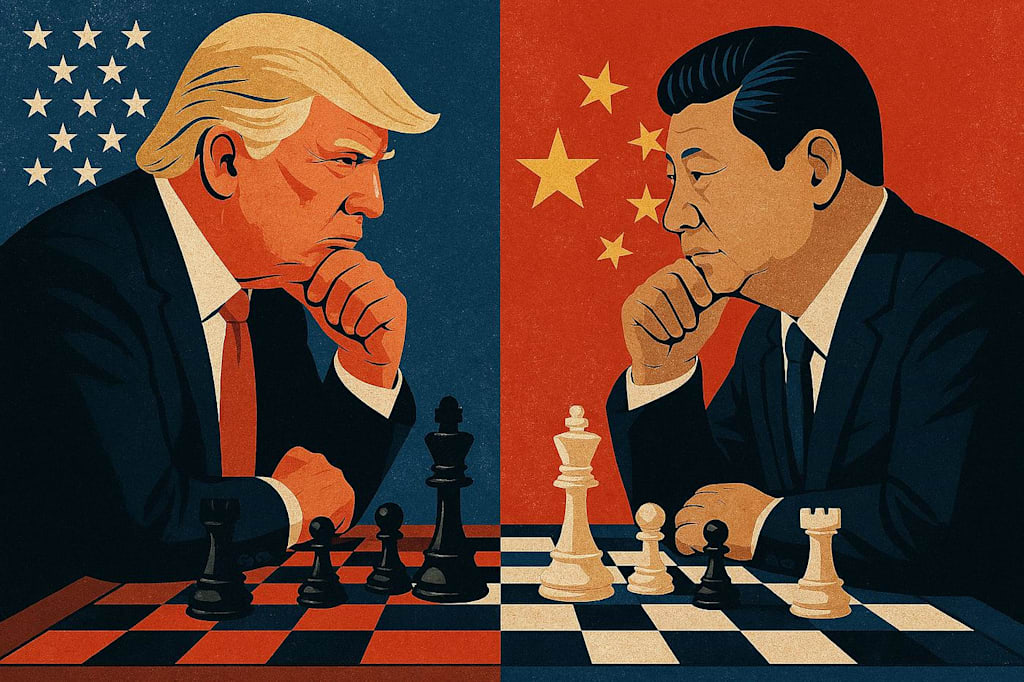
Will Taiwan Be on the Menu When Xi Visits the White House?
When Chinese President Xi Jinping arrives in Washington later this month, the ceremony will probably look very different from the arguments taking place behind closed doors.
Donald Trump is scheduled to host Xi at the White House on September 24, 2026, in their second summit of the year. The meeting is expected to cover trade, technology, artificial intelligence, critical minerals and Taiwan. The United States is looking for economic gains from Beijing, including purchases of American agricultural products and aircraft. China wants relief from some U.S. technology restrictions and greater stability in its access to overseas markets. Taiwan sits in the middle of several of these disputes.
That is why a pending U.S. arms package for Taiwan has attracted so much attention.
The package, reported to be worth up to $14 billion, has been waiting for Trump's approval for months. After meeting Xi in Beijing in May, Trump said he was holding the deal back and called it a "very good negotiating chip." The description matters because it places Taiwan's defense procurement inside a broader bargaining process with China rather than treating it solely as a defense-policy decision.
That does not mean Washington has agreed to trade Taiwan away.
It does mean that Taiwan has entered the bargaining mechanics of U.S.-China relations more directly than it did under previous administrations.
The distinction is important.
Taiwan has long been a Chinese red line. The novelty is the bargaining mechanism.
Beijing's opposition to U.S. arms sales to Taiwan is not new. China has consistently treated Taiwan as a core sovereignty issue and has objected to American military support for the island.
What has changed is the way the issue is being handled.
Under a traditional national-security framework, an arms sale would be considered mainly through questions of military need, deterrence, defense planning and U.S. policy toward Taiwan. Under a transaction-driven approach, the same decision can be connected to unrelated subjects.
Trade concessions can be discussed alongside technology restrictions.
Rare earth exports can be discussed alongside tariffs.
Boeing aircraft purchases can sit alongside agricultural imports.
And a Taiwan arms package can become another bargaining item.
That approach is closely associated with Trump's style of diplomacy. It does not necessarily mean that every foreign-policy issue has a fixed price. It means that the administration is more willing than many previous governments to connect issues that had usually been handled separately.
That creates a difficult problem for Taiwan.
A weapons sale is no longer only a weapons sale if the president of the United States publicly describes it as a negotiating chip.
The decision can affect Beijing's calculations, Taipei's confidence, American defense companies, congressional politics and the expectations of other U.S. partners in Asia.
The $14 billion figure therefore matters less as a dollar amount than as a test of how Washington now handles competing interests.
Beijing is asking for more than a delay in weapons sales
The arms package is only one part of the dispute.
Reuters has reported that people familiar with China's efforts say Beijing also wants Trump to use language explicitly stating that the United States opposes Taiwan independence, rather than the formulation Washington has traditionally used, that it does not support Taiwan independence.
Those phrases are not interchangeable in the eyes of Beijing, Taipei or Washington.
Diplomatic language becomes policy signaling when it is repeated by a president.
If Trump were to adopt Beijing's preferred wording, the immediate legal effect might be limited. But the political signal would be different. Taiwan would hear a harder warning against moves toward formal independence. Beijing could present the statement as evidence that Washington's position is moving closer to China's demands. Other Asian governments would also study the change because they need to understand how much room Washington is leaving for future crises.
This is why language can matter even when no treaty is signed.
A statement costs Washington little in financial terms. Its strategic consequences can be much larger.
For Beijing, that makes presidential rhetoric an attractive target.
The same is true of military sales. Delaying a package for a few months is easier for an American president than permanently abandoning arms transfers. The policy can later be reversed. That flexibility makes delay useful in a negotiation.
But flexibility cuts both ways.
If Beijing learns that pressure before a summit can delay American arms sales, it has an incentive to repeat the tactic. Washington therefore has to think about the precedent created by each concession, not just the immediate payoff.
That is where the bargaining becomes difficult.
Trump has room to maneuver, but he does not control every part of Taiwan policy
It would be easy to look at Trump's negotiating style and assume that Taiwan is simply another item on a balance sheet.
The U.S. system is more complicated.
The Taiwan Relations Act remains an important part of America's legal framework. It states that the United States should make available defense articles and defense services in quantities necessary for Taiwan to maintain sufficient self-defense capability, and it establishes U.S. policy to maintain the capacity to resist coercion that would threaten the security or social or economic system of the people on Taiwan.
That does not amount to a treaty commitment to defend Taiwan in every circumstance. The United States continues to maintain a policy of strategic ambiguity over the exact conditions under which it would intervene militarily.
But the law does put constraints around the president's freedom of action.
Congress has its own interests. Defense contractors have contracts, production schedules and investment plans. The Pentagon has operational requirements. Japan, the Philippines, Australia and other partners in the region watch American behavior because their own security planning is partly based on expectations about U.S. involvement.
A president can delay a sale.
Changing the entire U.S. policy toward Taiwan is a much larger task.
This is also why a delay should not automatically be interpreted as a strategic surrender. Equally, the eventual approval of a weapons package should not automatically be read as proof that the United States has rejected bargaining with Beijing.
The two things can happen at the same time.
Washington can support Taiwan's military capabilities and still use individual arms sales as negotiating tools.
That contradiction is likely to remain.
Taiwan's own defense policy is now part of the story
There is another factor that receives less attention when the debate is reduced to Trump and Xi.
Taiwan itself has to decide how much it is willing and able to spend on defense.
In May, Taiwan's opposition-controlled legislature approved T$780 billion, roughly $24.9 billion, in supplementary defense spending. The government had asked for T$1.25 trillion. The final amount was therefore about two-thirds of the government's request. Reuters reported that the proposed package included U.S. weapons as well as domestically produced systems such as drones. The opposition argued that the government's plan lacked sufficient clarity and could create corruption risks.
That dispute matters in Washington.
American policymakers have repeatedly encouraged Taiwan to spend more and to build military capabilities that can survive a Chinese attack. The question is not simply how much Taiwan spends, but what the money buys and how quickly those capabilities can be fielded.
A large headline number is not the same as military readiness.
A defense budget has to cover ammunition, maintenance, logistics, communications, training, bases, command systems and the ability to replace equipment after the first days of a conflict. Weapons that arrive years after they are ordered do not solve an immediate readiness problem.
The same principle applies to U.S. arms sales.
A $14 billion announcement would be politically important, but the military effect would depend on what is included, when the systems arrive and whether Taiwan has the infrastructure and personnel needed to operate them.
That gives Taipei a difficult position.
It needs American weapons, but it also needs to demonstrate that it can build and maintain enough of its own capacity that U.S. support is not the only pillar of its defense.
The relationship becomes more credible when the two sides are doing both.
The semiconductor question makes Taiwan harder to treat as a simple bargaining chip
Taiwan also has an economic value that goes far beyond the Taiwan Strait itself.
The island remains a central part of the global advanced semiconductor supply chain. Its importance to the United States is therefore partly military and partly industrial.
This creates another limit on any purely transactional approach.
Washington can pressure Taipei.
Washington can negotiate arms sales.
Washington can ask Taiwan to spend more on defense.
But the United States also has a strong interest in maintaining a stable, functioning Taiwanese economy and semiconductor industry.
The shift of semiconductor production toward the United States and other locations is already reducing some supply-chain concentration. It does not erase Taiwan's importance overnight. Chip manufacturing depends on equipment suppliers, specialized engineers, materials, process knowledge, customer qualification and years of production experience. Moving individual factories is much easier than recreating an entire industrial network.
That creates an unusual form of strategic dependence.
The United States wants greater control over semiconductor supply chains while also wanting to avoid a military crisis that could destroy or disrupt a major source of advanced chip production.
China has its own reasons for wanting to prevent a deeper American military relationship with Taiwan.
Taiwan therefore sits where security policy and industrial policy meet.
That makes the island harder to reduce to a single bargaining item.
Beijing has leverage, but leverage has a price
China enters these negotiations with its own sources of influence.
Beijing can affect access to rare earths and other critical minerals. China is a huge market for American companies. It can increase or reduce purchases of U.S. products. It also has bargaining power in areas connected to trade and supply chains.
Washington has different forms of leverage, particularly in technology, finance and access to American markets.
Neither side controls the other.
That matters because negotiation only works when both sides have something the other side wants.
The Taiwan issue therefore cannot be understood separately from the broader U.S.-China bargaining process.
Trump wants deals that can be presented as concrete results. Reuters has reported that agricultural purchases, Boeing aircraft and other commercial commitments are part of the economic discussions surrounding the summit. Beijing is seeking relief from technology-related restrictions and a more stable economic relationship.
Each side has something to offer.
Each side also has something it cannot easily surrender.
For China, Taiwan is tied to sovereignty and national identity.
For the United States, Taiwan is tied to law, regional security, technology, defense planning and the credibility of commitments to Asian partners.
That makes a clean trade much harder than the phrase "negotiating chip" suggests.
The biggest risk may be a change in expectations
The most important consequence of the summit may not be whatever is announced on September 24.
It may be what governments believe will happen next time.
Suppose the United States delays an arms sale before the summit and approves it shortly afterward. The immediate effect is limited. The episode could simply become another example of short-term bargaining.
A different pattern would be more consequential.
If repeated Chinese pressure consistently produces delays, smaller packages or changes in American language, Beijing would have evidence that the tactic works. Taiwan would have to assume that future arms decisions could also be affected by unrelated U.S.-China negotiations. American allies would have to consider whether their own security issues might someday become part of a similar bargain.
That changes behavior even without a formal agreement.
Foreign policy is partly about what governments expect other governments to do. Once expectations move, military planning and economic decisions move with them.
For Taiwan, that is the deeper concern.
It is not simply whether one shipment of weapons is approved.
It is whether the political market value of American security commitments is changing.
What to watch after the White House dinner
The first signal will be the $14 billion arms package.
Approval before the summit would show that Beijing has not managed to block the deal during the immediate pre-summit period. Continued delay would show that Trump still wants to keep the issue available for bargaining. A change in the size or composition of the package would provide more information than a simple yes or no.
The second signal will be Trump's language on Taiwan.
A shift from the long-standing wording toward an explicit statement opposing Taiwan independence would carry political weight even without creating a new treaty or law.
The third signal will come after the summit.
What happens to the arms package in October, November and beyond may tell investors and governments more than what happens during the ceremony itself.
The fourth signal is Taiwan's own defense spending.
Washington has an interest in seeing Taipei spend enough to make U.S. support useful. Taipei has an interest in avoiding a situation in which its security depends almost entirely on decisions made in Washington.
The fifth is the broader U.S.-China deal.
If trade, technology, rare earths and Taiwan begin to appear repeatedly as parts of the same negotiation, that would indicate that the transaction-based approach is becoming normal rather than exceptional.
Taiwan is already at the table, but the terms are not settled
The image of Taiwan being placed on a White House "menu" works because it captures a genuine fear.
But it also risks making the situation sound simpler than it is.
There is no public evidence that Washington and Beijing have reached a secret bargain under which Taiwan's security has been exchanged for economic concessions.
There is, however, clear evidence that Taiwan-related arms sales are being treated as part of a wider negotiation. Trump has said so himself, and Beijing is pressing Washington on both weapons and the language it uses to describe Taiwan.
That is the important change.
Taiwan has always been part of the U.S.-China relationship. What is changing is the number of other issues being placed next to it.
The old framework separated trade from security as much as possible.
The new approach is more willing to connect them.
That creates opportunities for deals. It also creates uncertainty.
A temporary arms delay can be reversed. A presidential statement can be revised. A tariff agreement can expire. A promise about mineral exports can be broken or renegotiated.
But once governments begin to expect that Taiwan policy can be used in this way, every future negotiation starts from a different baseline.
That is why September 24 matters.
Not because one dinner will decide Taiwan's future, and not because a single arms package can settle the balance of power across the Taiwan Strait.
It matters because the meeting may offer an early indication of how much security policy Trump is willing to fold into the broader bargain with Beijing.
Taiwan will not be absent from the table.
The question is how much room is left around it.
About the Creator
Jin
Writer of reamstories
https://reamstories.com/jin
Enjoyed the story? Support the Creator.
Subscribe for free to receive all their stories in your feed. You could also become a paid subscriber, letting them know you appreciate their work.
Comments
There are no comments for this story
Be the first to respond and start the conversation.