
Blood for Oil, Soldiers for Russia: Why North Korea Is Sending Its Men Into Putin’s War
The battlefield in Kursk has given Pyongyang something it could not buy at home: money, military experience, fuel, and a closer strategic relationship with Moscow. Now Ukraine is warning that thousands more North Korean troops could be on the way.
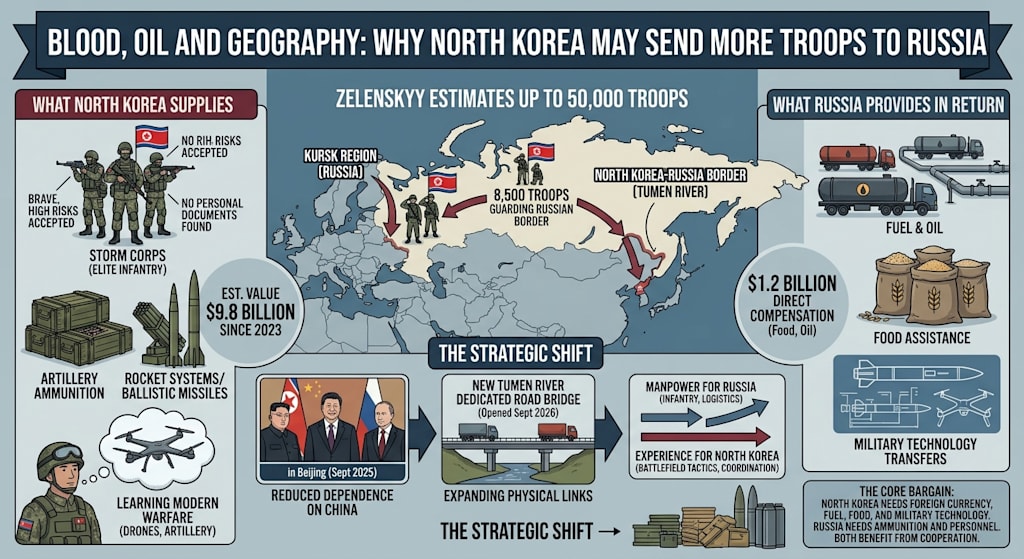
Ukrainian President Volodymyr Zelenskyy says Russia could receive as many as 50,000 North Korean troops, revising his earlier estimate of 30,000. The figure has not been independently confirmed. Reuters reported that Zelenskyy did not publicly explain the basis for the new estimate.
Ukraine's military intelligence agency says about 8,500 North Korean servicemen remain in Russia. It says they are organized into four brigades within Russia's "North" group of forces and are being used to protect the Russian border in Kursk against possible Ukrainian incursions. The agency says they are not currently taking part in combat operations and have not been observed in Russian-occupied Ukrainian territory.
That is a very different role from the one North Korean troops played in late 2024.
13,000 troops, and little else in their pockets
North Korea sent its first large contingent to Russia in late 2024. The troops fought alongside Russian forces during the campaign to drive Ukrainian forces out of Kursk.
It was the largest overseas combat deployment in North Korean history.
Earlier deployments were much smaller. North Korea sent roughly 1,500 military personnel and instructors to Egypt during the 1973 Yom Kippur War. In the late 1960s, an estimated 87 North Korean pilots served in North Vietnam. The Kursk deployment was on a different scale.
Estimates of the original force vary, but Ukrainian officials put it at about 13,000 personnel. Ukraine's intelligence service has estimated roughly 3,000 killed and 1,500 wounded. A BBC Korean investigation using photographs and satellite imagery of a North Korean memorial estimated about 2,300 deaths. North Korea has not published an official casualty figure.
Yang Uk of the Asan Institute for Policy Studies said the troops came largely from the Storm Corps, an elite North Korean formation.
The first reports of North Korean troops in Kursk were treated cautiously because Moscow and Pyongyang did not initially acknowledge the deployment. Ukrainian forces first encountered them in combat in November 2024. Two North Korean soldiers were later captured alive.
Russia did not officially acknowledge their participation until April 2025, when General Valery Gerasimov praised the North Korean troops for their role in the Kursk operation.
A Ukrainian soldier from the 95th Air Assault Brigade, using the callsign Sultan, fought them during the campaign.
"They would first send a large assault group, then send another 15 to 20 people to the same position, and then send even more. The North Koreans fought differently. They kept moving. That gave them some advantages, but not decisive ones."
Sultan said communication between North Korean and Russian units often appeared poor. Ukrainian soldiers also described North Korean troops as badly equipped, particularly in body armor, winter clothing and helmets.
The most striking difference appeared after the fighting.
Ukrainian soldiers searched Russian bodies for identification papers and personal equipment. The North Koreans were different, according to Sultan.
"But when we specifically searched the North Koreans, all we found was ammunition. We checked every small pocket. There were no documents, nothing."
Yang Uk said the troops were willing to accept very high risks but initially lacked experience in modern drone warfare.
"North Korean soldiers are extremely courageous, especially those from the Storm Corps. They are willing to die for their country. But the problem is that enthusiasm does not equal effective combat capability... Early in the Kursk campaign, they suffered enormous casualties, but they learned from modern drone warfare."
Their tactics changed. They adapted to the presence of drones and became more effective during the later stages of the fighting. Russia subsequently announced that Ukrainian forces had been expelled from Kursk, although Kyiv disputed Moscow's account at the time.
The North Korean contingent then largely disappeared from public reporting.
It did not disappear from the Russian military system.
What Pyongyang got in return
North Korea has paid a substantial price in manpower, but the relationship with Russia has also produced economic and military benefits.
A September 2025 report commissioned by the Korea Office of the Friedrich Naumann Foundation estimated that North Korea had supplied Russia with weapons and troops worth as much as $9.8 billion since 2023. The same report estimated direct compensation from Russia at no more than about $1.2 billion, mainly in food, oil and military assistance.
That distinction matters.
The $10 billion figure is not the amount of cash deposited into Pyongyang's accounts. It is an estimate of the value of military supplies and manpower provided under the relationship.
North Korea has received food, fuel and military assistance from Russia. South Korean and Western assessments have also linked the relationship to transfers of military technology and operational knowledge.
The military experience may be at least as important as the economic return.
North Korean troops have now seen how drones are used against exposed infantry, how assault units move under persistent surveillance, and how Russian forces combine artillery, drones and infantry operations.
That experience has a direct value for Pyongyang.
The relationship with China has changed
North Korea's relationship with Russia has also altered its position between its two larger neighbors.
For decades, China was Pyongyang's most important economic partner and external lifeline. Russia is now providing North Korea with another source of food, energy, military support and diplomatic backing.
Kim Jong Un appeared alongside Xi Jinping and Vladimir Putin in Beijing in September 2025, when the three leaders attended events surrounding China's military parade. The appearance did not turn North Korea into an equal power alongside China and Russia, but it demonstrated that Pyongyang now has more than one major external partner.
North Korea's strategic outlook has changed with that relationship.
At the Ninth Congress of the Workers' Party of Korea in February 2026, Kim used the country's growing military cooperation with Russia as part of a broader foreign-policy direction. South Korean analysts have described the period since the congress as a new phase in the Kim Jong Un government's external strategy.
Yang Uk's point is simpler: North Korea now has direct experience of a modern war.
"North Koreans now know what modern combat looks like."
That knowledge is difficult to obtain through military exercises alone.
Russia needs manpower
Russia's problem is manpower.
Four years after the full-scale invasion of Ukraine, Moscow continues to sustain a large military force while absorbing heavy casualties. North Korean troops offer one way to add personnel without another large-scale mobilization of Russian citizens.
The value is not limited to infantry.
North Korean personnel can guard border areas, build defensive positions, clear mines and perform other tasks that release Russian troops for combat elsewhere. North Korea is also supplying artillery ammunition, rocket systems and ballistic missiles, according to Ukrainian and other Western assessments.
The arrangement therefore gives Moscow two things at once: ammunition and manpower.
The cost is coordination.
Russian and North Korean forces do not share a language or military culture. The North Korean units arrived with limited experience of drone-heavy battlefield conditions. Their early losses showed what can happen when an outside force enters a war without the same operational experience as the army it is supporting.
Those problems did not prevent the deployment from producing results. They did mean that Russia had to absorb the cost of integrating a foreign force.
Why the number could reach 50,000
Zelenskyy's latest warning is therefore about more than replacing casualties.
He said in August that 30,000 to 50,000 North Koreans could be deployed on Russian territory and again asked South Korea to provide air-defense support. Ukraine has also said that a North Korean missile unit is deploying in western Russia. Reuters reported that Kyiv's military intelligence believed the unit could eventually operate with up to 120 ballistic missiles and six launchers.
The 50,000 figure should not be treated as a confirmed order of battle.
What is established is narrower. Ukraine says about 8,500 North Korean personnel remain in Russia. South Korean officials said in late August that preparations for another deployment were continuing, but they did not see evidence that a new deployment was imminent at that time. On September 9, Reuters reported that Western and South Korean officials estimated North Korea had sent roughly 14,000 to 15,000 troops since late 2024, while North Korea was still preparing for possible additional deployments.
That leaves a large gap between confirmed deployments and Zelenskyy's upper estimate.
The gap matters.
A force of several thousand can reinforce border security and selected military tasks. A force approaching 50,000 would represent a much larger North Korean commitment and would give Moscow considerably more manpower for a prolonged war.
There is no public evidence yet that such a force has actually arrived.
Two prisoners
Only two North Korean soldiers are known to have been captured alive by Ukrainian forces during the Kursk fighting.
That number is unusually low relative to the size of the deployment. South Korean lawmakers have cited reports that wounded North Korean soldiers sometimes killed themselves rather than risk capture. One captured soldier told a Korean broadcaster that becoming a prisoner was viewed as unacceptable.
"For a North Korean soldier, becoming a prisoner of war is itself a crime. It is not an option. We cannot become prisoners."
Another captured soldier, Ri Kang-on, said he had been badly wounded in the arm and jaw.
"I had no grenade or knife with me to kill myself."
The details matter because they show how the North Korean military's political culture affected battlefield behavior.
One wounded soldier remained on the battlefield for days before being captured. Another said he feared that his family would suffer because of his capture.
The two men said they did not want to return to North Korea and expressed a desire to go to South Korea. Ukraine said it would follow its obligations under international law and would not forcibly return prisoners.
The cases also created a diplomatic problem for Seoul.
South Korea has supported Ukraine but has largely restricted its assistance to non-lethal aid. Kyiv wants more, especially air-defense equipment. The fate of the two prisoners therefore became entangled with a broader debate over how far Seoul should go in responding to North Korea's military support for Russia.
The risk of moving beyond Kursk
The clearest boundary so far is geography.
North Korean troops have fought Russian forces' enemies in Russia's Kursk region, but there has been no confirmed deployment of North Korean combat troops into Ukraine itself or into Russian-occupied Ukrainian territory.
Crossing that line would change the diplomatic calculation.
For South Korea, it could turn North Korea's military support for Russia into a more direct security issue. For Ukraine, it would provide a stronger argument that the war has become a battlefield involving a much wider coalition of states.
Pyongyang also carries risks.
Heavy casualties could become politically difficult if the losses grow far beyond what the leadership can manage domestically. Dependence on Russian technology and economic support could give Moscow greater influence over North Korea. At the same time, North Korea's battlefield experience is no longer private. Ukrainian and South Korean intelligence services have had an opportunity to study how North Korean troops behave under modern combat conditions.
Russia faces a different problem.
A larger North Korean force would mean more manpower, but also more coordination requirements. Language barriers, different doctrines, different equipment and different assumptions about acceptable battlefield losses do not disappear because the two governments are politically close.
The first deployment demonstrated that North Korean troops can adapt.
It also demonstrated how much they had to learn.
The economic calculation
The logic behind further deployments is fairly direct.
North Korea needs foreign currency, fuel, food and military technology. Russia needs ammunition and personnel. Each side has something the other wants.
The relationship is therefore less mysterious than it first appears.
The question is not whether the two governments benefit from cooperation. They do.
The harder question is how far each side is willing to go before the costs rise faster than the benefits.
That is why the next North Korean deployment matters.
It would reveal whether the Kursk operation was a limited military bargain or the beginning of a standing manpower relationship between Pyongyang and Moscow.
North Korea and Russia have already expanded their military cooperation beyond the battlefield. In September 2026, the two countries opened their first dedicated road bridge across the Tumen River. Russian officials said the bridge would support freight traffic and eventually passenger traffic as well. The infrastructure adds another physical link between the two countries at a time when their political and military ties are expanding.
The war has created a transaction that did not exist before 2024.
Russia supplies money, fuel, food and military assistance. North Korea supplies ammunition, weapons and soldiers.
As long as those exchanges remain valuable to both governments, the arrangement has a strong reason to continue.
About the Creator
Jin
Writer of reamstories
https://reamstories.com/jin
Enjoyed the story? Support the Creator.
Subscribe for free to receive all their stories in your feed. You could also become a paid subscriber, letting them know you appreciate their work.
Comments
There are no comments for this story
Be the first to respond and start the conversation.