
€22.5 Million Is Pocket Change to Him — So Why This Fine Could Cost a Billionaire Everything
The tax ruling against Bernard Arnault looks like a parking ticket for the ultra-rich. Look closer, and it reveals a historic crack in France’s social contract.
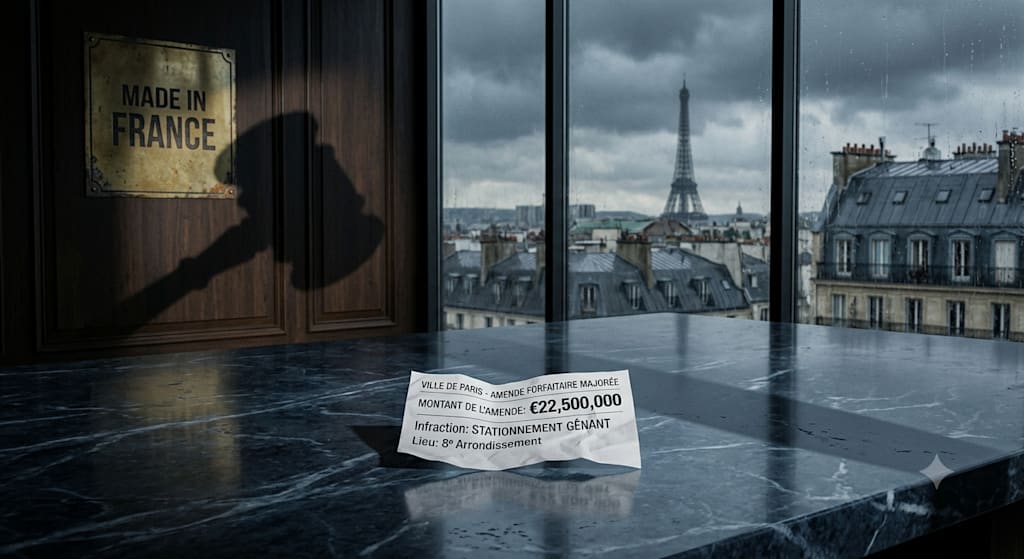
A Ruling from Paris: What the Arnaults Lost Goes Beyond €22.5 Million
The decision handed down by the Paris Administrative Court of Appeal is as clean as an invoice: Bernard Arnault and his wife must pay €22.5 million in back taxes, late penalties, and social levies, covering the 2010 wealth solidarity tax (ISF) and related surcharges for 2012–2015. Converted, that figure hovers around 174 million yuan.
A sense of scale is useful. LVMH paid €5.5 billion in corporate income tax last year. The €22.5 million ruling amounts to 0.4% of that. For a man whose net worth has spent years rotating through the top three slots on the global rich list, this sum carries roughly the same weight as a parking ticket tucked under a windshield wiper.
But staring at the number is precisely how you miss what the ruling actually leaked.
I. A label that sticks, and tears skin when removed.
Arnault’s spokesperson quickly produced a counter-figure: LVMH is France’s largest corporate taxpayer, its total contribution representing about 1% of French GDP. The intended audience was not the judges but the street. The trouble is, the court’s decision has handed the street a freshly sharpened dagger: “You can pay all the tax you like—the court says what you underpaid was the solidarity tax.” The ISF was designed specifically for high-net-worth individuals. Once a shortfall on that tax is judicially affirmed, the label rich and uncharitable goes on. Peeling it off later takes skin.
This is no longer a corporate tax dispute. Since 2023, the domestic debate over restoring or increasing wealth taxes has never subsided, and Arnault remains the most conspicuous target. In this climate, any adverse legal finding is automatically magnified into a systemic symbol. Even if the Council of State eventually overturns part of the ruling, the narrative, “France’s richest man was found by a court to have evaded tax,” will have already seeped into collective memory like bitumen. Repairing bitumen stains costs far more than €22.5 million.
II. The handbags are fine. The broth, however, has gone thin.
The iron law of luxury consumption still holds: people buy Louis Vuitton handbags for totems, class admission tickets, and artisanal heritage—not for the CEO’s tax probity. Historical precedents queue up neatly. The Pinaults of Kering, the Hermès family, the Prada clan have all waded through tax or legal murk without any measurable ripple in store sales. In the consumer’s mind, the brand and the boss sit on two completely separate ledgers.
But the brand’s immunity does not mean the group is calm. The ruling landed at a moment already studded with numbers that twist the stomach: full-year 2025 revenue of €80.8 billion, down 5% year-on-year, with net profit shrinking 13%. The core Fashion & Leather Goods division saw revenue fall 8% and recurring operating profit drop 13%—the money printer is losing revs. Asia excluding Japan crawled from negative growth in the first half to +2% in the third quarter, and support from the Chinese and American markets helped steady the second half. But the reality of a stalled growth engine grips management’s throat far tighter than any tax surcharge. This court decision is merely an extra pinch of salt tossed into a broth already bland. What it stings is not cash at the till but investor nerves, already stretched.
III. The most concealed variable: an unspoken understanding, unstitched in public.
Here lies the source of the tension. With France’s fiscal deficit stubborn and public debt elevated, taking a swing at the ultra-wealthy has become a political move of exceptionally low risk and handsome populist return. The court’s willingness to exhume a case from 2010 and rule against the country’s richest man in 2026 is itself a statement. The old tacit arrangement, “You are the national champion, so we’ll look the other way,” is being systematically dismantled.
Arnault once built a moat by intertwining LVMH with symbols of national soft power, such as the Paris Olympics. The irony is that the moat has now become the target: the more you embody France, the more relentless French society becomes in its moral demands upon you. The reactivation of a long-dormant tax claim signals that the judicial and administrative apparatus, propelled by the political climate, no longer feels obliged to preserve a special “grey zone” for the richest citizen. For international investors, this is far more alarming than €22.5 million. It forewarns that forensic-style tax audits of billionaires may shift from exception to routine.
IV. Two concrete indicators investors should now track.
First, the final ruling of the Council of State. If upheld, it will create a binding precedent for similar cases, potentially triggering retroactive reviews of other ultra-wealthy individuals. Second, succession risk has abruptly gained heat. Arnault is 77; his five children already hold their respective spheres of influence within the group. Any event that erodes his personal authority, no matter how small the monetary amount, will automatically be repriced by the market as an uncertainty premium on family transition. Fortunately, LVMH’s operating free cash flow still stands comfortably above €11 billion—the cushion remains thick, and a single tax lawsuit is not lethal. But the erosion of authority, during a handover period, gets magnified exponentially.
V. Coda
Arnault himself remarked not long ago that “the business environment in 2026 will not be easy.” Read alongside the tax ruling, that cautious forecast gathers an extra layer of meaning. €22.5 million will not buy a single handbag atelier, but it has precisely priced one thing: the psychological threshold for the French state to “publicly hold its richest citizen to account” has dropped to its lowest historical level.
When wealth reaches the stratosphere, an entrepreneur’s greatest adversary is no longer a competitor in the same industry. It is the social contract in which he is steeped. With this symbolic fine, Paris has dispatched a clear whisper to the outside world: in years governed by fiscal austerity and demands for fairness, even the wealthiest national no longer enjoys immunity.
Arnault wakes early in the morning. Outside his apartment window, the plane trees lining Boulevard Haussmann are the same plane trees as last year. It is the rules of the street below that have changed.
About the Creator
Jin
Writer of reamstories
https://reamstories.com/jin
Enjoyed the story? Support the Creator.
Subscribe for free to receive all their stories in your feed. You could also become a paid subscriber, letting them know you appreciate their work.
Comments
There are no comments for this story
Be the first to respond and start the conversation.