
Who Pays for the Bullet? The Hidden Tradeoff Behind the U.S. Army’s Rifle Upgrade
The light machine gun was supposed to carry long-range fire. Then the bill landed on the infantryman.
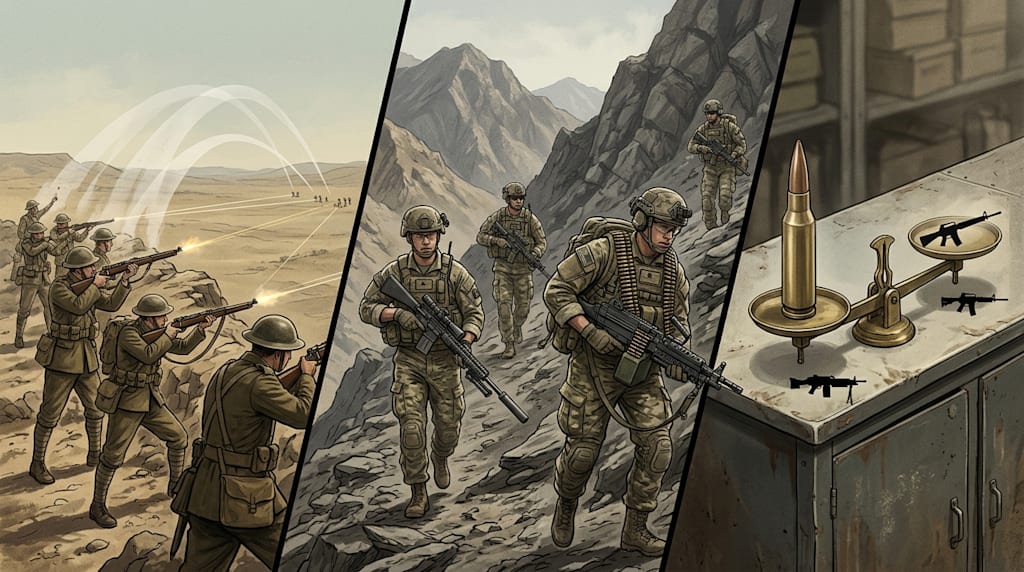
At the end of World War II, one fact looked odd. Most rifle fights happened inside four hundred meters, while rifle sights and training still pointed to eight hundred meters or farther. The gap did not come from lazy soldiers or worse rifles. It came from the squad’s fire structure. Before light machine guns were common, the rifle was the only weapon between the squad and artillery. Mortars arrived late. Heavy machine guns were scarce and usually grouped. So the rifle had to cover the empty space.
The Boer War shows the extreme version. Boer commander Reitz claimed his marksmen could engage British forces beyond twelve hundred meters. That was not range theory. It was hunters with Mausers, using terrain and distance to make British rifles irrelevant. On Spion Kop, British soldiers drew fire by moving their heads. The Boers were using rifles to do work that should have belonged to denser automatic fire.
The British Expeditionary Force in 1914 pushed the same logic into drill. Lee-Enfield volley fire was practiced at a thousand yards and beyond. The U.S. Marine Corps trained soldiers to use the M1903’s ladder sight at a thousand meters. These drills were not showmanship. In the absence of light machine guns, the rifle had to reach that distance for the whole squad.
The Browning Automatic Rifle in 1918 is usually described as the moment the U.S. finally got an automatic weapon. Its larger effect was conceptual. It took long-range suppression off the rifleman. As squad automatic weapons reached companies and platoons, rifle training pulled back inside four hundred meters. The assault rifle became logical only after that shift. Once the rifle no longer had to hit a man at a thousand meters, an intermediate cartridge made sense. Recoil could drop. The weapon could get lighter and more controllable. The light machine gun was not the assault rifle’s replacement. It was the precondition.
Afghanistan exposed a different problem. The M249 fired 5.56 mm. At mountain distances, accuracy and penetration fell off. The Taliban’s PKM fired 7.62×54 mm and could suppress at fifteen hundred meters. The M249 could reach but not hit hard enough. The M240 could hit hard but was too heavy to carry through the mountains. At six hundred to eight hundred meters, the squad had a gap. This was not riflemen doing a machine gun’s job. The machine gun end had failed.
The Pentagon’s answer was to raise the whole squad’s ballistic baseline. The M250 and M7 would both use 6.8×51 mm. The goal was to restore suppression at six hundred to eight hundred meters and beyond. On that point, the NGSW logic is consistent.
The mistake was allocation. The M7 weighs 3.8 kilograms empty and 4.46 kilograms with a suppressor. Its magazine holds twenty rounds, down from the M4A1’s thirty. Seven magazines give a soldier one hundred forty rounds. For a weapon meant to fight inside four hundred meters, that is too much weight and too little capacity. Soldier complaints about bulk, length, and high-pressure ammunition wear pushed the Army toward the shorter XM8. The Marine Corps kept the 5.56 mm M27. The M250 is about four pounds lighter than the M249, but 6.8 mm ammunition adds about 3.6 pounds to the gunner’s total load and cuts roughly two hundred rounds. Even the machine gunner pays. The rifleman pays more. Differentiation is not the problem. The problem is making the rifleman carry the machine gun’s ballistic bill.
Ukraine has pushed the debate further without canceling the split. Frontline reports say three hundred meters counts as long range. Trench fights happen close. Drones and artillery handle much of the distant suppression. That does not mean the squad no longer needs long-range fire. It means long-range fire must sit on the right platform. The rifleman needs mobility, ammunition, and speed in close terrain. A 3.8 kilogram rifle with a twenty-round magazine does not become reasonable because drones exist. It leaves the infantryman carrying a long-range requirement into a close-range fight.
The split remains. The automatic weapon pins the enemy at distance. The rifle solves the fight up close. The stronger the light machine gun’s long-range performance, the more the rifle should be allowed to get lighter and handier. The thing to watch is not one caliber’s success or failure. It is whether a task’s weight gets quietly moved onto the wrong platform. Armies that paid for this in history did not lack light machine guns. They let men with rifles carry distances that should have been shared by the whole squad’s fire system.
About the Creator
Jin
Writer of reamstories
https://reamstories.com/jin
Enjoyed the story? Support the Creator.
Subscribe for free to receive all their stories in your feed. You could also become a paid subscriber, letting them know you appreciate their work.
Comments
There are no comments for this story
Be the first to respond and start the conversation.