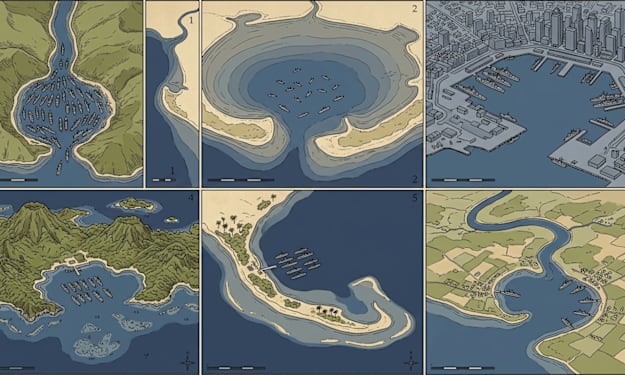
The Drawstring Harbors: How Geography Picks a Navy’s Home
A good naval harbor often looks, from the air, like a drawstring bag. The sea outside is a moving blue field. The entrance is a narrow neck. Inside, hills, peninsulas, and islands close around a broad sheet of sheltered water. The old rule of thumb is simple: a small mouth, a large bag, good depth, and a tidal range that does not make trouble. A small mouth keeps swell out, makes the channel easy to watch, and gives the defense a chokepoint. A large bag gives room for anchorages, berths, repair yards, and dispersal. Depth lets large ships and submarines move without waiting on the tide. A small tidal range keeps piers, mooring, channel depth, and mine countermeasures from becoming a daily calculation.