
The Command Change No One Is Talking About: How Ukraine’s New Drone General Is Rewriting the Rules of Retreat
Pokrovsk is falling back, Russian armor is advancing, and a burnt‑out T‑90 on a dirt road has become the waypoint for a war fought with chips, not steel.
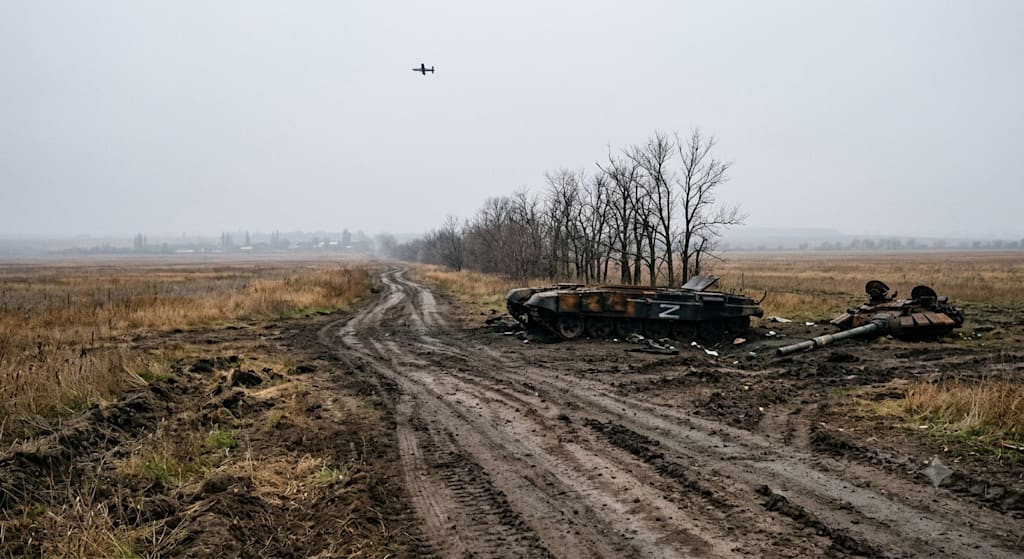
After the Command Change: A Footnote on a Dirt Road Outside Pokrovsk
July 2026. DeepState updated its front‑line map that afternoon. On the southern flank of Pokrovsk, the Ukrainian 47th Mechanized Brigade had pulled back 2.3 kilometres. Hours earlier, reports from Kyiv had surfaced that General Oleksandr Syrskyi was stepping down and that General Andrii Drapatyi would take over as Commander‑in‑Chief. Those two events on the same day say more about the real nature of this reshuffle than any official statement. This is not a punitive dismissal. It is a re‑vote on how the next twelve months of war will be fought.
I. Three Numbers Syrskyi Left Behind
Syrskyi's command system rested on three assumptions. The battlefield reports from the first half of 2026 invalidated all three.
The first set of numbers concerns manpower. Ukraine has not released official mobilisation figures, but third‑party open‑source estimates put the monthly intake of combat‑ready troops at roughly 6,000 to 8,000. During the same period, Russia sustained monthly replenishment of 25,000 to 30,000 through rotations and recruitment. The high‑exchange‑ratio strategy that Syrskyi used in Bakhmut—trading time for blood—can no longer hold under this manpower gap. Protests by soldiers' families outside recruitment centres made local headlines in April and May. These were not isolated incidents.
The second set concerns artillery shells. In the autumn of 2025, Ukrainian forces in the Zaporizhzhia direction fired an average of 3,000 155 mm rounds per day. By June this year, that number had dropped to around 600. Russian forces maintained more than 4,000 rounds per day over the same period. At a five‑to‑one disadvantage in firepower, static defence is no longer a tactical problem—it is pure arithmetic.
The third set concerns timing. On 3 July, a complaint Syrskyi made during a non‑public meeting was leaked to the media. He stated bluntly that ammunition and reinforcements were not reaching the front. The next day, President Zelensky convened a national security meeting. No formal statement regarding the Commander‑in‑Chief was issued afterward. But the signal sent outward was unmistakable: the chain of trust between the supreme commander and the field commander had fractured.
Add these three numbers together, and the command change was only a matter of time. It is not that Syrskyi did anything wrong. It is that the style of warfare he excels at can no longer function under the available resources.
II. The Cards Drapatyi Has Already Played
Drapatyi, his successor, previously headed Ukraine's drone systems and electronic warfare units. He is not an outsider parachuted into the job. His tactics have been tested repeatedly on the front over the past six months.
In May, the Ukrainian 3rd Assault Brigade carried out a small‑unit infiltration north of Kharkiv. It was the first operation to use “full unmanned cover”—reconnaissance, fire support, and withdrawal were all handled by drones; the ground team was only responsible for the final 200‑metre confirmation strikes. The mission wiped out a Russian platoon‑sized stronghold with zero Ukrainian casualties. This approach grew out of the “swarm” experimental project that Drapatyi oversaw.
In June, an oil refinery in Russia's Samara Oblast was hit, and one of its main distillation units was knocked offline. Open‑source analysis later indicated that the strike was carried out by Ukrainian‑made long‑range drones, not Western‑supplied weapons. That fits Drapatyi's long‑advocated concept of “deep asymmetrical strikes”—not throwing all combat power into the front line, but using low‑cost systems to repeatedly cut Russia's energy logistics chain.
A subtler shift has taken place in the electromagnetic spectrum. In recent weeks, Russian battalion‑sized units attacking in the Donetsk direction have repeatedly experienced communications blackouts and formation disorganisation after moving into their assault staging areas. Delays of one to two hours are common. Ukrainian forces have used these “windows” for local counter‑attacks. Drapatyi's expertise lies precisely here: turning the electromagnetic domain into the first line of defence.
III. Retreating Ground, Lengthening Supply Lines
Outside observers often equate a retreating front with a deteriorating situation. But if Drapatyi actively pulls back his lines after taking command, it is likely a calculated choice.
Let us run a simple logistical calculation. The Russian offensive on Pokrovsk currently relies on the M04 highway as its main supply route. From Donetsk city to the outskirts of Pokrovsk, the one‑way trip for supply convoys is about 110 kilometres. If Ukrainian forces give up the city centre and withdraw to the high ground in the north‑west, then the open fields along the M04 highway will fall within the loitering munition coverage radius—and the typical combat range of those munitions is between 40 and 60 kilometres. That means for every kilometre the Russians advance, their supply convoys stay exposed to that danger zone for longer.
In internal meetings, Drapatyi once used a metaphor: do not arm‑wrestle the bear; lure it into a swamp. The swamp is the lengthened supply line. In the coming weeks, if the map shows Russian gains expanding rapidly, it does not necessarily mean the Russian offensive is unstoppable—it may mean they are walking into a new fire trap. The key indicator is not square kilometres of territory, but daily Russian armoured vehicle losses. That number, updated every day on open‑source tracking sites, is far more telling than any front‑line map.
IV. Pokrovsk: Street Fighting or a Blockade?
The ongoing urban battle for Pokrovsk—currently the most intense sector—is the first stress test for the new tactical approach.
Syrskyi's instinct would have been to defend street by street, turning every building into a fortress. Drapatyi will most likely do otherwise. His special‑operations and drone background points to a different idea: turn the urban area into a “containment zone” rather than a “meat grinder.”
Concretely, Ukrainian forces might leave only small reconnaissance teams inside the city, while the main body withdraws to pre‑prepared positions on the outskirts. Acoustic and seismic sensors would be seeded throughout the city, alongside loitering drones overhead. When Russian assault squads enter a given block, Ukrainian troops would not engage in close‑quarters street fighting. Instead, they would seal off that block's entry and exit points with precision munitions, cut off reinforcements, and clear it in phases. The advantage: lower infantry casualties. The disadvantage: enduring the political pressure of being seen as “abandoning” the city.
But three years into the war, for Ukraine, people are more valuable than land. If Pokrovsk ultimately changes hands this way—provided the Russians pay a far higher loss ratio than in previous cities—then Drapatyi's tactics will have accomplished their immediate objective.
V. Where This New System Could Break
Drapatyi's system depends on three external conditions, each of which could snap at any moment.
First, chips and navigation signals. The vast majority of Ukrainian drones rely on civilian‑grade GPS and commercial microchips. If the United States or Europe cuts back on jamming equipment and spare parts in the next aid package, or if Russian electronic suppression intensifies, the combat efficiency of existing drone fleets could drop sharply within weeks.
Second, weather. The autumn rains in Ukraine begin in October. Prolonged fog and low cloud cover can severely degrade optical guidance accuracy. Whether Drapatyi can stockpile enough anti‑jamming inertial navigation modules before winter is an open question.
Third, the adaptation speed of frontline battalion and company commanders. Officers who have spent years fighting static positional warfare will need time to adjust to small‑unit, high‑mobility tactics. If this transition period coincides with a Russian winter offensive, command disarray could follow.
None of these three is insoluble, but each requires political decisions and industrial mobilisation. The General Staff cannot fix them alone.
VI. Coda: A Burnt‑Out Tank
About seven kilometres north of Pokrovsk, along a dirt road that runs beside a windbreak, satellite imagery shows a destroyed Russian T‑90 tank. The turret has been blown off and now lies more than ten metres to the right of the hull. On the side of the hull, a tactical marking in white paint is still visible.
Ukrainian forces have not sent a recovery team to tow it away, nor do they plan to salvage it. Drone operators have marked it on their tactical maps as a fixed reference point—used for calibrating wind drift and range. Every day, new loitering munitions pass over it, heading further north.
The tank cannot speak. But it sits there, and it says more than any grand declaration about “generational leaps in warfare.” The old heavy armour is becoming a waypoint. The new eyes are already in the sky.
About the Creator
Jin
Writer of reamstories
https://reamstories.com/jin
Enjoyed the story? Support the Creator.
Subscribe for free to receive all their stories in your feed. You could also become a paid subscriber, letting them know you appreciate their work.
Comments
There are no comments for this story
Be the first to respond and start the conversation.