
Can the Newest M1 Abrams Tank Outmatch China’s and Russia’s Top Battle Tanks?
Tank Battles

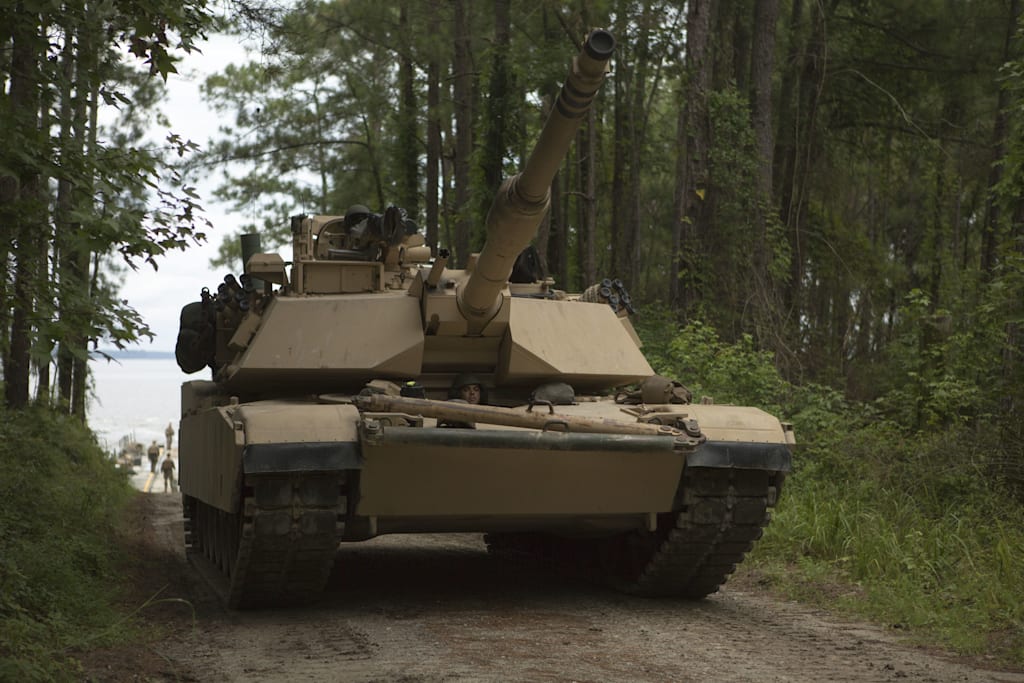
U.S.: M1A2 Abrams SEPv3
The M1A2 Abrams SEPv3 remains the centerpiece of American armored warfare and is still considered one of the deadliest tanks ever built. Originally introduced during the Cold War as the M1 Abrams in 1980, the platform has survived for more than four decades because of constant modernization. The newest SEPv3 version transforms the old Abrams into a digital battlefield machine capable of fighting in drone-heavy, missile-saturated modern warfare environments. Unlike older tanks that relied mainly on thick armor and firepower, the newest Abrams combines electronics, sensors, networking, active defense systems, and upgraded ammunition into a single battlefield ecosystem.
The Abrams became legendary during the 1991 Gulf War, especially at the Battle of 73 Easting, where American tank crews annihilated Iraqi armored divisions in one of the last major tank battles in modern history. Iraqi Soviet-made T-72 tanks were often destroyed before they even knew American tanks were nearby. Thermal imaging systems allowed U.S. crews to fight effectively at night and in sandstorms while maintaining deadly accuracy at long range. Since then, the Abrams has fought in Iraq, Afghanistan, and Syria, surviving countless ambushes, roadside bombs, and anti-tank missile attacks.
The newest SEPv3 upgrade package dramatically improves survivability. The tank now carries the Israeli-designed Trophy Active Protection System, one of the most battle-proven anti-missile defenses in the world. Trophy uses radar to detect incoming anti-tank rockets or guided missiles and then launches explosive countermeasures to destroy them before impact. This became necessary after the rise of advanced anti-tank weapons like the Russian Kornet and American Javelin missiles, which proved devastating in conflicts such as Syria and Ukraine. Modern tanks can no longer rely purely on armor thickness because top-attack missiles can strike weaker upper surfaces.
The Abrams still uses its famous 120mm M256 smoothbore cannon, derived from the German Rheinmetall gun family, but the ammunition has evolved dramatically. The new AMP round, or Advanced Multi-Purpose round, replaces several older shell types with one programmable munition. Tank crews can set the shell to explode after penetrating walls, burst in the air over infantry positions, or detonate on impact against armored vehicles. This flexibility is critical in urban warfare where tanks may need to destroy bunkers one minute and engage infantry hiding in buildings the next.
The Abrams also possesses one of the most advanced targeting systems ever installed in a tank. Thermal sights, laser rangefinders, stabilized optics, and computerized fire-control systems allow crews to hit moving targets while traveling at high speed across rough terrain. The commander’s independent thermal viewer means the tank commander can search for new targets while the gunner destroys another, a capability called hunter-killer targeting. This allows the Abrams to engage enemies extremely rapidly during high-intensity combat.
One of the tank’s greatest strengths is survivability. Abrams tanks feature Chobham-style composite armor enhanced with depleted uranium mesh inserts in some classified areas. Depleted uranium is extraordinarily dense and offers exceptional resistance against armor-piercing rounds. The tank also stores ammunition in isolated compartments with blowout panels. If the ammunition detonates, the explosion vents outward instead of killing the crew. This is a major difference compared to many Russian tanks, whose ammunition is stored beneath the turret, often causing catastrophic turret explosions when penetrated.
However, the Abrams also has weaknesses. At more than 73 tons, the tank is extremely heavy. Many bridges around the world cannot support it, transportation is difficult, and fuel consumption is enormous. Its gas turbine engine delivers incredible acceleration and speed but burns massive amounts of fuel compared to diesel-powered competitors. Logistics become a major challenge during prolonged warfare. In Iraq, Abrams units often required huge fuel convoys to sustain operations.
The future Abrams variant, unofficially called the M1E3, is expected to address these problems. The U.S. Army wants a lighter, more fuel-efficient design with hybrid-electric technologies, artificial intelligence-assisted targeting, and improved drone integration. Modern battlefields increasingly depend on unmanned aerial systems, and future Abrams tanks may deploy their own reconnaissance drones directly from the turret to scout enemy positions beyond visual range.

Russia: T-14 Armata
Russia’s T-14 Armata represents one of the most ambitious tank projects since the end of the Cold War. Unlike upgraded Soviet-era vehicles such as the T-72 or T-90, the Armata was designed completely from scratch as a next-generation combat platform. Russian officials have repeatedly described it as a revolutionary design that could surpass Western tanks technologically.
The T-14’s most radical feature is its unmanned turret. Unlike traditional tanks where crew members sit inside the turret next to ammunition, the Armata’s three-man crew remains protected inside an armored capsule deep within the hull. The turret itself is controlled remotely using cameras, sensors, and computerized systems. In theory, this greatly improves crew survivability because the most dangerous part of the tank — the ammunition storage area — is separated from the crew compartment.
The Armata uses a 125mm 2A82-1M smoothbore cannon capable of firing armor-piercing sabot rounds, guided missiles, and programmable ammunition. Russian designers have even discussed future upgrades involving a larger 152mm cannon, which would massively increase firepower. Reports claim the gun can destroy enemy tanks at ranges beyond three miles under ideal conditions.
Its Afghanit active protection system is another major innovation. Similar in concept to Israel’s Trophy system, Afghanit uses radar sensors and interceptor projectiles to stop incoming anti-tank missiles before impact. Russian sources also claim it can interfere with enemy guidance systems using electronic warfare technologies. Combined with the tank’s composite and reactive armor, the T-14 was intended to become one of the hardest tanks in the world to destroy.
The Armata is packed with sensors and automation. Panoramic sights, infrared imaging, radar arrays, and battlefield networking systems allow the tank to detect threats rapidly. Russian officials have even claimed the platform includes early forms of artificial intelligence capable of helping prioritize targets and assist decision-making during combat.
Despite all this promise, the Armata has faced serious problems. Production delays, technical difficulties, high costs, and sanctions against Russia’s defense industry have slowed deployment for years. Although unveiled publicly in 2015 during Moscow’s Victory Day Parade, the tank has still not entered large-scale service. Several prototypes reportedly broke down during rehearsals, fueling skepticism about reliability.
The war in Ukraine further complicated Armata production. Russia suffered enormous tank losses and was forced to rely heavily on older Soviet-era T-72 and T-80 models instead of deploying large numbers of T-14s. Reports occasionally emerged claiming limited Armata testing near the front lines, but there is little evidence the tank has seen sustained combat.
Many military analysts believe the Armata remains more important psychologically and politically than practically. It demonstrates Russia’s desire to compete technologically with NATO and project an image of military modernization, even if mass production remains elusive.

China: Type 99A
China’s Type 99A is considered the People’s Liberation Army’s premier armored vehicle and reflects China’s rapid transformation into a technologically sophisticated military power. Developed from earlier Type 98 and Soviet-inspired designs, the Type 99A incorporates advanced electronics, modular armor, active protection systems, and high mobility into a platform intended to compete directly with Western tanks.
The tank features a 125mm smoothbore cannon with autoloading capability, reducing crew size to three. Chinese engineers designed the tank for speed and mobility as much as protection. Powered by a 1,500-horsepower diesel engine, the Type 99A reportedly reaches speeds close to 50 miles per hour, making it one of the fastest modern main battle tanks.
The vehicle uses modular composite armor and explosive reactive armor to defeat incoming projectiles. Some reports suggest the tank incorporates laser-based countermeasures capable of disrupting enemy targeting systems and rangefinders. China has also developed active protection systems similar to Trophy and Afghanit to intercept missiles before impact.
One of the Type 99A’s greatest strengths is networking capability. China heavily emphasizes integrated warfare, where tanks, drones, artillery, satellites, and aircraft operate as a unified information system. The Type 99A can reportedly share targeting information digitally across battlefield networks in real time. This reflects China’s growing focus on AI-assisted warfare and battlefield automation.
Chinese military doctrine increasingly integrates drones directly with armored formations. Future Chinese tanks may deploy swarms of reconnaissance drones for surveillance, electronic warfare, or kamikaze attacks against enemy vehicles. This mirrors global trends toward unmanned systems becoming central components of armored warfare.
Unlike the Abrams, which has extensive combat experience, the Type 99A has never fought in major war. This leaves many questions unanswered regarding reliability, survivability, and crew effectiveness under actual battlefield conditions. Nevertheless, China’s enormous industrial capacity means the country can potentially produce advanced tanks at scales impossible for most Western nations.
The Type 99A also benefits from China’s growing expertise in electronics manufacturing, sensors, and AI development. Analysts increasingly view China not merely as copying Western designs but as emerging as a true competitor in military innovation.

Germany’s KF51 Panther and the Future of Tank Warfare
The KF51 Panther may represent the future direction of tank warfare more clearly than any current operational vehicle. Introduced by Rheinmetall in 2022, the Panther combines lessons from Ukraine with next-generation technologies emphasizing automation, drones, artificial intelligence, and active defense systems.
The Panther’s huge 130mm cannon offers dramatically more penetrating power than current 120mm NATO guns. Rheinmetall claims it is 50 percent more effective against armored targets. The tank is also designed to deploy loitering munitions — small kamikaze drones capable of scouting or attacking enemy vehicles independently.
Artificial intelligence may eventually assist the Panther’s crew by identifying targets automatically, managing sensor data, and helping prioritize threats. Rheinmetall has even discussed fully autonomous versions in the future, although human-controlled tanks remain politically and ethically preferred for now.
The rise of drones has transformed tank warfare. In Ukraine, cheap quadcopters equipped with grenades and FPV suicide drones have destroyed tanks worth millions of dollars. Future tanks must therefore fight not only enemy armor but also swarms of aerial threats. This is driving investment into laser defenses, electronic warfare systems, radar-guided interceptors, and AI-assisted targeting.
Who Would Win?
In a direct confrontation, the M1A2 Abrams SEPv3 still likely possesses the edge overall because of combat experience, crew survivability, sensor quality, and proven battlefield performance. American tank crews train extensively using realistic combat simulations and integrated combined-arms tactics involving aircraft, drones, infantry, and artillery support.
The T-14 Armata is technologically ambitious but remains largely unproven and limited in production. If Russia solved its reliability and manufacturing issues, the platform could become highly dangerous, especially with improved AI and active protection systems.
China’s Type 99A may ultimately become the greatest long-term challenge simply because of China’s industrial scale, technological growth, and integration of AI-driven warfare concepts.
Still, the future of tank warfare may depend less on which tank has thicker armor and more on which military best integrates drones, networking, electronic warfare, artificial intelligence, and battlefield awareness. Tanks are no longer isolated steel fortresses. They are becoming mobile command nodes inside massive digital combat ecosystems where information, automation, and speed matter just as much as firepower.
About the Creator
History Seeker
I like the metal music I like the good food and the history...
Enjoyed the story? Support the Creator.
Subscribe for free to receive all their stories in your feed.
Comments
There are no comments for this story
Be the first to respond and start the conversation.