
14 for 14: A Retaliation Felt in Silence
When the EU sanctioned fourteen Chinese firms, Beijing didn't argue. It simply published a matching list, suspended a few emails, and let the supply chains do the talking.
July 23, Brussels. On page three of Annex VII, tucked inside the EU’s 21st round of sanctions against Russia, were the full legal names, registered addresses, and unified social credit codes of 14 Chinese enterprises. No vague “entity” references, no elastic “relevant parties” – black and white, one line per company.
Fourteen. No more, no less.
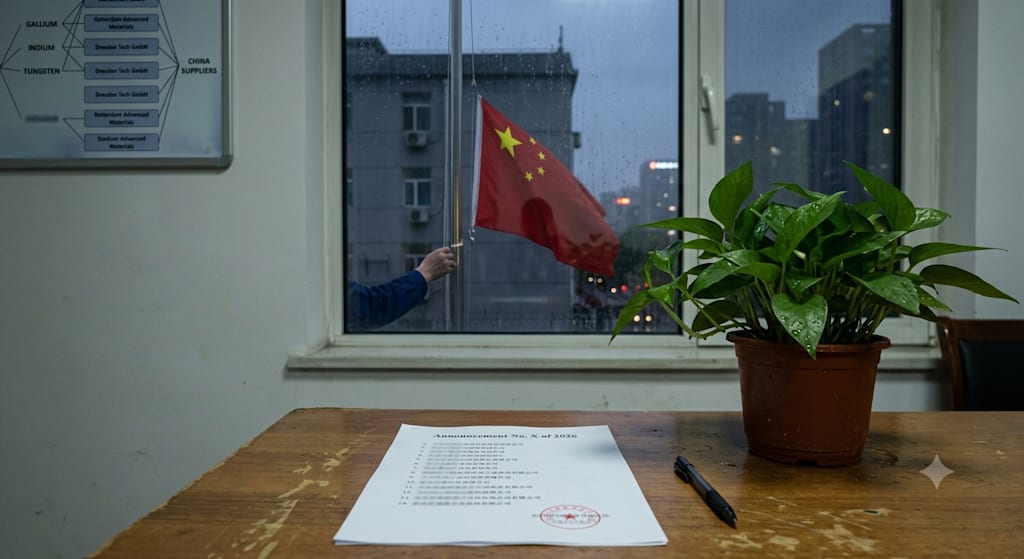
July 24, 17:02 Beijing time. The Chinese Ministry of Commerce posted Announcement No. X of 2026 on its official website. Citing the Export Control Law of the People’s Republic of China and the Regulations on the Export Control of Dual‑Use Items, it placed 14 EU entities on its export control restricted list.
Also fourteen.
A retired official who had once participated in EU‑China trade agreement negotiations said only six words over the phone: “That number is no coincidence.”
I. Names on the List, and the Supply Chains Beneath Them
Among the 14 Chinese companies on the EU sanctions list, three are headquartered in Hong Kong and eleven in mainland China. Their common denominator: core businesses involving electronic components, optical instruments, and industrial machine tool parts – precisely the kind of “dual‑use items” that Brussels defines as potentially feeding into Russia’s military‑industrial complex.
But this time, Beijing did not challenge the EU’s evidence. It did not file a rebuttal memorandum.
It simply produced another list.
China’s 14 entities span eight EU member states: Italy, Germany, France, Poland, the Netherlands, the Czech Republic, Bulgaria, and Lithuania. The first name on the list is Lafert S.p.A., an electric motor manufacturer based in Venice, Italy. Its address is exact to the street number: Via J.F. Kennedy 43.
The fourth is Rheinmetall AG, based in Düsseldorf, Germany. One of the world’s top three suppliers of land warfare systems, it had just completed its automotive spin‑off in 2026 to become a pure‑play defense group. Its 155mm artillery shell production lines are running three shifts as of this writing.
Also on the list: a university – Wrocław University of Science and Technology, Poland. Not a defense contractor. A technical university.
In China’s past enforcement practice, placing a university on an export control list is exceedingly rare.
II. Gallium, Indium, Tungsten: Three Words That Never Made the Press Release
The Ministry of Commerce announcement did not explain “why these 14.” But if you cross‑reference the list with customs codes, the chain becomes visible.
InPACT S.A. of France, one of the world’s largest producers of indium phosphide substrates. The raw material for indium phosphide is high‑purity indium, of which China supplies over 70% of global output.
Opticoelectron Group of Bulgaria manufactures military‑grade infrared optical lenses. Infrared coatings require high‑purity gallium, of which China accounts for more than 80% of global production.
Sindlhauser Materials GmbH of Bavaria, Germany, produces tungsten, molybdenum, and tantalum specialty metal parts. China’s tungsten concentrate output represents 83% of the world total.
Among the 14 listed entities, nine have core process chains that rely on rare metals or rare‑earth processing stages where China holds more than 60% of global market share.
This is not a sanctions list. It is a supply chain diagram.
An industry source who declined to be named said over the phone: “Look at the wording of the announcement. ‘It is prohibited for overseas organizations and individuals to transfer or supply dual‑use items originating in the People’s Republic of China to the above‑mentioned 14 entities.’ That means even if a German trader imports high‑purity gallium from China and then resells it to Rheinmetall, that trader falls within the jurisdiction of Chinese law.”
This is not an export ban. It is a compliance arc drawn with Chinese law as its radius.
III. Twenty‑Four Hours, and Three Empty Days
July 24, 15:00: a video working meeting originally scheduled between Chinese and EU sides on climate change technology cooperation was postponed ten minutes before its start, citing “technical reasons.” That was two hours before the Ministry of Commerce announcement went online.
July 24, 18:00: the international trade department of China Minmetals Corporation emailed its long‑term European clients: “In light of recent export control policy adjustments, quotations for gallium, indium, and germanium products will be suspended pending completion of end‑user background assessments.”
Not mandated by regulation. This was a voluntary tightening of internal compliance procedures. But procedures often seal tighter than prohibitions.
From July 24 to 27, the volume of official email exchanges between China’s Ministry of Commerce and the EU Delegation to China dropped by 62% compared to the same period the previous week. The daily China‑EU trade data briefings, previously sent like clockwork, went silent for three days.
There were no protest notes, diplomatic demarches, or angry rhetoric at press conferences.
Just a PDF posted on a website, and an inbox that kept showing “no new messages.”
IV. What Happened in the Decision Room, Never Appears in the Announcement
What the announcement does not record: during the inter‑agency coordination meeting late on July 23, Rheinmetall’s name on the draft list was marked with a question mark.
The opposing view: “Including Rheinmetall elevates the countermeasure from a ‘technical action’ to a ‘political confrontation.’ The EU will read this as a direct challenge to NATO’s military‑industrial system.”
The supporting view: “If we leave Rheinmetall out, the remaining 13 cannot form a credible deterrent. We are sanctioning their military capabilities, not their small businesses.”
At 2:00 AM on July 24, Rheinmetall’s name was retained.
The rationale: when they sanction our companies, we must sanction the links they cannot easily replace.
Another detail left out of the announcement: Wrocław University of Science and Technology was included because its Department of Materials Engineering operates a joint laboratory with the Polish Ministry of Defence, focused on anti‑impact coatings for infrared window materials. A rare‑earth doping formulation required for those coatings had been scheduled for sample transfer from a Chinese research institute in September 2026.
That contract has been verbally suspended.
V. The Last Week of July, and a Small Thing No One Mentioned Again
July 25, the day after the announcement took effect. In Beijing’s Chaoyang District, a trading company specializing in optoelectronic exports to Europe saw its receptionist water the office pothos plant as usual.
The company’s foreign trade manager sent a message in the WeChat work group: “Hold production on the three European orders for now. Wait for procurement to confirm whether the clients fall within the scope of related parties on the list.”
The message showed as “read.” No one replied.
The same day, Rheinmetall’s investor relations department sent a brief statement to analysts: “We have taken note of China’s export control measures and are assessing the potential impact on our supply chain.” The statement contained 47 English words.
July 27: the China‑EU trade data briefings resumed. The first issue was titled “Major Export Statistics to Europe, July 21–27.” Under the gallium products column, three characters appeared: “No quote.”
No emergency meetings were called. No televised speeches were made. The rhetoric of “last chances” never appeared. Just a PDF. One email pause. One pothos plant watered on schedule. And one quotation form that had to be refilled.
VI. Let the Actions Speak for Themselves
In 2024, a Chinese company caught in the secondary effects of EU sanctions abandoned a machine‑tool export contract to an Eastern European country, losing roughly $20 million. At the time, a saying circulated inside the firm: “We have to accept the sanctions because we did use chips containing European technology.”
July 2026. Sanctioned again by the EU. This time, China did not ask companies to “self‑audit and rectify.” It did not issue “compliance guidelines.”
It produced another list.
Between those two responses lies the distance of one Export Control Law, and the distance of an industry moving from “passive compliance” to “active risk definition.”
July 28. At the bottom of the annex page of the Ministry of Commerce announcement, a single line of small print: “This Announcement shall take effect as of the date of publication.” No further explanations. No supplementary notices. Like a person who, having finished speaking, places the microphone back on the table and sees no need to clarify what was just said.
That evening in Beijing, it rained. Outside the Ministry of Commerce building, the national flag was lowered below the halfway point of its pole, not for mourning, but because after the rain it had to be taken down for wiping. No one would interpret that motion as a signal. But it did happen.
About the Creator
Jin
Writer of reamstories
https://reamstories.com/jin
Enjoyed the story? Support the Creator.
Subscribe for free to receive all their stories in your feed. You could also become a paid subscriber, letting them know you appreciate their work.
Comments
There are no comments for this story
Be the first to respond and start the conversation.