The Vocal Community Reacts to Roe's Reversal
In light of the SCOTUS decision reversing Roe v. Wade, the Vocal Team has put together a resource to help the community navigate the many conversations taking place around this divisive issue. We will continue to update this story with the latest information and content from political figures, thought leaders, and voices on Vocal.


The constitutional right to an abortion—granted to all U.S. citizens in 1973 in the case of Roe v. Wade—was overturned by the Supreme Court on Friday, drastically altering the future of health care and bodily autonomy in the United States. The Vocal Team recognizes and acknowledges that this is a deeply complex ongoing conversation, and many groups are divided over this issue. While some are celebrating, others are grappling with feelings of hopelessness, confusion, and grief due to the Court's decision. To aid our community, we have created a list of links and resources to inform and facilitate ongoing discussions around the subject of abortion rights in the U.S.
The Supreme Court's Decision
"Roe was on a collision course with the Constitution from the day it was decided"
-Samuel Alito, Associate Justice of the Supreme Court of the United States
In 2018, the state of Mississippi passed a law prohibiting most abortions after the 15th week of pregnancy. The only licensed abortion facility in Mississippi, Jackson's Women's Health Organization, along with one of the doctors who worked there, filed a federal lawsuit to challenge the law's constitutionality. The district court in Mississippi ruled in favor of the abortion facility. The United States Court of Appeals affirmed this decision. Eventually, the case made its way to the Supreme Court, where it was argued before the Justices in December 2021.
On Friday, June 24th, the Supreme Court reversed the lower courts' rulings regarding Mississippi's abortion law and overturned the precedent outlined in Roe v. Wade and affirmed in Planned Parenthood v. Casey. Five Justices—Samuel Alito, Clarence Thomas, Neil Gorsuch, Brett Kavanaugh, and Amy Coney Barrett—voted to overturn Roe and Casey. Chief Justice John Roberts agreed with the majority that the Mississippi abortion law was constitutional but voted that the Court should not overturn Roe. The remaining three Justices—Stephen Breyer, Sonia Sotomayor, and Elena Kagan—voted against the decision. The Court's majority opinion, which Justice Alito wrote, can be read in its entirety here. A summary of the case, the majority opinion, Chief Justice Roberts's opinion, and the liberal justices' dissent can be found here.
The Country Reacts
Abortion rights have taken center stage in American political discourse for decades, becoming an increasingly polarizing topic.
Numb. Shattered. Happy. Ashamed. Heartbroken. Elated. Livid. Indifferent. Pleased. Powerless. Gutted. Grateful. These are just some of the words our readers used to describe their feelings about the Supreme Court’s ruling on abortion.
Protests and celebrations have erupted simultaneously nationwide, drastically interrupting what would have been an otherwise Pride-dominated weekend across the country as June comes to a close.
Meanwhile, politicians and public figures from both sides of the discussion took to the internet to voice their opinions.
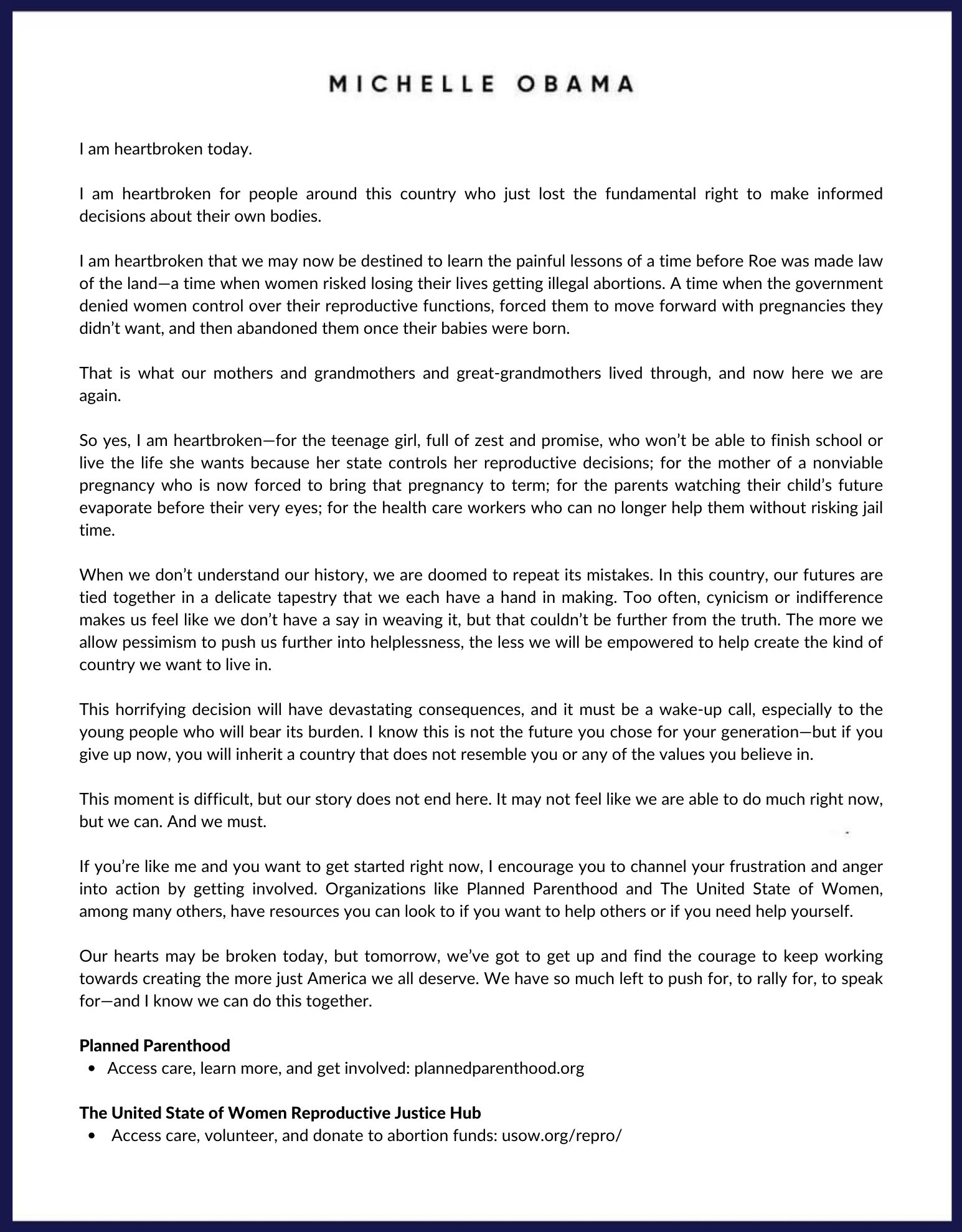
As always, in times of civil unrest, we turn our gaze toward our own community for insight and understanding. Vocal creators range across political and idealogical spectrums, offering a balanced vantage point to attempt to interpret the state of a divided society.
Here are some of the conversations taking place right now within the Vocal communities.
On Autonomy:
On the Aftermath:
On Action:
What Happens Now?
The Supreme Court's decision to eliminate the constitutional right to an abortion has and will continue to create seismic shifts in reproductive rights across the country. It is estimated that over half of states will ban or severely restrict abortion in the days and weeks ahead. Therefore, individuals must have a firm understanding of the laws in their state. The Center for Reproductive Rights has created an interactive map that indicates the abortion restrictions, bans, and protections in the US states, the District of Columbia, and the five most populous US territories.
The map updates in real time and includes a glossary of terms to help you understand how your local government is responding to the reversal of Roe.
It's important to note that abortion is NOT illegal nationwide and that resources exist to help women get the care they need. It is still legal for women to travel to states where abortion is permitted to seek medical care. Wired has created a guide, which has more information about creating an abortion access plan for those living in states that ban or severely restrict abortion.
In addition, a comprehensive directory of trusted and verified abortion service providers in the United States can be found here.
About the Creator
Vocal Team
By creators, for creators.
Enjoyed the story? Support the Creator.
Subscribe for free to receive all their stories in your feed.
Comments
There are no comments for this story
Be the first to respond and start the conversation.