
Prince William Breaks His Silence on a Troubling Military Issue: “I Want Women to Feel Safe and Respected”
The Prince of Wales has revealed why he believes the British Armed Forces must change, after hearing difficult accounts from women serving in the military. His message goes beyond royal duty—it raises questions about leadership, equality, and the future of an institution he may one day help lead.

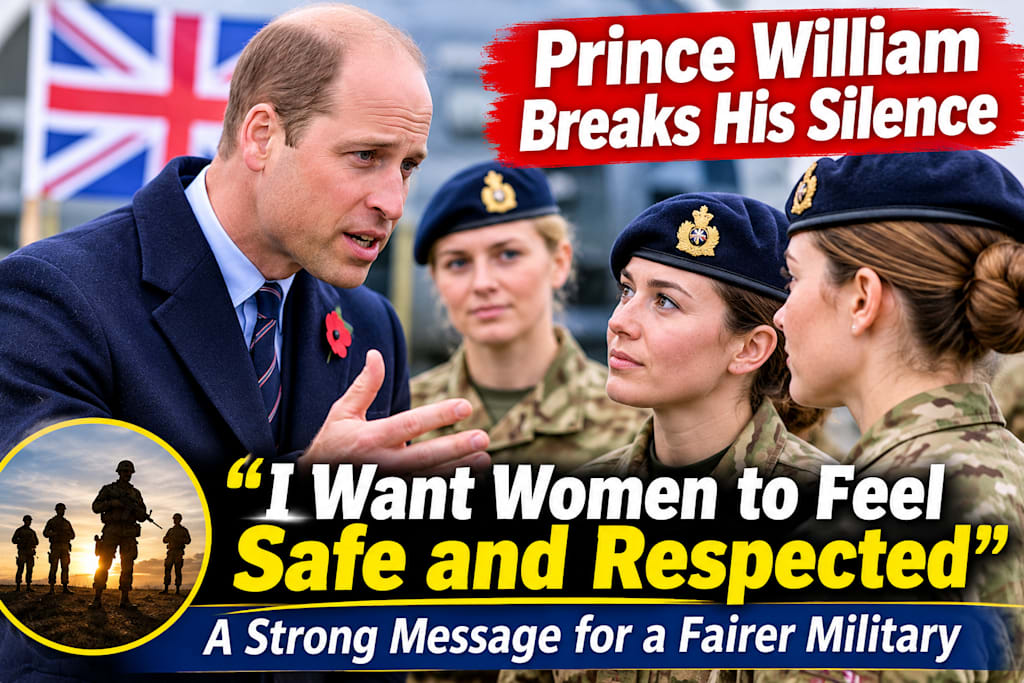
Imagine dedicating your life to serving your country, putting on a uniform with pride, and believing that your colleagues have your back.
Now imagine discovering that the place where you are supposed to feel respected and protected is also where you must worry about inappropriate comments, unwanted attention, and being treated unfairly.
For some women serving in the British Armed Forces, this is not an imaginary situation. It is an experience they have reportedly shared with Prince William.
And the future king has decided that remaining silent is no longer enough.
In a new article for Country Life magazine, published on November 11, 2026, the Prince of Wales has spoken about the need to make military culture safer and more inclusive for women. His words are significant not simply because of his royal position, but because they come from someone who understands military life through his own experience.
A Message From Someone Who Has Worn the Uniform
Prince William is not unfamiliar with military service.
Before becoming one of Britain's most prominent royal figures, he trained as an officer and served with the Royal Air Force as a search-and-rescue helicopter pilot. Between 2010 and 2013, he was based at RAF Valley in North Wales.
That experience gave him an understanding of the discipline, responsibility, and teamwork expected of military personnel.
But his recent conversations have introduced him to a different side of military life.
William has reportedly been meeting service personnel from the Royal Navy, British Army, and Royal Air Force. Rather than limiting his attention to senior officers, he has sought to hear from people across different ranks.
His purpose has been to understand what women experience while serving and what needs to change.
In his Country Life article, he wrote: “I want to play my part in making the military feel like the welcoming, open and professional place I enjoyed and make it feel like that for everyone.”
It is a statement that connects his personal experience with a much wider responsibility.
The Accounts That Made Him Speak Out
Perhaps the most serious part of this story concerns what women have reportedly told the prince.
According to the magazine's reporting, the accounts included inappropriate comments, rumors targeting women who rejected advances, harassment in military accommodation, and concerns about women being treated as commodities.
These are not small issues that can simply be dismissed as workplace disagreements.
They raise difficult questions about professional standards, personal dignity, and whether every person wearing the uniform receives equal respect.
Military service requires trust. Personnel must depend on one another, often in demanding and dangerous circumstances.
If someone feels unsafe or undervalued within their own working environment, that trust can be damaged.
William acknowledged that the military does not yet meet the standards he expects.
For a future head of state who may one day have a significant constitutional role connected to the Armed Forces, speaking about these concerns carries particular weight.
Why This Matters Beyond the Palace
The story is about more than Prince William.
Across many professions, women continue to face questions about workplace culture, equality, harassment, and opportunities for advancement.
The military presents an especially important example because its members are expected to operate as one team, regardless of rank or background.
A respectful environment is not simply a matter of good public relations. It can influence morale, confidence, recruitment, retention, and the ability of people to perform their duties.
Women who choose military careers should be able to concentrate on training, leadership, and service—not worry about whether they will be respected by the people around them.
The challenge is not only to create policies, but to make sure those policies are reflected in everyday behavior.
That requires leadership at every level.
William's Work Is Not Just About Words
The Prince of Wales has reportedly taken the feedback he gathered to senior figures across the British defense sector.
He is also exploring how he might support a longer-term initiative aimed at encouraging positive change.
That distinction matters.
Public statements can attract headlines for a day, but meaningful improvements require continued attention, accountability, and a willingness to listen to people whose experiences may be uncomfortable to hear.
The UK's Chief of the Defence Staff, Air Chief Marshal Sir Richard Knighton, also acknowledged that more work is needed to ensure women can serve, succeed, and progress in an environment where they are respected and valued.
His comments suggest that the issue is being recognized beyond the royal household.
However, recognition is only the beginning. The real test will be whether servicewomen see lasting improvements in their daily working lives.
A Different Side of the Future King
Prince William's public role is often associated with royal ceremonies, international visits, environmental projects, and family appearances.
This intervention reveals another dimension of his responsibilities.
He is using his position to draw attention to a difficult institutional issue, one that cannot be solved through a photograph or a carefully written statement.
There is also something important about the way he approached the subject: listening before speaking.
The experiences of women in the military deserve to be taken seriously on their own merits, not simply because a prince has chosen to discuss them.
William's involvement may help bring wider attention to the issue, but the voices of the women who shared their experiences should remain at the center of the conversation.
The Change That Still Needs to Happen
A modern military should be judged not only by its strength, equipment, or achievements, but also by how it treats the people who serve within it.
The women who wear its uniform deserve the same opportunity to develop, lead, succeed, and feel proud of their service.
Prince William has now made clear that he believes more must be done.
Whether his involvement leads to lasting change remains to be seen. But raising the issue publicly is an important step toward a conversation that should never have been ignored.
The most powerful measure of this story will not be how many headlines William receives.
It will be whether, years from now, a young woman entering the British Armed Forces can do so with confidence, knowing that her colleagues will respect her and that her contribution will be valued.
What do you think? Can Prince William's influence help bring meaningful change to the British military, or must the responsibility rest entirely with military leaders and the government?
About the Creator
Behind the Curtain
"Exploring the untold stories and hidden truths. From royal rumors to cultural deep dives, Behind the Curtain brings you bold, insightful narratives that spark curiosity and conversation."
Enjoyed the story? Support the Creator.
Subscribe for free to receive all their stories in your feed.
Comments
There are no comments for this story
Be the first to respond and start the conversation.