
Amber or White Wine?
Traditional Georgian "White" Wine

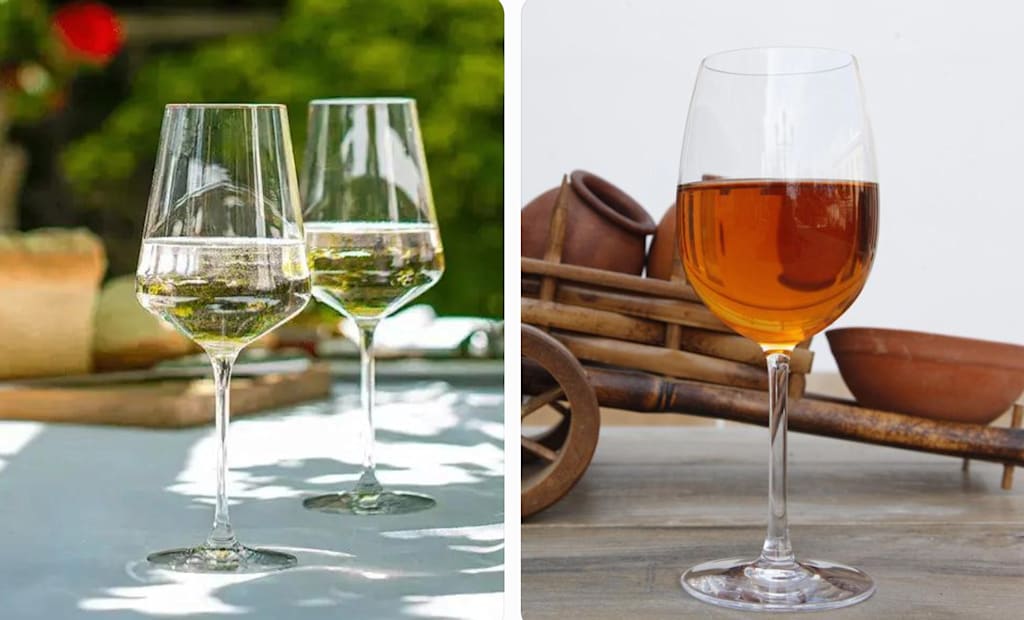
Even those who don't really drink wine know that in terms of color, there are three types of wine in the European-style wine making: red, white, and rose. Intuitively, we understand that the difference comes mostly from the types and color of the grapes used for the particular wine. The coloring pigment is contained in the grapes' skin and generally red grapes produce red, white grapes - white, and pink grapes - rose wine.
However, the wine color does not result from the grapes' skin color alone. It's also about the process of wine making, specifically for how long the skin stays in contact with the flesh and juice in the process of fermentation.
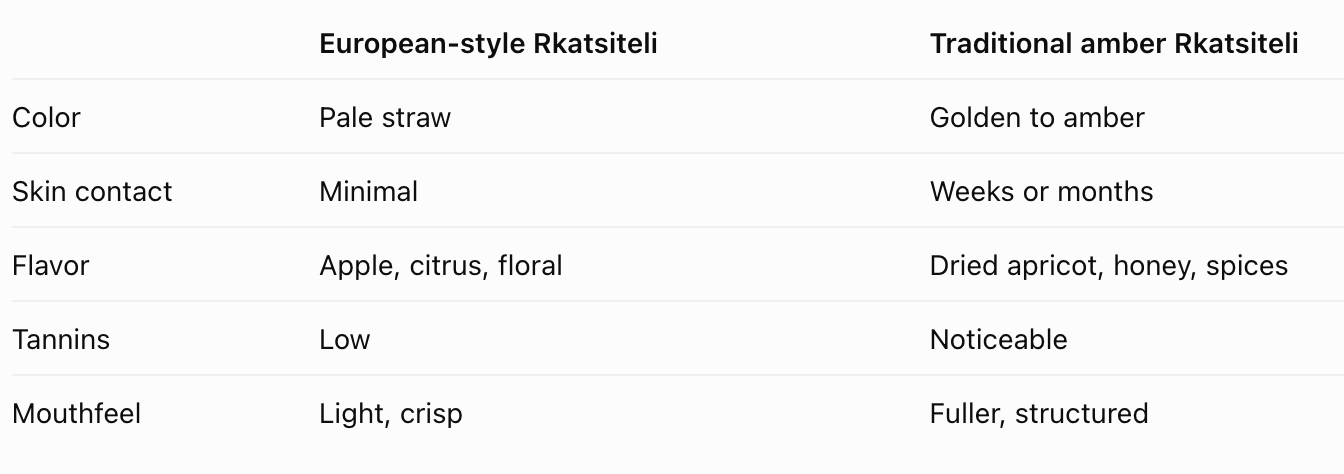
For 8,000 years, Georgians have been making wine from white grapes using the traditional qvevri (large clay pots) method. In this method, the grapes are pressed but skins are never separated from the flesh and juice. As a results, the wine would never be white, ranging in color from light golden to deep amber. But Georgians still call it white because it comes from white grapes.
Why Amber?
In the European-style wine making, to achieve the white color, the skins are separated from the grapes' flesh before or shortly after fermentation. It is crucial as white grape skins contain natural compounds called phenolics, including tannins and color pigments.
In the Georgian qvevri method, the skins remain in the fermenting juice, and these compounds are extracted into the wine. Chemical reactions, including oxidation of some phenolic compounds, contribute to the development of golden, amber, and sometimes tea-like darker colors.
It is similar to brewing tea: the longer the tea leaves remain in hot water, the darker and more astringent the tea becomes. The chemistry isn't identical, but the principle of extraction of color and flavor is similar.
The same process also explains why amber wines can have a slightly bitter, dry, tangy, almost mouth-puckering sensation associated with red wines.
The Role of Qvevri in Making Amber Wine
A qvevri is a large, egg-shaped clay vessel buried in the ground up to its neck. Here's a great video explaining how qvevris are made and maintained:
Qvevri provides a relatively stable temperature for fermentation and aging. But the clay itself does not turn white wine to amber in color. The principal reason is prolonged contact with grape skins and other solids.
The traditional Kakhetian method frequently keeps white wine in contact with grape skins for several months. Western Georgian methods, particularly in Imereti, often use fewer grape solids (skins, seeds, stems, and flesh), producing lighter-colored wines.
The qvevri winemaking tradition was recognized by UNESCO as Intangible Cultural Heritage in 2013.
Can Georgians make ordinary, European-style white wine?
Absolutely! I've seen it while I was in Georgia, when I visited the Tsinandali Estate owned by the Georgian nobleman Alexander Chavchavadze, who introduced European winemaking techniques at his winery in the 1830-40s.
I saw bottles of Saperavi (arguably, the most famous Georgian red wine) from the 1839 harvest, bottled in 1841, displayed in the Tsinandali Estate's historical collection. We were told that it was not drinkable, however. Something to do with sealing and oxidation.
Since Chavchavadze's time, Tsinandali white wine is made from Rkatsiteli and Mtsvane grapes using European-style white winemaking techniques. It is generally pale straw-colored, crisp, and refreshing.
For comparison, the same Rkatsiteli grape can produce two remarkably different wines using the two different methods, European barrel vs Georgian qvevri fermentation:
By the way, Tsinandali Estate to this day uses both methods of wine-making and when you visit it you will have a chance to buy a bottle of each (if you can stop at one bottle) and compare the taste.
Recently, due to revival of pre-Soviet methods of winemaking, Georgian qvevri is going through a huge renaissance. Georgians always made wine at home, even during the restrictive Soviet times and Gorbachev's alcohol ban. The difference is then they had to do it secretly in their garages and now they can do it openly on their rural estates. If you want to flatter a Georgian man, ask him where his personal winery is located and how many qvevries he owns.
The Georgian amber wine recently became so well-known and appreciated beyond Georgia that in 2020, the International Organisation of Vine and Wine formally recognized the category "white wine with maceration," partly in response to Georgia's initiative. So, now we have red, white, rose, and amber wines as official categories.
P.S. Here's another excellent video on Georgian winemaking:
About the Creator
Lana V Lynx
Avid reader and occasional writer of satire and short fiction. For my own sanity and security, I write under a pen name. My books: Moscow Calling - 2017 and President & Psychiatrist
@lanalynx.bsky.social
Enjoyed the story? Support the Creator.
Subscribe for free to receive all their stories in your feed. You could also become a paid subscriber, letting them know you appreciate their work.
Comments
There are no comments for this story
Be the first to respond and start the conversation.