
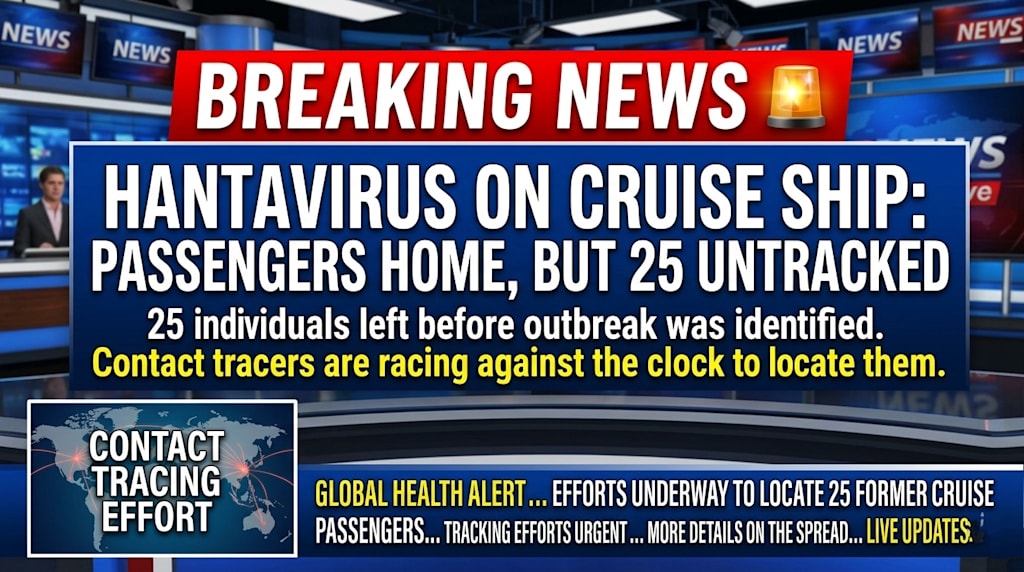
The Hantavirus Cruise Ship Passengers Are Finally Home — But 25 of Them Left Before the Outbreak Was Identified. Now Contact Tracers Are Racing Against the Clock.
The MV Hondius passengers have been evacuated from the Canary Islands. Americans are heading to Nebraska for evaluation. But 25 passengers who disembarked before the outbreak was confirmed are now scattered across the world with unknown exposure status. Hantavirus has an 8-week incubation period. The contact tracing race is on.
The passengers of the MV Hondius — the Dutch expedition cruise ship at the center of one of the most unusual maritime public health crises in years — are finally going home. American citizens have arrived onshore after being evacuated from the M/V Hondius in the Granadilla Port in Tenerife, part of the Canary Islands, Spain. Most of the Americans aboard are headed for Nebraska to be evaluated by health officials. The Dutch Foreign Ministry has been coordinating repatriation flights for passengers of other nationalities, with the final passengers being evacuated over the course of Sunday, according to Euronews, with each group facing a quarantine period in their home country before being cleared to resume normal life. The nightmare voyage is approaching its end. But the public health crisis it created is not over. It may be just beginning.
The specific concern driving public health authorities across multiple countries this week is the approximately 25 passengers and crew members who disembarked from the MV Hondius at various ports of call during the voyage — before the hantavirus outbreak was identified, before quarantine measures were implemented, and before the ship's unusual disease burden was understood. More than two dozen passengers left the cruise ship before the outbreak was identified. The race is on to connect with them to monitor their health — and the health of those they've interacted with. These individuals have dispersed across their home countries in Europe, North America, Asia, and elsewhere, having interacted with family members, colleagues, airport staff, fellow passengers on onward flights, healthcare workers if any became ill, and communities in their home cities. Each of these secondary contacts represents a potential exposure link. Each of those secondary contacts has their own network.
"More than two dozen passengers left the cruise ship before the outbreak was identified. The race is on to connect with them to monitor their health — and the health of those they've interacted with." — NPR, May 8, 2026
The epidemiological challenge is made significantly more complex by hantavirus's incubation period. Unlike respiratory illnesses such as influenza or COVID-19, which typically produce symptoms within two to five days of exposure, hantavirus can incubate silently in the human body for one to eight weeks before producing any clinical signs. This means that a passenger who was exposed to the virus on the ship in early April might not have developed symptoms until early May — and might have been living, travelling, and interacting normally during the entire intervening period. Alternatively, they might never develop symptoms at all, as subclinical hantavirus infections are known to occur. The public health task is not only finding the 25 individuals but determining — through symptom monitoring, serological testing for antibodies, and detailed exposure history — whether any of them were actually infected, and if so, whether they transmitted the virus to others during the incubation period before they became ill.
The hantavirus strain suspected in the MV Hondius outbreak is believed to be associated with the Andes virus — the Patagonian strain most commonly linked to human-to-human transmission. The ship traveled through Argentina and Chile, where Andes virus is endemic in rural areas. Standard hantavirus strains — such as Sin Nombre virus, the North American strain responsible for the 1993 Four Corners outbreak — are transmitted almost exclusively through contact with infected rodents and do not spread person-to-person. Andes virus is the notable exception: documented cases of human-to-human transmission have occurred in Patagonian outbreaks, most recently in the 2019 Epuyén cluster in Argentina that killed nine people. Whether the Hondius strain is confirmed as Andes virus, and whether any person-to-person transmission has occurred, are among the most urgent questions public health investigators are trying to answer.
For the Americans heading to Nebraska — where the state health department has established an evaluation protocol in coordination with the Centers for Disease Control and Prevention — the process will involve a full clinical evaluation, blood tests for hantavirus antibodies, detailed history of symptoms during and after the voyage, and assessment of any secondary contacts who may need monitoring. The CDC has been engaged with the outbreak since the ship's situation became public knowledge. The agency will be tracking the 25 dispersed early-departure passengers with urgency, using airline passenger manifests, customs records, and coordination with foreign health authorities to locate and contact each individual as quickly as possible.
The voyage is over. The virus is not. The contact tracing race is underway — and hantavirus's long incubation window means the clock has been ticking for weeks already.
About the Creator
Enjoyed the story? Support the Creator.
Subscribe for free to receive all their stories in your feed.
Comments
There are no comments for this story
Be the first to respond and start the conversation.