
How the U.S. Fought Iran from the Sky: Airstrikes, Drones and Modern Warfare Explained
A detailed look at how American air power—fighter jets, long-range missiles, and stealth technology—targeted Iran’s defenses and reshaped the battlefield.

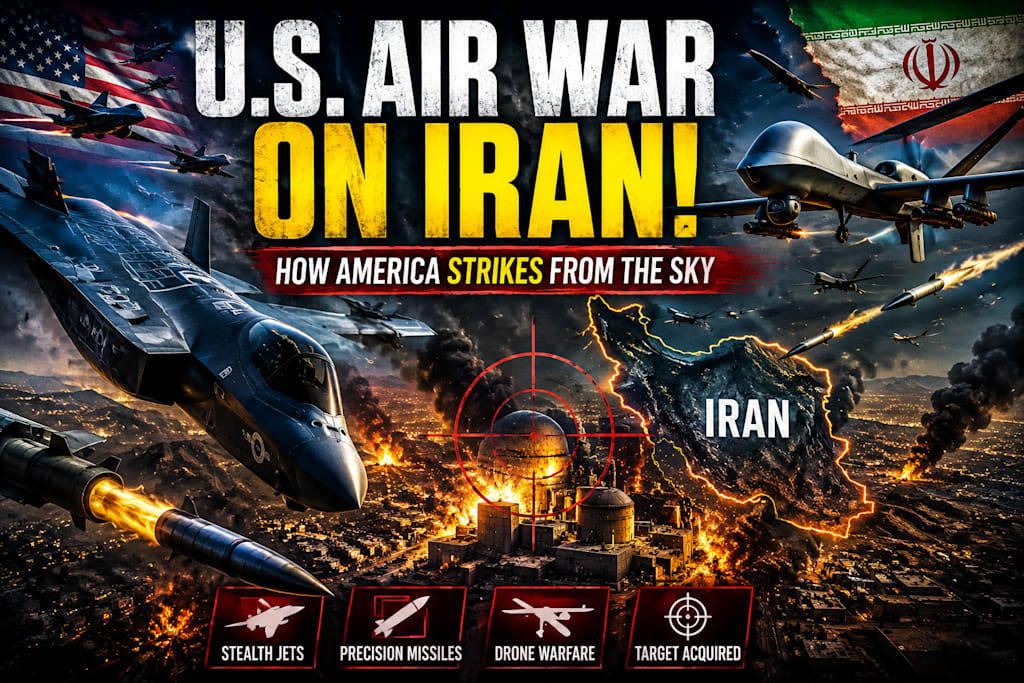
1. War Begins Above the Ground
Modern wars are no longer decided only by soldiers on land—they are shaped in the skies. In the U.S.–Iran conflict, air power became the first and most decisive tool of engagement. Instead of large ground invasions, the United States relied heavily on precision airstrikes, drones, and long-range missiles to weaken Iran’s capabilities. This shift reflects a broader transformation in warfare, where control of the air often determines the outcome before ground forces are even deployed.
2. Operation Midnight Hammer: The Opening Strike
The U.S. air campaign began with a highly coordinated and secretive operation known as Operation Midnight Hammer. More than 125 aircraft, including stealth bombers, participated in the mission targeting Iran’s nuclear facilities. Advanced bunker-buster bombs were used to strike deep underground sites like Fordo and Natanz, while submarines launched cruise missiles simultaneously.
This opening strike demonstrated not only the scale of American air power but also its ability to hit multiple high-value targets within minutes.
3. Stealth Technology: Invisible but Deadly
One of the most powerful tools used by the U.S. was stealth technology. Aircraft like the B-2 bomber can evade radar systems, allowing them to penetrate heavily defended airspace undetected. This capability enabled the U.S. to strike critical targets deep inside Iran without suffering major losses. The success of these stealth missions highlights how modern warfare is increasingly defined by technology rather than sheer numbers.
4. Precision Strikes: Hitting with Surgical Accuracy
Unlike traditional bombing campaigns, the U.S. relied on precision-guided munitions. These weapons use GPS and laser guidance to hit exact targets, minimizing collateral damage. In the early stages of the conflict, dozens of such weapons were used in a single coordinated strike.
This approach allowed the U.S. to focus on key infrastructure—such as nuclear facilities, missile systems, and command centers—rather than widespread destruction.
5. Drones: The Eyes and Weapons of the Sky
Drones played a crucial dual role in the conflict. First, they acted as surveillance tools, providing real-time intelligence about Iranian movements and defenses. Second, they were used as attack systems, capable of striking targets with precision.
Recent reports show that U.S. forces even targeted Iranian drone launch sites near the Strait of Hormuz to prevent further attacks.
This drone warfare represents a major shift in military strategy—reducing risk to human pilots while increasing operational efficiency.
6. Air Superiority: Controlling the Battlefield
A key objective for the U.S. was achieving air superiority—the ability to control the skies. Once Iranian air defenses were weakened, U.S. forces gained freedom to operate deeper داخل Iranian territory. This allowed continuous strikes on strategic targets and reduced Iran’s ability to respond effectively.
Air superiority essentially turned the battlefield in favor of the U.S., making it difficult for Iran to defend its infrastructure.
7. Massive Firepower: Thousands of Targets Hit
The scale of the U.S. air campaign was enormous. Within weeks, American forces had struck thousands of targets using a wide range of weapons systems. Reports indicate that over 20 types of aircraft and multiple missile platforms were used to hit more than 1,000 targets early in the war—and eventually far more.
This overwhelming firepower was designed to degrade Iran’s military capabilities rapidly and decisively.
8. Iran’s Response: Drones and Missiles Strike Back
Despite U.S. air dominance, Iran responded with its own asymmetric strategies. It launched drones and ballistic missiles targeting U.S. bases and regional allies. In some cases, these attacks damaged infrastructure and disrupted operations. Recent clashes show that Iran continues to use drones and missiles to challenge U.S. forces across the region.
This back-and-forth highlights that even advanced air power cannot completely eliminate threats.
9. The Role of Electronic and Cyber Warfare
Modern air warfare is not just about bombs and missiles—it also involves electronic warfare. The U.S. deployed advanced systems to disrupt Iranian radar, communications, and defense networks. By jamming signals and disabling systems, American forces reduced Iran’s ability to detect and respond to incoming attacks.
This invisible layer of warfare plays a critical role in ensuring the success of air operations.
10. A New Era of Warfare
The U.S. air campaign against Iran reflects a new era of warfare—one defined by precision, technology, and speed. Instead of prolonged ground battles, conflicts are increasingly fought through coordinated air and missile strikes supported by intelligence and surveillance systems.
However, the conflict also shows the limits of air power. While the U.S. achieved significant tactical success, Iran’s ability to retaliate with drones and missiles proves that modern warfare is no longer one-sided.
Final Thought: Power in the Sky, Uncertainty on the Ground
The U.S. may dominate the skies, but victory is not guaranteed. Air power can weaken an enemy, destroy infrastructure, and control the battlefield—but it cannot fully eliminate resistance. The U.S.–Iran conflict demonstrates that even the most advanced military forces must adapt to new threats like drones and asymmetric warfare.
In the end, the war in the sky is only one part of a much larger and more complex struggle—one that continues to evolve with every passing day.
About the Creator
Muhammad Zeeshan
I’m Muhammad Zeeshan, a curious student who loves science, geology, and exploring how the Earth works. I write to share ideas, stories, and knowledge that inspire thinking and discovery.
Enjoyed the story? Support the Creator.
Subscribe for free to receive all their stories in your feed.
Comments
There are no comments for this story
Be the first to respond and start the conversation.