
Thoughts and Prayers
How a phrase meant to comfort became a sentence we stopped feeling.

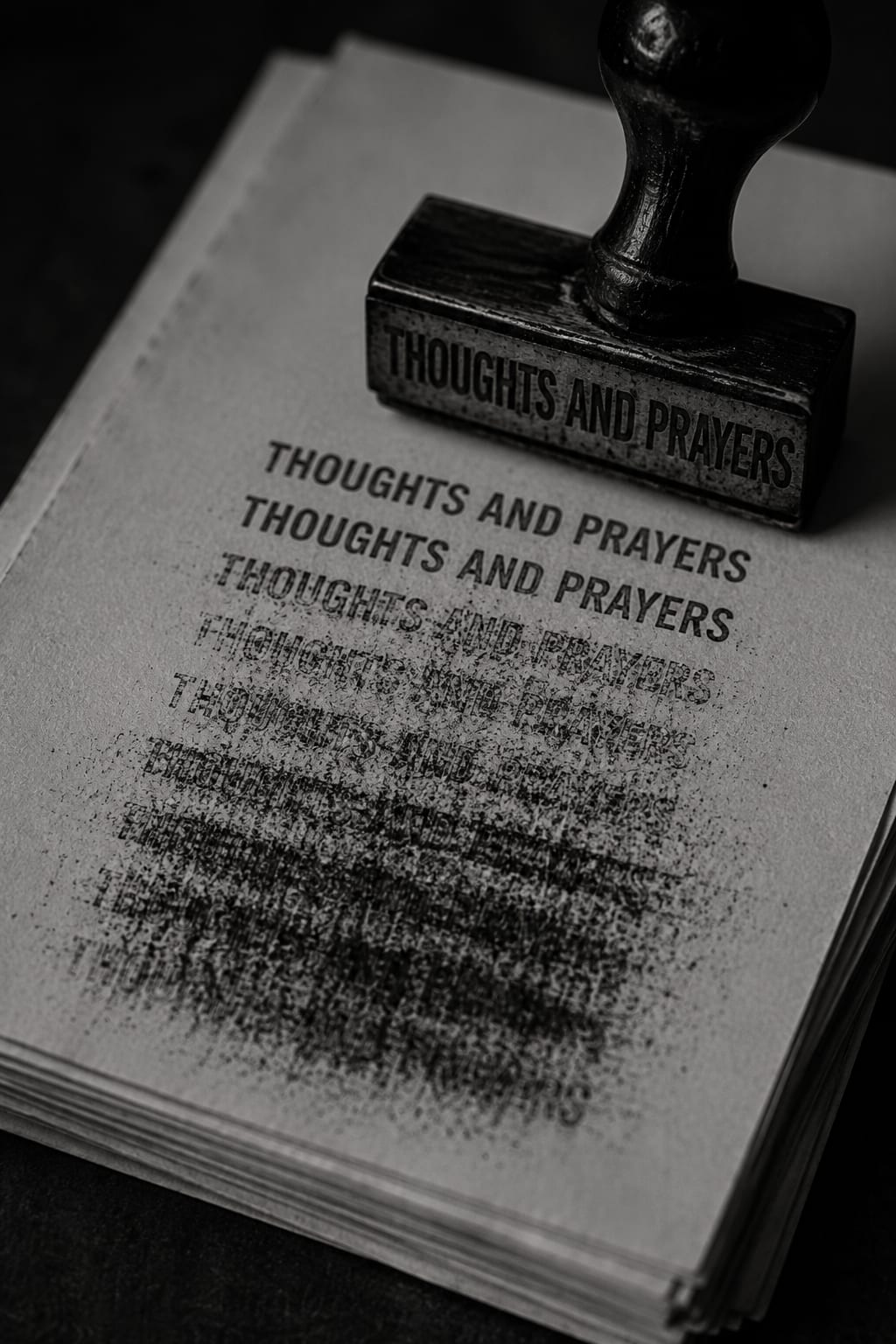
The senator says it first, hand on his tie,
three cameras finding the practiced grief in his eyes.
Our thoughts and prayers are with the victims.
He says it the way you'd say bless you to a stranger's sneeze,
a reflex dressed as reverence,
already thinking about lunch.
Somewhere an aide is drafting the next one,
just in case, just to have it ready,
because these days you always need to have it ready.
I say it too.
I'll admit that.
I saw the news at a red light,
thumb already moving
before my brain caught up to my hand,
and I typed it into the small blue rectangle
where I keep the rest of my feelings these days:
Our thoughts and prayers are with the victims.
Eleven likes.
A crying emoji from someone I met once.
Then an ad for a mattress.
I felt something, briefly,
the way you feel a phone buzz through a coat pocket,
present, but not exactly in you.
It was my sister who taught me what the words used to mean,
though she never meant to teach me anything.
She said it standing in a hospital corridor
that smelled like hand sanitizer and fluorescent light,
not to a camera,
not to a stranger's feed,
but to a nurse, quietly,
holding her own two hands
like something breakable she was trying to keep together.
Our thoughts and prayers are with the victims.
This time there was no "our."
There was just her, alone in a corridor,
meaning every syllable so hard
it came out sounding like it had never been said before.
Like she'd had to invent the words from nothing,
because the ones that existed had been emptied out
by people on television who needed a sentence
that cost them nothing
and asked of them less.
I don't scroll past it anymore, that phrase.
I used to think it was empty
because we said it too often.
Now I think it went empty first,
and we just kept saying it,
the way you keep turning a key
in a lock that stopped being a door.
Somewhere, right now, someone is drafting the next one.
Copy. Paste. Adjust the date.
Our thoughts and prayers are with the victims.
And somewhere else, someone is standing in a corridor,
trying to make the same four words
hold the entire weight of a person,
not knowing they're using
what's left of a language
we broke on purpose,
one press release at a time.
About the Creator
Aarsh Malik
Poet and storyteller who believes in the quiet power of words.
My first book, QUIET FLAME
Enjoyed the story? Support the Creator.
Subscribe for free to receive all their stories in your feed. You could also become a paid subscriber, letting them know you appreciate their work.
Comments
There are no comments for this story
Be the first to respond and start the conversation.