
The Just King and the Tyrant
A Tale of Power, Pride, and Reflection

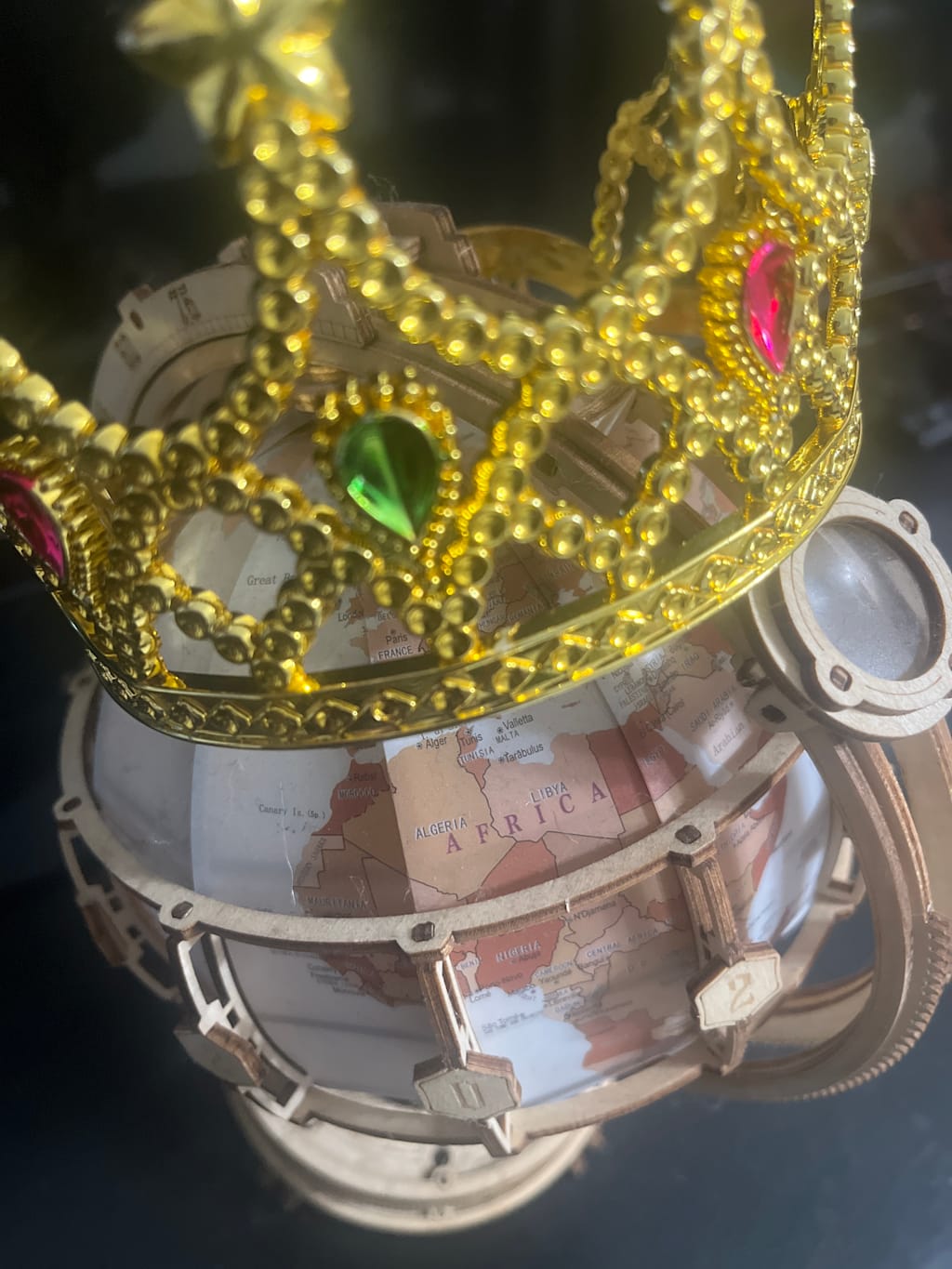
Do you know the difference
between a just king and a tyrannical one?
Well, I will tell you the story of a King,
his family, his people, and what his reign would bring.
He believed himself noble.
He believed himself just.
But whether he truly was
well, that is for you to judge and trust.
So don't get out of your seat.
Don't even budge.
Listen closely to his tale,
and in the end, you be the judge.
He was a grand and jolly fellow,
who decorated his palace in red, blue, and yellow.
He loved those colors dearly
and accepted no other.
For why should a King bend his wishes
just to satisfy another?
His wife loved purple and pink,
but whenever she mentioned them,
he'd run and pretend to vomit in the sink.
“Of course you may have a few things
among your own possessions,
but the rest of the palace is mine,
and its colors aren't up for discussion.”
The Queen found this rather strange,
but remained careful with her expression.
After all, he was the King, and the palace was his obsession.
This King would rather eat the very same dish, even though his children had told him their wish.
“We'd love to expand our palates, Father!
Maybe something new upon our plates?” But the King didn't even bother.
He'd already decided their fates.
“Why? This is my palace!
You have food upon your plate.
Isn't that enough? Why must you always debate?”
“Eat your corned beef hash!
It'll make you strong and buff! Pass the gravy my may dear, and you know I love that stuff”
His children rolled their eyes.
What else did they expect?
Their father rarely questioned himself,
and even less did he reflect.
That was simply how their father was,
or so they'd learned to accept.
For questioning the wishes of their King
was always taken as disrespect.
Outside the palace stretched his kingdom,
and the King believed himself generous and wise. Surely no one could question his goodness just look around with your own two eyes!
He gave charity to the poor
until walking made his feet sore.
To him, generosity was another chore,
Yet kindness, he believed, lived at his core.
So certain was he of his generous fame,
He built his whole kingdom around that name.
“What could my people possibly ask for more?” They should praise what I give, not question what for”
He made sure his kingdom
was quite pleasant to see,
yet the people themselves
weren't as happy as he believed them to be.
One day they came before him. “We wish we had more recreation!” The King simply laughed. “Do you have money for this creation?”
“But this is your kingdom!
These are your people's faces!
Wouldn't you want us laughing and smiling
throughout these beautiful places?”
“Be gone!” laughed the King.
“Do not tell me what to do!
You people are fools.
Now run along and shoo!”
One man dared question the King that day.
“Your rule is pretty unfair,” he had the courage to say.
The King looked at him with an angry glare.
“You question your King? How dare! How dare!”
But the man stood firm, for clearly he truly cared, and went on to tell the King exactly why he dared.
“You drove your people away!
All we requested was something enjoyable to make us want to stay.
Yet you laughed at our wishes and shooed us away. You are a horrible King who doesn't listen to a thing we say!
Why should we stay when misery is all that you bring? Why should we bow down to such a terrible King?
Why should we remain within the walls of this town, when you'd rather see your own people buried in the ground?”
“Silence!” yelled the King. “I will hear none of this!” The King grew angry. The King grew quite pissed.
“Guards! Take this man! He has said enough! Perhaps losing his head will teach him not to speak up!”
And so the King ordered the man put to death, For questioning his rule with his very own breath.
And as his people looked on that execution day, Many began wondering why they should stay.
For if questioning their King could end this way, Perhaps it was safer to leave than have something to say.
But when it came to war,
this King was mighty.
He kept his soldiers prepared,
their formations neat and tidy.
Unfortunately, with war came sorrow,
especially when the King failed to tell his knights what he had borrowed.
This left another kingdom angry and upset,
For the King had built himself a great big debt.
When he failed to make his payment on time, they marched toward his kingdom to collect every dime.
His failure brought a terrible loss of life.
Even his greatest man met his end by the knife.
The kingdom mourned.
The surviving soldiers wailed.
They asked their King to answer
for the ways that he had failed.
But rather than reflect
upon what his choices had cost,
the King grew angry
at the very men he had lost.
“I did what I did!
My soldiers had everything!
What more could I have given?
What more could I possibly bring?
“Ungrateful men! You complain about everything! Have you all forgotten that I am the greatest King?”
And with those words, he dismissed the entire thing. For in the King's own mind, good intentions excused everything.
And if something went wrong
beneath his reign,
surely another must carry
the burden of blame.
As the years passed on,
his people began losing their faith. “How can our King preach principles
that he himself does not undertake?
He demands that we listen.
He demands that we reflect.
Yet when we ask the same of him,
he calls it disrespect.
“We are tired of this kingdom.
We'll find somewhere else.”
The King rolled his eyes.
“I hope you realize
what you've brought upon yourselves!
Be gone from my kingdom!
Go one, go all!
I do not need you
I don't need you at all!”
But what the King had forgotten
was something rather small:
A kingdom without its people
is hardly a kingdom at all.
There was no longer unity,
hardly anyone left to protect his walls. And then, one dreadful day bursting through the air came a tremendous cannonball!
“Down to the dungeon!”
the King shouted to his loved ones.
“I will protect you!
I will keep you safe!
Listen to your King,
and please just have faith!”
The Queen and his children were weary,
for trusting their King had become rather dreary.
Still, they followed him through the halls,
believing he would guide them safely
behind the dungeon walls.
But the King made one wrong turn. Then came a thunderous blast. And in one terrible moment, the King had lost his Queen at last.
A terrible pain tore through the King's heart as he watched his lovely wife
carried away upon a cart.
His children ran toward him.
“We trusted you!
You told us where to go!
Why did you do this to us?
How could you not know?”
The King looked down
at the children making such a fuss.
“I did everything
I possibly could for us!
How was I supposed to know
another cannon would blast here too? I was trying to protect your mother!
What more did you expect me to do?
It is not my fault! You cannot put the blame on me! I am your King! How dare you hold me responsible for this tragedy!”
His children stared at their father,
but there was nothing more to say. For even with their mother gone, the King would see things only his way.
The years passed on,
and the King grew very old.
And throughout the land,
this was the story that was told:
He became known as
the Not-So-Great King,
for throughout his reign,
he tried to control everything.
No accountability.
No reflection.
Not even, in the end,
true protection.
If you spoke out against the King, his guillotine he would bring.
Execution became his favorite way to silence. How could a King bring his own people such violence?
Money troubles worsened; debts began to grow, yet where all the money went, his people did not know.
The people lost their faith; you could see it on each face, for trust had slowly vanished from this once-beloved place.
Even his children began to look at him differently, for the father they once loved was not the man they wished to see.
They loved their father still, but their hearts began to stray, for it becomes hard to love a King who keeps pushing you away.
His children grew older
and ran in every direction,
leaving their father alone
with little remaining connection.
Still, the King could not see his fate. Until one day, one of his sons returned and invited his father for a date.
They sat together at a table,
and his son now a King began telling his father of everything his new title would bring.
“My palace is wonderful, Father! You really should see the sight. I've decorated everything in green and gold, with hints of white.
My wife keeps asking
for a little variation,
but I told her those colors
have no place in my decoration.
This is my palace. I'll decorate it how I want. Of course, I let her keep a few little things to flaunt.
She can put them in her chambers.
Surely that's only fair. After all, I am the King. Why should I change simply because she cares?”
The old King looked baffled
at what he heard from his son.
He couldn't believe this was how
he treated his precious honey bun.
A little confused,
the old King simply said,
“Go on.”
So his son smiled and happily carried on.
“Our meals are grand! We eat only a particular brand. Morning, noon, and dinner, the same meal fills our hands.
My children sometimes complain
and eat without much glee. But who cares what they think? This palace belongs to me!
If they want something different,
they know where they can go. There's an old tavern down the road and a little convenience store.
They can grab something small
and add it to their plate. But Father, is this really what we'll discuss on our date?”
Again the old King was shocked
by the words coming from his son.
How had his children tolerated this? Why hadn't they simply run?
“Oh, and my people!” said the son.
“They complain all day. I give them everything, yet they always have something to say!
They're never satisfied. They're terribly ungrateful. How do you make people happy
when they refuse to be thankful?
All their constant complaining was making me quite snappy! I am the King so why should they be happy?
Do you know what I did, Father? I took away their money! They begged me to reconsider, but I found their pleading funny.
With empty little pockets, they can’t wander all about, So surely now I’ve found a way to hush their whining mouths!
They cannot complain there’s nothing fun to do when they haven’t got a coin to spend or somewhere else to go to.
And crumbs? Oh, Father, they can’t complain about those. For you need food for crumbs, as everybody knows!
Not a crumb upon the table, not a morsel in the house, Not a speck of food remaining not even for a mouse!”
And I haven't even gotten to my soldiers yet. They're mighty, neat, and tidy the finest soldiers you could get.
Just like yours, Father, but they complain far too much. They question my decisions,
and I've had quite enough.
So I'm making a deal with another kingdom instead. I'll bring in better soldiers and replace the ones I've led.
Why bother keeping people who disagree with me? A King deserves loyal subjects
who simply let him be!
Who cares if the soldiers lose their jobs
and have no money to spare? Their families are not my problem why should I even care?
They should have thought about their families before questioning their King.
Their troubles are their own to bear I don't owe them anything!”
The old King could take no more.
“Son! Do you not hear yourself? Have you forgotten what a King is for? This is not how a just King behaves! And with every word, the old King’s heart tore.
You cannot control everyone and still expect their trust. A King must listen to his people. A King must be fair. A King must be just!”
His son slowly looked at him.
Then came a laugh.
“Oh, Father. You have something to tell me
about the proper path? You have something to tell me about how a King should be oh let me laugh
This is how you ruled, Father, until your own kingdom fell. I only looked up to you. And you never knew all your people lived through hell.
I wanted to be mighty.
I kept my kingdom beautiful,
my soldiers neat and tidy.
I learned that what the King wants matters more than what others need. I learned when people question me, I need not listen nor concede.
I learned that when things go wrong,
the blame belongs elsewhere. I learned that being King means I decide what's right and fair.
Who cares what they think? Isn't this all about me? I love being tyrannical, Father. I love being me.”
The old King fell silent. For the first time,
there was no defense to discuss. The man standing before him had become the mirror
he'd spent his whole life refusing to trust.
And finally the King understood why his kingdom had turned to dust. He had spent his entire life believing himself just, when all along he had been unjust.
Tears rolled from the old King's eyes
as he reached for his son's hand.
“Forgive me, Son. There is something now
I finally understand.
I made mistakes I simply refused to see. I blamed everyone around me when the one constant was me.
I demanded people's trust without becoming worthy of their trust. I thought because I wore the crown, my choices must be just.
Please, Son do not become like me. A crown does not make a man just, nor does a throne make him wise. For a tyrant may call himself righteous while ignoring everyone's cries.
I thought I was a just King because that's who I wanted myself to be. But I spent so much time defending myself
that I never looked at me.
I controlled when I should have listened. I defended when I should have reflected. I demanded everyone's trust when their trust should have been protected.
And when those I loved told me that my choices caused them pain, I pointed my finger toward everyone else instead of examining my reign.
Now I see my reflection in the King sitting before me. And the very things that anger me in you are the things you learned from me.”
His son sat quietly. The old King lowered his crown. For once there was no argument, no explanation, no one else to blame around.
Only a King, an empty kingdom,
and the consequences he had found.
And so, dear reader, do you remember the question I asked when our story had begun?
Do you know the difference
between a just king
and a tyrannical one?
Perhaps now you know it isn't the crown upon his head, nor the noble things he claims, nor simply the words he's said.
A just king can face the mirror, even when the truth causes disgust. He can hear that he has caused harm without insisting he was just.
A just king can make a mistake and admit when he was wrong. For taking responsibility doesn't make a ruler less strong.
But a tyrant demands reflection from everyone but himself, until one day his kingdom crumbles and his crown sits upon a shelf.
Our King believed himself noble.
Our King believed himself just.
But you have heard his story now.
You watched his kingdom turn to dust.
I told you not to leave your seat.
I told you not to budge.
And now that you have heard his tale
I'll leave you to be the judge.
About the Creator
Nomora Bautista
I write from real life, dreams, pain, and an overactive imagination. Writing is how I bring the worlds inside my head to life. Some stories are personal, others pure daydreams, but each carries a little piece of me.
Enjoyed the story? Support the Creator.
Subscribe for free to receive all their stories in your feed.
Comments
There are no comments for this story
Be the first to respond and start the conversation.