
The Crimes of Sisyphus
A Stream of Consciousness Poem

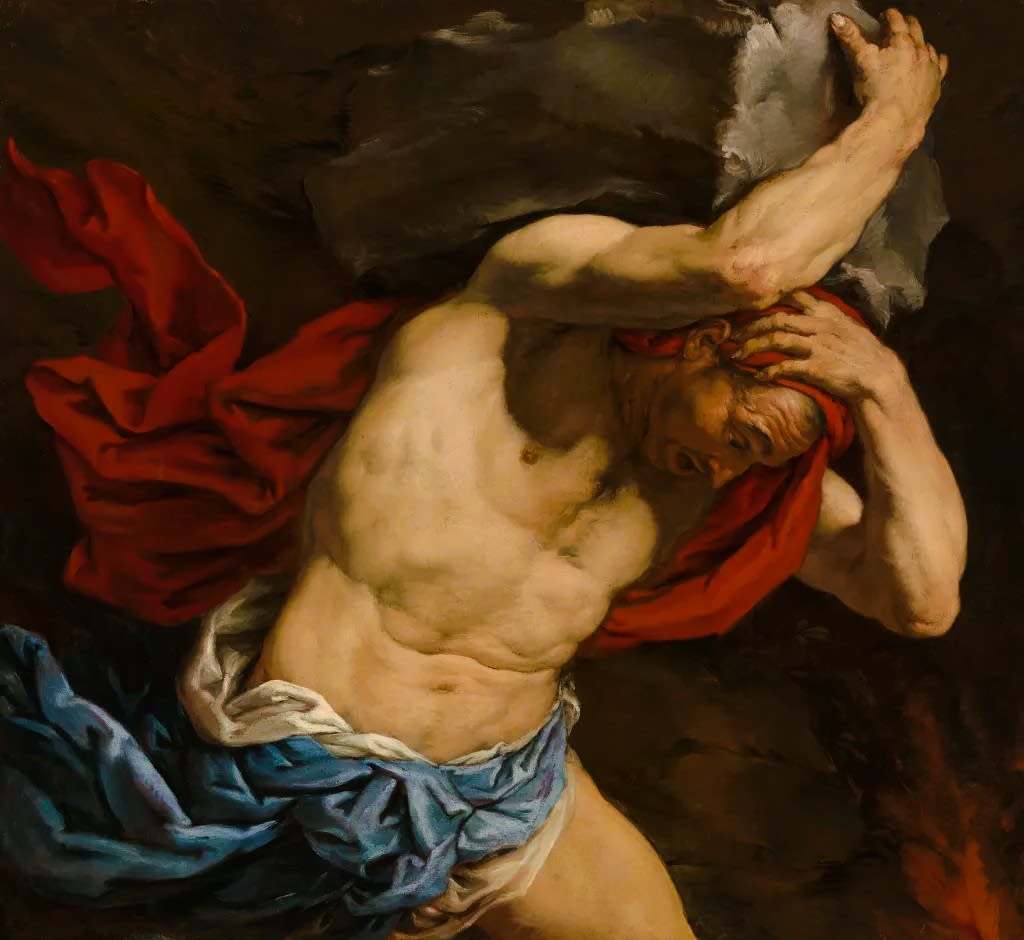
What were the crimes of Sisyphus? We all know about his punishment, but why did Homer think the gods would force him to endure it?
I have only the vaguest idea, despite having read Homer and Camus. I'm obviously a pretentious twit.
Here is what the shallowest part of the ocean of magical misinformation reveals:
In Greek mythology, Sisyphus or Sisyphos (/ˈsɪsɪfəs/ ⓘ; Ancient Greek: Σίσυφος, romanized: Sísyphos) is the founder and king of Ephyra (now known as Corinth). He reveals Zeus's abduction of Aegina to the river god Asopus, thereby incurring Zeus's wrath. His subsequent cheating of death earns him eternal punishment in the underworld, once he dies of old age. The gods condemned him to push an immense boulder up a hill only for it to roll back down every time it neared the top, repeating this action for eternity. Through the classical influence on contemporary culture, tasks that are laborious, futile, and never-ending are therefore often described as Sisyphean (/sɪsɪˈfiːən/).
This is just Wikipedia citing the OED, but it's enough to go on, given how intimately we know the sadistic genius of the penalty.
We could go on about the Odysseus rumor (glorious, given what Odysseus got up to) and Corinth (Oedipus thought he was fine there until he followed up a rumor he heard from a drunk--then we know what he found out) but Sisyphus seems, given the above, to have ratted on Zeus. That was the primary transgression. According to Homer, the haughty denizens of Olympus would not permit that crime to go unpunished, and stale, standard suffering simply would not get the job done. Do the same, meaningless thing forever. The futility will be obvious, and painful.
You may begin
He released the files, to another, lesser deity
That's the great thing about polytheism, or in this case, henotheism
One deity to rule them all, as it were, but badly, as only a human being would, even if that human had power over the sea or war or love
Theogonies of this kind represent conflict among those who are not just powerful, but powers themselves
When a soldier decides to recover the sword from the dirt, where he dropped it because his hand is sweaty and trembling with the fear of an agonizing, imminent death, all in the name of keeping those he loves fed, Mars is there
When a bashful woman steals a tender kiss from someone she just met but likes very much for no reason she could possibly explain, Aphrodite is there
When the water has turned from friend to foe and all aboard will give anything to see tomorrow, Poseidon is there
Zeus is their dreadfully annoying hypocrite and randy knave of a CEO. Sure, he's very much like them, but he can end the meeting and tell them what to do. He frequently breaks the rules and invents new ones on a whim. He is a serial rapist. He is not above committing that crime in the form of a bird or beast.
Sisyphus rats him out when he abducts a woman; what's her story? She was abducted by a god with a terrible reputation, so the odds are not in her favor.
Who among the powerless feels safe in the custody of the powerful? When their black SUV arrives, who leaps into it with glee?
Here is a vague echo of her story, from the same dubious source:
Abduction
According to Apollodorus and Pindar, Aegina was abducted by Zeus,[6] with Ovid adding that he did so in the form of a flame;[7] he then took her to an island near Attica,[8] then called Oenone,[9] henceforth known by her name. Aegina's father Asopus chased after them; his search took him to Corinth, where Sisyphus was king. Sisyphus, having chanced to see a great bird bearing a maiden away to a nearby island, informed Asopus. Though Asopus pursued them, Zeus threw down his thunderbolts sending Asopus back to his own waters. Aegina eventually gave birth to her son Aeacus, who became king of the island.
Wait. So Sisyphus suffers for eternity in Hades, pushing a gigantic boulder (Camus invites us to imagine him learning to love it--desperate times) up a hill, knowing it will appear at the bottom of the hill the moment the valiant struggle is over
Rinse and repeat, always, for as long as time is
Know it is pointless, this thing you do
Know that it could be done by a machine
And the gods want you to do it instead
While the machines do something much more interesting and important
Because you told one of them, a minor guy who's pretty important in a niche area--wet work of some kind
That the guy who runs the whole thing, who is known to be a slave of his genitals, took a beautiful innocent to a remote island--now known by her name, which you can visit today
Huh.
Isn't that something.
Why would you rat out a god, anyway?
Same source (I know, Tl;DR--it's here if you're interested):
Cheating death
Sisyphus betrayed one of Zeus's secrets by revealing the whereabouts of the Asopid Aegina to her father, the river god Asopus, in return for causing a spring to flow on the Corinthian acropolis.[8]
Zeus ordered Thanatos to chain Sisyphus in Tartarus. But Sisyphus sensed him coming, and seized the opportunity to trap Thanatos himself in chains instead. Once Thanatos was bound by the strong chains, no one died on Earth, causing an uproar. Ares, the god of war, perhaps annoyed that his battles had become less diverting because his opponents would not die, intervened and freed Thanatos, enabling deaths to happen again, and turned Sisyphus over to him.[15]
In some versions Hades was sent to chain Sisyphus and was chained himself. As long as Hades was trapped, nobody could die. Consequently, sacrifices could not be made to the gods, and those that were old and sick were suffering. The gods finally threatened to make life so miserable for Sisyphus that he would wish he were dead. He then had no choice but to release Hades.[16][better source needed]
Before Sisyphus died, he had told his wife to throw his naked corpse into the middle of the public square (purportedly as a test of his wife's love for him). This caused Sisyphus to end up on the shores of the river Styx when he was brought to the underworld. Complaining to either Hades or Persephone that this was a sign of his wife's disrespect for him, Sisyphus persuaded her to allow him to return to the upper world, in order to scold his wife for not burying his body and giving it a proper funeral as a loving wife should.[17] But when back in the world of the living, Sisyphus refused to return to the Underworld. He returned many years later either from dying of advanced age, or being forcibly dragged back there by Hermes.[18]
In another version of the myth, Persephone was tricked by Sisyphus that he had been conducted to Tartarus by mistake, and so she ordered that he be released.[19]
In Philoctetes by Sophocles, there is a reference to the father of Odysseus (rumoured to have been Sisyphus, and not Laërtes, whom we know as the father in the Odyssey) upon having returned from the dead.[clarification needed] Euripides, in Cyclops, also identified Sisyphus as Odysseus's father.
Ah, so the minor guy in wet work was her father. Shit. So Sisyphus wasn't just tattling on Zeus for sport. He was filling her old man in about the abduction of his daughter.
Imagine the abduction of any daughter by a lusty, depraved person with enormous power
Imagine what you would do to help any parent rescue an abducted child
Even if her abductor thought himself a god of gods
Ancient myths
How little they have to teach the happy, sophisticated present
About itself
Sisyphus was clever enough to vex the gods and cheat death
Not just his own
For a while, no one died, thanks to him
He told power the truth about its own crimes
He understood that the same justice should apply on Olympus that applies everywhere else
He told those running Olympus as much
And they condemned him to an eternity of absurd toil
But we remember him
His punishment, at any rate
We ought to learn from him
Not to treat our existence as absurd toil
But to know that there will only be justice everywhere
When we are willing to suffer abiding, absurd humiliation
The wrath of those who make laws they do not follow
Who see us merely as their playthings
Objects, not subjects
And continue, bravely, to demand it
Some crimes, not even gods should get away with
About the Creator
D. J. Reddall
I write because my time is limited and my imagination is not.
Enjoyed the story? Support the Creator.
Subscribe for free to receive all their stories in your feed. You could also become a paid subscriber, letting them know you appreciate their work.
Comments
There are no comments for this story
Be the first to respond and start the conversation.