
The Colors and Christophanies
To whom do you today mean freedom?
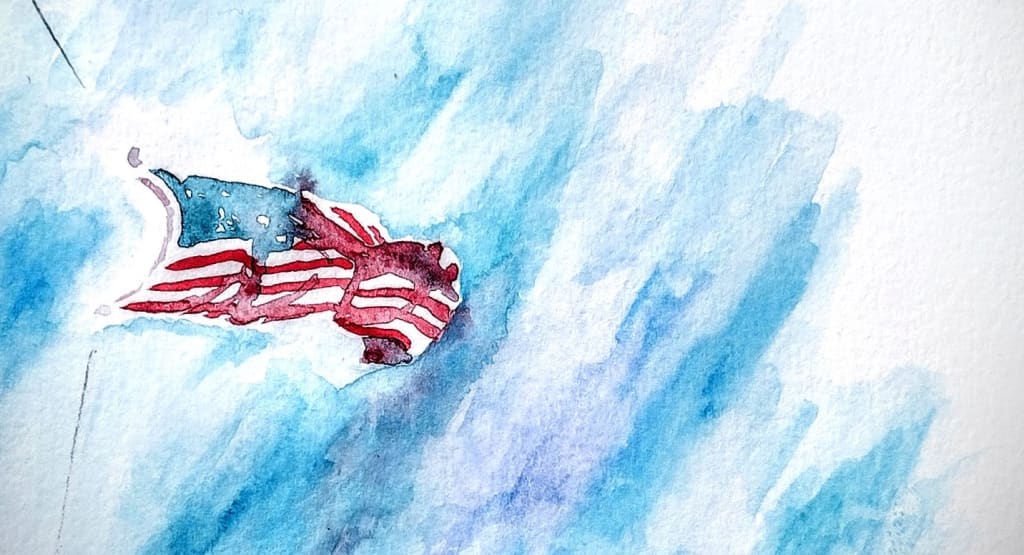
To you, Old Glory, I find myself turned, in days ever more strange,
Wondering, in the shifting wind, when did the colors start to change?
Weren't you born a symbol, bold, for voiceless beneath a cruel kingdom?
So tell me now, with verity, cold - to whom do you today mean freedom?
*
As this chill east wind wraps you 'round an invisible finger,
troubling doubts, dark as gun smoke, eerily long linger;
Old State House's echo dwindles, from when he last tolled,
And cracked - as liberty's glory, his copper form could not hold.
Warning shots were aimed upon him, and in ringing silence now we wait;
As quiet the query sings, can liberty endure in earthly state?
*
Then upon a New Colossus was set that hopeful, impossible load,
And she welcomed the wretched refuse, unconcerned with what they owed.
Yet even a regal, glinting visage, burnished with apparent ideal
May turn a kind tone to covetous green, at prospect of a better deal.
Thus today the humble stable is crushed in favor of glossy estate -
And the dream again falters that we might ever bear liberty's weight.
*
We hold not these truths, heavy as well, self-evident to the modern throng,
As the rich man tells good Christian nation it's the poorest in the wrong.
Your tired, your poor, your huddled masses yearning to breathe free
Are turned away from Ellis's isle, for 'poisoning the blood of our country.'
And believers back the billionaire; why should the meek inherit their earth?
What is truth, in the age of agenda - what's an illegal's story worth?
A label, cruel and simple, removes Imago Dei from refugee,
Thus blamed or bombed - crucified - can be each modern Christophany.
*
So to you, Old Glory, I find myself turned, in days ever more strange,
Wondering, in the shifting wind, when did the colors start to change?
Some stripes, hot red, have forgotten the hue of the sky behind your stars -
And have it in their red-crowned heads, to banish all blue behind bars.
Yet I knew the old guard who used to say, "you might not think like me -
But I'll fight - oh trust, I'll always fight - for your right to disagree!"
*
For the nation, which, on ideal built, fails not when justly criticized
So much as when one lonely pow'r, sees dissidents - difference - exorcised.
But somehow along our tear-stained path, 'liberty and justice for all,'
Was spurned by the new king - so ended its ring, as the noble patriot's call.
Symbols, writs, countries and creeds; they all crest and fall as a rhyme,
And their meanings, each, to whom and why, are made and unmade in time.
*
So to you, Old Glory, I find myself turned, in days ever more strange
Wondering, in the shifting wind, when did the colors start to change?
Weren't you once the symbol, bold, for voiceless beneath a cruel kingdom?
So tell me now, with verity, gold - to whom do you today mean freedom?
*
*
*
*
*
Thank you for reading my poem! Working on this piece has been a mode of cathartic processing in these strange and deeply troubling times. As you have already obliged to give my writing your attention thus far, I will not keep you much longer; I merely wanted to provide some brief further reflections, and the definitions for a few of the potentially obscure terms within the poem above.
In the realm of reflections: I think it important, in light of the tone and central stanza of this poem, that I mention that I am in fact a person of Christian faith. I can imagine that some might read this poem as bitter attack or take-down on Christianity; this is not my intention. What I do intend is to call out the priorities and practices of many Christian churches in the United States today - namely, to unswervingly defend the decisions of our current president - as being almost entirely juxtaposed to the biblical call to see, value, and pursue the good of the most vulnerable in one's society, and generally operate with love, patience, goodness, kindness, and so on. (see Galatians 5:22) We are meant to be a people aware of our own brokenness, comforted by an undying grace and love, and ready to operate with humility in service to a hurting world. I do not see this reflected in so much of the American church today.
Likewise, I am a citizen of the United States of America. Similarly, I can see readers coming away from this piece with the conclusion that I am 'un-or-anti-American.' Once again, this is not the case; on the contrary, I share my critique of the situation at hand as a means of concerned defense of what the Land of the Free is meant to be.
This is a crucial, and on the whole, lost art in modern political landscape: to give and hear the critiques of a differently-minded person, not as a destructive attack, but as a collaboration. This does not mean that disagreement cannot be impassioned - but it does mean that one ought to be able to believe that the people for whom they vote are more interested in building a better world than tearing down the vision of their opponent. Discussion and debate can and ought to be a participation in the great experiment of uncovering a truer, fairer world; to villainize and marginalize is to give in to the cycle of violence.
There are, of course, times when evils are being enacted with such clarity that equivocation must be set aside in favor of speaking out against current policies. I believe we may have arrived at such a point, here in the United States. We have the right to lawfully express our free speech - and I believe that in this moment, it must be utilized to call out the injustices being enacted by our government.
Here in closing is a brief list of definitions for some of the not-so-well known words or phrases which are used in this poem. Many of these, I only learned these through my own personal research - and while I think the narrative of this poem includes context clues about what different phrases allude to, I nevertheless thought it might be helpful to include a little list here.
"Old Glory" is a title used to refer to the flag of the United States of America.
"Old State House" is an old term for the Liberty Bell, the massive, brass, cracked instrument which sat in the Philadelphia State House (later called Independence Hall) and which holds great symbolic significance representing freedom and independence.
"The New Colossus" is the name of the poem written by Emma Lazarus, referring to the Statue of Liberty, which is inscribed at its base; the term makes reference to the statue as a New Colossus, juxtaposed to its Greek namesake for representing liberty and hope for the weary and poor instead of power and cultural domination.
"Imago Dei" is a phrase in Latin used to refer to the theological tenet of the Christian faith that all people are made 'in the image of God.' This forms the basis for the Christian conviction to sacrificially love and serve everyone around them - especially those least seen and appreciated in a society - as it states that all people, regardless of creed, conviction, or background, have in them the heart and handprint of the divine, loving Creator.
"Christophany" is the word for an appearance of the person Jesus Christ outside of the New Testament accounts of his life, death, and resurrection.
About the Creator
Gabriel Huizenga
Twas for love of words that I first joined this site:
Poetry, especially, and dear short stories too;
For to live one's best is to read, and to write!
So find me in words here, and I'll find you 💙
Thanks for stopping by! :)
Enjoyed the story? Support the Creator.
Subscribe for free to receive all their stories in your feed. You could also become a paid subscriber, letting them know you appreciate their work.
Comments
There are no comments for this story
Be the first to respond and start the conversation.