sad poetry
The cathartic nature of poetry makes it one of the best outlets to channel feelings of sadness, emotional turmoil, grief and despair.
The Rhythm of Words: Discovering the Power of Poetry
Under the golden glow of a late afternoon sun, Maya sat by her window, pen poised above her notebook. Outside, the wind whispered through the trees, and somewhere in that soft rustle, she felt a poem waiting to be found. She didn’t think of herself as a poet — just someone trying to make sense of the world through words. But that quiet moment, like countless others before her, echoed a truth as old as time: poetry lives in all of us. Poetry has been humanity’s companion since the dawn of language. Long before written words existed, people used rhythm and rhyme to remember, celebrate, and share. Ancient tribes chanted verses around fires; storytellers in Greece recited epics like The Iliad and The Odyssey; and across the world, poems were sung to honor gods, love, nature, and loss. Poetry was not just art — it was memory, emotion, and history woven together. In every era, poetry has changed its shape but not its purpose. The medieval sonnets of Shakespeare explored love and time, while the powerful verses of Maya Angelou and Langston Hughes gave voice to freedom and identity. From haikus in Japan to ghazals in Persia, from African oral traditions to modern slam poetry, verse has always found a way to speak what the heart cannot say in prose. Maya thought of this as she wrote. She loved how poetry didn’t need perfection — just honesty. A poem could be three lines or three pages. It could rhyme or dance freely across the page. It could whisper softly or shout like thunder. What mattered most was the feeling it carried. As she scribbled her thoughts about the fading day — the amber sky, the whispering leaves, the quiet ache of time passing — she realized she wasn’t just writing about nature. She was writing about herself, too. That’s the quiet magic of poetry: it turns the personal into the universal. A single poem can make a reader halfway across the world nod and think, Yes, I’ve felt that too. Whether it’s heartbreak, hope, or joy, poetry creates bridges between souls. It is both mirror and window — reflecting who we are, and showing us what others see. Modern poetry has found new homes in surprising places. On social media, short verses travel farther than books once did, reaching millions in seconds. A few carefully chosen lines can stop someone mid-scroll, reminding them to breathe, to feel, to think. Poetry readings and slam competitions bring verses to life through rhythm, performance, and passion. In classrooms and therapy sessions, poetry is used to heal — helping people find words for pain that once felt unspeakable. For Maya, poetry became a daily ritual, a way to listen to herself. Sometimes she wrote to celebrate, sometimes to grieve. When words failed, she found comfort in reading others’ poems — lines that seemed to understand her even before she did. She kept a small notebook of favorites: Rumi’s mystic whispers, Mary Oliver’s tender reflections on nature, Amanda Gorman’s courageous call to hope. Each poem was a light, guiding her through different seasons of her life. One evening, she gathered the courage to share her own poem online. It was short — only a few lines about learning to love silence. To her surprise, people responded with warmth, saying the words had touched them. In that moment, she understood what poetry truly was: a conversation between hearts, across time and distance. Poetry reminds us that beauty doesn’t always need to be explained. Sometimes it’s found in a single word, a fleeting image, a pause between lines. It teaches us to slow down, to notice, to feel deeply. Whether carved in stone or typed on a glowing screen, poetry endures because it speaks to what makes us human — our longing, our wonder, our endless search for meaning. As night settled outside her window, Maya closed her notebook, smiling. The day’s poem was complete, but its rhythm still lingered — a soft heartbeat in her mind. Tomorrow, new words would come. And through them, she would keep listening to the quiet music of life.
By Muhammad Saad 11 months ago in Poets
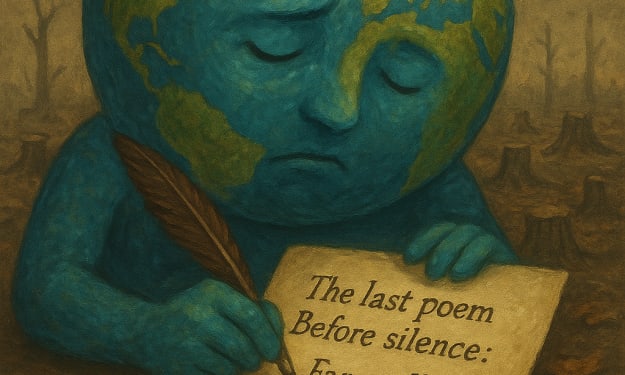
Earth’s Last Poem Before Silence
The wind carried a voice that night — soft, trembling, ancient. It was not a storm or a whisper through the dying trees. It was something older. Something sorrowful. The Earth was speaking for the last time. In a world covered with rusted cities and silent seas, there were no birds to sing, no forests to echo her cry. Humanity had long since gone — leaving behind towers of glass and memories of progress. Yet, beneath the layers of dust and silence, the planet still had one story left to tell. And so, she began her farewell — not in words spoken aloud, but in a poem written with her soul 🌍 Earth’s Poem > “I was once your cradle, your mother of green, Your rivers fed you, your skies kept you clean. You danced in my sunlight, you slept in my rain, But forgot my heart feels sorrow and pain.” The waves, tired and heavy, lapped against broken shorelines, carrying whispers of coral long gone. The oceans, once teeming with life, now mirrored only the dull grey of a lifeless sky. > “You built your kingdoms, your cities of might, But dimmed all the stars that gave you light. You mined my bones, you drank my tears, You called it progress — I called it fear.” The last mountains stood still, their snowy crowns melted into nothingness. Even the glaciers — the ancient keepers of time — had vanished. The Earth remembered when the air once carried laughter, when spring would bloom in a thousand colors. > “I watched you grow, I watched you learn, But love was something you let burn. The trees you cut still whispered your name, But you never listened — and I was to blame.” In a forgotten field, one lone flower pushed through cracked soil — a fragile miracle. Its petals trembled, fragile against the toxic wind. The Earth’s voice grew fainter. > “I gave you oceans and endless skies, You gave me smoke and goodbye eyes. I sang in thunder, I wept in rain, Hoping you’d understand my pain.” 🌧 The Memory of Humanity Even as the Earth spoke, she remembered them — her children. The dreamers. The scientists who tried to heal her. The poets who wrote about her sunsets. The farmers who whispered prayers before planting seeds. Not all had forgotten love. Some had fought to protect her. But their voices were drowned by the noise of greed, by the hum of machines that could not feel the heartbeat of the soil. > “There were some who cared, who cried for me, Who planted hope beside dead trees. To them I give my final song — For even in loss, love lasts long.” Her pulse was slowing now. The core of her heart — once molten and wild — cooled with a weary sigh. The stars above watched in silence. They had seen worlds die before, but none with so much poetry in their ending. 🌑 The Final Breath > “And when the last leaf kissed the ground, When silence was the only sound, I closed my eyes beneath the sky, And whispered softly: ‘It’s okay to die.’” The poem ended there — not with rage, but with forgiveness. The Earth did not curse humanity. She did not scream or demand justice. She simply remembered them with love. Her oceans became mirrors. Her mountains turned to dust. Her air became still. And then — silence. A silence deeper than space, where time stood still and memories floated like ashes. But somewhere, in the universe, perhaps on a new world, a spark of her essence drifted — carrying her poem across galaxies. A fragment of her love for the children who once called her home. 🌠 Epilogue — The Whisper Beyond Time Billions of years later, when another young planet came to life, its soil shimmered with a familiar energy. Beneath its oceans, something began to stir — life. And deep in its roots, faint and eternal, the old Earth’s voice whispered once more: > “If they ever come again, teach them to love me sooner.” Author’s Note (for Vocal Media): This story is a poetic reflection of what happens when we stop listening to our planet. It’s not just about the end of Earth — it’s about the power of forgiveness, memory, and the love that nature holds for its children, no matter how flawed they are. Even if we are gone, Earth’s love — like poetry — might never truly die.
By Fazal wahid 11 months ago in Poets