sad poetry
The cathartic nature of poetry makes it one of the best outlets to channel feelings of sadness, emotional turmoil, grief and despair.
The Poetry Within Us: Unlocking the Human Mind Through Verse
It started with a whisper. Not from another person, but from within—the kind of whisper that stirs at the edge of sleep, that makes you pause mid-step and wonder if you’ve forgotten something vital. For Maya, a neuroscience student drowning in textbooks and lab reports, that whisper came on a rainy Tuesday afternoon. She had spent the past four years immersed in facts—studying neurons, brain scans, dopamine pathways. Everything had to be measurable, repeatable, explainable. Yet, despite her academic success, she felt detached from herself, like a satellite orbiting her own life. Then came the elective course: The Psychology of Poetry. She enrolled reluctantly, needing the credits, expecting little more than historical analysis and a few stanzas of Shakespeare. What she didn’t expect was to cry in class. The poem was “Having a Coke with You” by Frank O’Hara. The professor read it aloud—gently, deliberately, with reverence. Maya didn’t understand why her chest tightened or why her eyes stung. She had never met the poet, had never experienced his world, but somehow, in those lines, she felt seen. That was the moment everything changed. --- The human brain, Maya would later learn, doesn’t distinguish sharply between real and imagined emotion. When you read a poem that evokes sadness, joy, or awe, your brain often responds as if you’re living the experience. The same neural circuits activate—the limbic system lights up, oxytocin is released, and connections strengthen. Poetry, she realized, was a neurological symphony. And yet, it was more than chemistry. It was a bridge. In class, students shared poems that had shaped them. One read about their father’s death; another about coming out. A quiet classmate, who never spoke during biology lectures, recited a piece they had written about anxiety—each metaphor a map to a place they’d never shown anyone. For the first time, Maya understood the quiet power of shared vulnerability. Poetry didn’t just unlock the mind. It softened it. --- Maya began writing her own verses. At first, they were clumsy and overly structured, like her lab reports. But slowly, the lines loosened. Rhyme gave way to rhythm. She wrote about her mother’s silence, her childhood fear of thunderstorms, the pressure to be “smart” and composed. Each poem was a key, unlocking memories she hadn’t realized were sealed away. More importantly, it made her a better friend, sister, and researcher. She started noticing emotional subtleties in conversations, listening not just for content but for cadence, for pauses, for what went unsaid. Her empathy deepened, and so did her curiosity—not just about how the brain worked, but about how it felt to be alive. --- Scientific studies began to echo what Maya felt intuitively. A 2023 research article revealed that reading and writing poetry could significantly reduce symptoms of anxiety and depression, especially in adolescents. Another found that poetic language activated regions of the brain associated with reward and memory more intensely than ordinary speech. Even patients with dementia, when exposed to familiar poems, displayed improved communication and mood. Poetry, it turned out, could tap into neural pathways long after others had deteriorated. Maya started volunteering at a memory care center, reading poems to elderly residents. One woman, who rarely spoke, began reciting lines of Emily Dickinson, her voice frail but steady. For a moment, her eyes sparkled with recognition, as if time had folded in on itself and brought her home. It was more than therapy. It was resurrection. --- Years later, with a PhD in neuroscience and a poetry collection published, Maya stood at a TEDx stage. Her talk was titled “The Poetry Within Us: Unlocking the Human Mind Through Verse.” She spoke not just of neurons and scans, but of silence broken by verse, of people finding their voices, of science meeting soul. She ended with her favorite line from Mary Oliver: > “Tell me, what is it you plan to do with your one wild and precious life?” And then she answered, in a quiet voice: “To listen. To write. To feel. To remind others that within every brain—no matter how scarred or silent—there lives a poem waiting to be heard.” --- In a world obsessed with speed, productivity, and logic, poetry reminds us to slow down, to sit with discomfort, to find beauty in ambiguity. It sharpens cognition, enhances emotional literacy, and deepens connection. The poetry within us is not a luxury. It is a necessity. And when we unlock it, we unlock each other.
By Muhammad Saad 10 months ago in Poets
The Ink That Found Its Sunrise
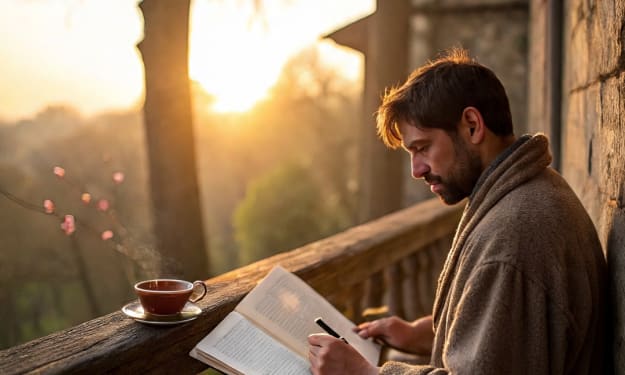
Mira had always believed that morning light carried its own kind of poetry. It slipped into the world quietly, softening everything it touched. But lately, she felt no connection to those first rays of the day. Her pen lay untouched, and the blank pages in her journal seemed to echo her uncertainty. For years, writing had been Mira’s companion—her way of expressing what she couldn’t speak aloud. She wrote about seasons changing, about laughter drifting between doorways, about the invisible threads that link people to one another. But as life became busier, and worries accumulated like unopened letters, her creative spark dimmed. One morning, she sat on her small balcony with a cup of warm tea. The sun was rising, turning the rooftops into softened shapes of gold and pink. The air smelled of dew and quiet beginnings, but the beauty felt distant, as though she were watching her life through a window. “I can’t feel anything to write about anymore,” she whispered. At that moment, her neighbor, Mr. Haleem, stepped onto his balcony. He was an elderly man known for tending to his flowers and humming old songs that carried across the courtyard. “You’re up early, Mira,” he called gently. “Everything alright?” She hesitated, then nodded politely. But something in her expression must have given her away. He smiled kindly. “You look like someone searching for something.” Mira sighed. “I used to write poetry every day. Now I hardly recognize the person who wrote those words.” Mr. Haleem leaned on his railing. “Tell me something,” he said. “When you look at that sunrise, what do you see?” Mira blinked. “I… don’t know anymore.” He chuckled softly. “Then perhaps you’re looking too hard.” She turned toward him, curious. “You know,” he continued, “people think poets need grand inspiration. Lightning moments. Extraordinary stories. But the truth is simpler. Poetry grows from noticing small things—things that most people walk past without seeing.” He gestured toward the potted jasmine plant beside him. “This little flower bloomed today. Just one. The rest are still waiting. But this one decided to open anyway. Isn't that something?” Mira looked at the jasmine. Its single white bloom glowed in the sunlight, gentle but confident. Before she could respond, Mr. Haleem added, “Sometimes we expect ourselves to bloom every day. But even flowers take their time.” The words settled into her like warm rain. After he went back inside, Mira stayed on the balcony, listening to the distant calls of vendors and the sound of early birds darting between rooftops. The world was waking up, soft and unhurried. She opened her journal—not to write a masterpiece, but just to write something true. She wrote: Today, a jasmine bloom reminded me that growth can be slow, and still be beautiful. For the first time in weeks, her hand didn’t tremble. She continued writing small observations—the sound of her neighbor’s humming, the warmth of her tea, the way sunlight softened the edges of her fears. Her words felt simple but sincere, like the first steps of someone learning to walk again. Later that day, she took a walk to the local market. Children were laughing, old women bargaining cheerfully, a young man sketching portraits near a tea stall. Life was unfolding in dozens of tiny stories, each one a poem waiting to be noticed. Mira paused beside a stall selling handmade notebooks. One had a sunrise painted on the cover. She held it in her hands, feeling an unexpected spark of joy. She bought it—not because she needed more pages, but because she wanted to celebrate this small return to herself. That evening, she sat by her window and wrote again, letting her thoughts flow gently, without judgment. Poetry doesn’t disappear, she realized. It simply waits for the heart to slow down enough to hear its voice again. As the sun dipped below the horizon, Mira closed her notebook, feeling steady and hopeful. She knew her creativity would rise and fall, just like the sun—but it would always come back, carrying light with it.
By Muhammad Saad 10 months ago in Poets