nature poetry
An ode to Mother Nature; poems that take their inspiration from the great outdoors.
Voices Woven in Ink
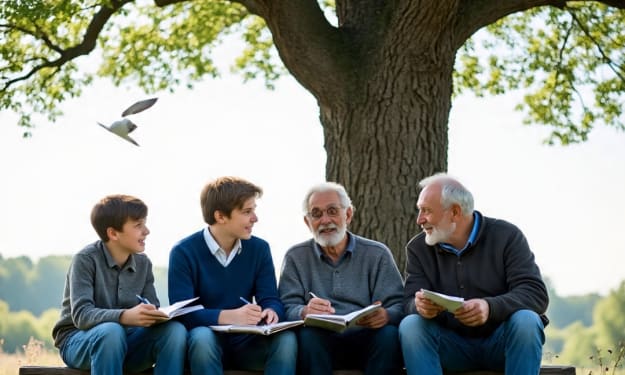
In the tranquil town of Penridge, words were not merely spoken—they were cherished, shaped, and refined like precious art. The people there believed that poetry was not something a person wrote; it was something a person lived. The community of poets in Penridge held this belief close to their hearts, and their devotion to honest expression made the town glow with creativity. Among these poets was a soft-spoken boy named Arham, who always carried a little notebook tied together with strings. He listened to people more than he talked, and the world fascinated him in ways he could never quite explain in everyday speech. But when he wrote, his words became strong, meaningful, and full of hope. He believed poems could heal sorrow, brighten a day, and bring people closer to kindness. Every Thursday evening, the poets of Penridge gathered under the huge Cypress Tree that stood near the old riverbank. The tree’s branches spread wide, as if protecting the writers who sat beneath it. Lanterns hung from the branches, glowing like stars trying to touch the earth. There were benches carved from logs, and a table filled with open notebooks, shared ink, and warm tea. This spot became the heart of their community. Poets of all ages sat together—old storytellers, young dreamers, and thoughtful writers who believed in the goodness of words. No one was judged for what they wrote. Every line was respected, every poem welcomed with warmth. When someone read a piece, others listened not to criticize, but to understand. Arham admired this culture deeply. He remembered how, months before, he had been too shy to share his writing. He feared his poems were not poetic enough, not grand enough to speak among great poets. But the community changed him. They taught him that poetry was not about perfect words; it was about true feelings. One evening, as the sun dipped behind the hills, their mentor, an elderly poet named Rahim, spoke with a gentle voice: “Poetry is not written to impress anyone. Poetry is the light we offer to others. Even a few honest lines can brighten a life.” That night, Arham took a deep breath and stood in front of the others. His hands trembled a little, but his heart felt brave. He read a short poem he had titled A Quiet Morning Speaks. His voice shook in the beginning, but the warmth of the community helped him continue: When silence wakes the river And dew rests upon each leaf, I hear the whisper of hope, Soft, gentle, kind, and brief. Morning brings a promise, Not loud, yet clear and true— That life grows in small moments, And light begins in you. When he finished, the group didn’t just clap—they smiled with a sincerity that made Arham feel understood. Some nodded in appreciation, others wiped tears they didn’t expect. For the first time, Arham realized his voice mattered, his feelings belonged in the world of poetry. From that evening on, Arham no longer wrote in secret. He shared his words proudly, not to show talent, but to spread peace. He helped younger boys learn how to value their own writings and reminded them that every poet was a gardener planting seeds of kindness through language. And so, the poets of Penridge continued to meet beneath the Cypress Tree, week after week, year after year. They built more than poems—they built connection, courage, and hope. Their words became a gift, shared freely with anyone willing to listen. In Penridge, poetry lived not just in books, but in hearts that believed every line could make the world a little more gentle, a little more true, and a little more beautiful.
By Muhammad Saad 10 months ago in Poets
Builders of the Unspoken Verse
There is a special community known not for their buildings or inventions, but for something far more precious: words that heal. They call themselves Builders of the Unspoken Verse, a small group of poets who meet every weekend beneath an old banyan tree near the river’s edge. Their leader, Master Faizan, was a wise elderly poet who believed that poetry wasn’t just a talent—it was a bridge that connected hearts. He often said, “Words are not written to be admired, they are written to be felt.” Among the members was Aamer, a quiet young man who rarely spoke, but always listened. His poetry was full of observations—small moments others overlooked: the ripples on water, the silent whisper of autumn leaves, the courage hidden in a simple smile. Everyone admired his work, even though his voice was too shy to read it aloud. Another member, Bilal, was the opposite. Loud, funny, and full of imagination, he wrote stories in verse. His poetry danced with humor and adventure, turning ordinary situations into magical tales. He often teased Aamer playfully, encouraging him to share his poetry out loud, but Aamer always refused with a shy grin. Then there was Umair, who wrote to heal. His poetry came from experiences—some painful, some heartwarming, all deeply honest. Whenever someone was troubled, his words were like gentle rain easing the dust of sadness. Umair often said, “Poetry is the voice we need when we cannot speak.” Every weekend, the community sat under the banyan tree, sharing verses that shaped their emotions into art. Some wrote about nature, others about faith, some about laughter, and some about sorrow that eventually found peace. Together, they believed that poetry was not just writing—it was a way of living with understanding, kindness, and awareness. One morning, Master Faizan arrived with a simple announcement: the city was holding its first Poetry Festival, and their community was invited to perform. The members were thrilled, except Aamer, who felt his chest tighten at the thought of reading in front of strangers. Master Faizan noticed his discomfort and placed a gentle hand on his shoulder. “You write what others feel but cannot express. You don’t need a strong voice, you only need a sincere heart. That is enough.” The day of the festival arrived. The stage was small but filled with excitement. Poets from many places came, each with their own style. When it was the turn of the Builders of the Unspoken Verse, Bilal read first, making the audience laugh with his witty storytelling. Umair followed with a deep emotional poem that left quiet reflection in the hearts of listeners. Then Master Faizan announced, “Our final poet is Aamer.” The crowd applauded, but Aamer’s hands trembled. As he stepped forward, Bilal whispered, “Don’t worry, we’re here.” Umair smiled, “Just speak your truth.” With his notebook shaking slightly, Aamer began. His voice was soft at first, but his words were powerful. He spoke of ordinary moments that revealed extraordinary emotions; of nature’s quiet wisdom; of unseen courage living in every human heart. By the end, the audience was silent—not from lack of interest, but from awe. And then, they erupted into applause. Aamer’s voice, though soft, reached every soul present. From that day on, the community grew, not because they sought fame, but because they shared something pure: poetry that healed, connected, and inspired. Under the banyan tree, their words continued to build bridges of understanding, reminding the world that feelings deserve a voice—and poetry is that voice.
By Muhammad Saad 10 months ago in Poets
Echoes of the Honest Pen
Poetry has always been a home for wandering hearts, and in the quiet town of Silver Pines, this truth lived inside every line written by its poets. Among them was Ayan, a gentle young man whose mind carried more thoughts than he could ever speak. For him, poetry was not simply a hobby—it was a bridge that connected his inner world with the world outside. Ayan believed that poetry was a form of honesty. He often said, “A poem is a voice that whispers the truth even when the world is loud.” His friends in the poets’ community admired him for this sincerity. They often gathered in an old library that smelled of old pages and soft memories. It was their meeting place, their creative shelter. One cool morning, the community decided to host a gathering where everyone would share a new poem. Ayan arrived early, carrying his simple brown notebook. He sat near the window, listening to the soft wind brushing against the pine trees. He felt calm, yet a small nervousness whispered inside him. He had written many poems before, but this time the poem felt special—because it carried a message he needed to share, not just one he wanted to write. As the poets arrived, the room filled with warm greetings, laughter, and the quiet rustle of papers. Some were older, with white beards and calm eyes; others were young, still learning the music of language. But they were all connected by one thread: the love of words. The meeting began with stories, reflections, and tiny moments of joy that only poets understood—like the excitement of a perfect metaphor or the comfort of a familiar line. Then came the time for reading. Ayan was the last to be called. He stood up slowly, holding his notebook gently as if it were something fragile. His heart thumped, but he knew his words had a purpose. He opened the notebook and began, “This poem is for anyone who has ever felt unheard.” His voice was soft but steady. He read about the quiet struggles people carry, the dreams they fear to admit, and the hope that hides behind tired eyes. He wrote about the power of a kind word, the strength in honesty, and the beauty found in simple moments—like sunlight on paper or the warmth of a shared smile. As he read, the room fell completely silent. Every poet listened, not just with their ears but with their hearts. When he finished, he slowly closed his notebook. For a moment, no one spoke. Then applause rose gently, filled with appreciation and warmth. One of the older poets stood up and said, “Ayan, your words remind us why we write—to heal, to connect, and to bring light.” Ayan felt a soft relief wash over him, like a quiet sunrise after a long night. He had always believed in the power of poetry, but now he understood something more: poetry was not just about expressing oneself. It was also about offering kindness to others through words. The gathering ended with new friendships formed, new ideas sparked, and a shared promise to continue writing with honesty and purpose. As Ayan walked home, he felt lighter. He knew that from now on, he would write not just to express his thoughts, but to lift others—just as the poets had lifted him. In Silver Pines, the echoes of the honest pen would continue to shine, reminding every poet that words, when spoken with truth and kindness, have the power to change lives.
By Muhammad Saad 10 months ago in Poets
Echoes of Gentle Lines
Poets live in a world that many never notice—a world built from quiet thoughts, gentle reflections, and the soft echoes of unspoken emotions. While others rush through life, the poet listens. He listens to the hush of the morning wind brushing against the window. He listens to the rustle of leaves announcing the change of seasons. He listens to his own heart, even when it whispers things too delicate to say aloud. In a small town surrounded by hills and calm rivers, there lived a young poet named Elias. He was known for carrying a small notebook everywhere he went. It was old, a little torn at the edges, but it held his world inside it—thoughts, pieces of stories, lines of poetry he did not yet understand, and emotions he was still learning to name. Elias believed poetry was not something created from brilliance, but something discovered inside moments. He found poems in warm cups of tea, in the peaceful silence after rain, in the way sunlight touched the earth every morning as though blessing it again. Yet, no matter how many lines he wrote, he often wondered if his words mattered to anyone. One morning, he walked to the old riverside bench—a place the local poets’ community often gathered. They called themselves The Gentle Lines Circle, a group of men who believed poetry could make the world softer, kinder, and more patient. When Elias arrived, they were already there: Malik, the oldest poet with a calm presence like steady rain; Haroon, whose laughter always arrived before his words; and Imran, a quiet thinker who wrote poems about stars even though he had rarely seen a truly dark sky. Malik welcomed Elias with a nod. “What do you bring today, my friend?” Elias hesitated. His notebook felt heavier than usual. “I’m not sure,” he said softly. “Maybe just a few broken lines.” Malik smiled. “Broken lines are still lines. They just need someone to hold them gently.” They all sat together, listening to the river’s steady melody. The poets took turns sharing their pieces. Some poems were long and thoughtful; others were short, just a handful of words. But all were sincere. When it was Elias’s turn, his voice trembled. “It’s not finished,” he warned. “It doesn’t need to be,” Imran replied. “Poetry is never finished. It simply pauses when we stop writing.” Taking a breath, Elias began to read: There is a place inside every heart, Where unspoken things rest, Waiting for a gentle morning, To rise like soft light through a window. The circle was silent for a moment—not from confusion but from connection. Malik placed a hand on his notebook and said, “Your words carry light, Elias. You think they are small, but they reach far.” Elias felt something warm grow within him. For the first time, he understood that poetry was not only about crafting beautiful lines. It was about touching another person’s inner world. About reminding someone they are not alone. About offering a moment of peace in a noisy existence. As the sun began to set behind the hills, the poets sat together in a comfortable silence. The river glowed golden. Birds flew low, heading home. And Elias realized that poetry was not a talent—it was a gift meant to be shared. That evening, he wrote in his notebook: Poetry is the gentle promise that even the quietest voice can brighten someone’s day. He smiled, knowing he was exactly where he needed to be—among poets, among friends, among hearts that understood the value of gentle lines.
By Muhammad Saad 10 months ago in Poets