love poems
Love poems for hopeless romantics; I'm the poet and you're my muse.
Ink Stains on My Soul
They say words are just words—harmless things floating on pages like dust in sunlight. But I know better. I’ve felt them cut through silence, echo in my chest, and settle like ink stains on my soul—permanent, haunting, and oddly beautiful.
By Hanif Ullah about a year ago in Poets
A Love Never Dies
Through fading dusk and morning skies, A true love lives, it never dies. Though years may pass, and faces change, Its echo sings in softest range. A whispered name, a fleeting glance, Revives the heart’s eternal dance. Though silence falls and time departs, It leaves its footprints on our hearts. No storm can wash its fire away, No night can steal its gentle day. It grows in grief, it shines in tears, It holds us close through distant years. In letters kept, in worn-out shoes, In songs that only we still choose— It lingers there, a tender flame, Untouched by loss, unscarred by shame. So let the seasons spin and bend, This love endures—it will not end. For when two souls are truly one, They shine beyond the setting sun. And though the world may change its guise, A love like ours—it never dies.
By Israr khanabout a year ago in Poets
She Left Her Shadow Behind
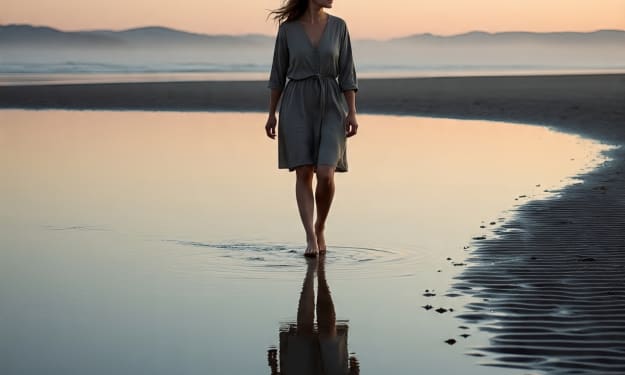
They say everyone carries a shadow. It trails us faithfully, stitched to our heels by sunlight and moonlight alike. It bends, dances, and sometimes grows monstrous at dusk. But hers was different. Or perhaps, she herself was different. Amara had always felt the weight of something she couldn’t quite name. In the glare of the morning sun, her shadow would stretch across the cobbled streets of her quiet town—long, dark, and unmistakably hers. Yet at dusk, when shadows thickened and blurred, hers seemed heavier, as though it whispered secrets she refused to hear. As a child, she would walk barefoot through meadows where dragonflies skimmed the tall grass. She would turn suddenly, trying to catch her shadow unaware. It always stayed. Always loyal. But deep in her heart, she sensed it was less a companion and more a tether. Years passed, and the world grew noisier around her. She became an artist, sketching women without faces and cities without names. Each canvas felt honest, yet incomplete. Friends would praise the raw emotion in her work, but she knew something was missing. A truth she couldn’t yet bring herself to paint. Then came the dream. It arrived one night like a silent tide, neither comforting nor terrifying. She stood on the edge of a forest at dawn, dew clinging to her bare feet. Her shadow lay behind her on the moss, darker than night itself. It whispered, though she could not hear words—only feel the gravity of its pull. She stepped forward. The whispering faded. And when she turned back, the shadow was gone. Amara woke with a start, breath caught in her chest, her heart drumming like a warning. Yet instead of fear, she felt an unfamiliar lightness, as though a lock had clicked open in her ribs. She painted feverishly that morning: a figure walking toward a sunlit clearing, leaving a shapeless dark form behind. The brush moved almost of its own accord, as if her hands had been waiting for this story to reveal itself. When it was done, she sat before the canvas for a long while. It was the first painting she signed. That evening, she went to the shore. The tide had pulled back, revealing small treasures: a sea-glass shard, a broken shell, driftwood bleached silver. As she walked, she caught glimpses of herself reflected in shallow pools. But where her shadow should have stretched beside her, there was nothing but wet sand and rippling light. At first, panic rose like a wave. How could she be here, in the realm of the living, without the dark echo that proved her existence? But slowly, as the sea breeze lifted her hair and salt stung her lips, she felt only release. The absence was not emptiness; it was freedom. That night, she dreamed again. This time, the forest was gone. She stood in an open field beneath a sky painted in bruised purples and soft golds. The world felt endless, and she felt infinitely small and infinitely whole. A voice, barely louder than a breath, spoke: “What is left when the shadow leaves?” She answered without speaking: “Only me.” In the days that followed, people noticed a change. Her friends spoke of a glow about her, an ease in her laughter, a softness in her gaze. Her art transformed too. Gone were the faceless figures and nameless streets. She painted light itself: wildflowers lit by dawn, city windows glowing at dusk, rain-slick cobbles catching lanternlight. Yet, even as her work brightened, there was a haunting beauty to it. As if the absence of her shadow had left space for something greater—a deeper honesty, a raw vulnerability that spoke to those who saw it. Some whispered that she had made a pact, traded her darkness for inspiration. Others said she had simply healed. But Amara knew the truth was both simpler and stranger: she had chosen to walk forward, even knowing the cost. One evening, standing before her latest canvas—a girl stepping into morning mist, leaving only footprints behind—Amara whispered to herself, “She left her shadow behind.” The words felt true, final, and yet filled with beginning. For in shedding what weighed her down, she had found the truest light: the one that came not from the sun, but from within. ---
By Mati Henry about a year ago in Poets