love poems
Love poems for hopeless romantics; I'm the poet and you're my muse.
The Garden of Growing Hearts
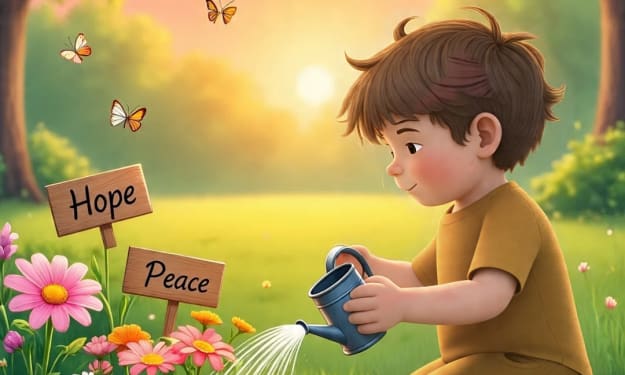
🌼 Poem Story: “The Garden of Growing Hearts” In a corner of the world so still, so bright, Lived a garden kissed by morning light. Not made of roses alone, but dreams so sweet, Where every heart-shaped flower learned to beat. The seeds were sown by a gentle thought, Not bought with money, not ever bought. They grew from whispers of caring words, From kindness shared and softly heard. One blossom bloomed when someone forgave, Another rose up when a stranger braved To help a soul without asking why— Planting hope beneath the endless sky. There was a lily called Patience Today, It opened slowly in a humble way. Beside it stood Courage, tall and bright, Guarding the garden through cold and night. Gratitude glimmered in the morning dew, Reflecting golden, warm, and new. And Love, the biggest flower of all, Grew roots so deep, it stood like a wall. A little child with a watering can Visited daily, with a simple plan— To feed each bloom with words so kind, With peaceful thoughts and a giving mind. And oh, how marvelous those flowers grew, Coloring mountains, painting skies blue. For kindness multiplies just like seeds, Blooming strongest when meeting needs. So tend your garden with care each day, Let empathy lead you along the way. Hearts grow stronger where love takes part, For the world is a garden— and you are the heart.
By Muhammad Saad 10 months ago in Poets
The Symphony of Quiet Pens
The sun rested just above the horizon like a shy dream, spreading golden warmth across the old park. The air smelled of wildflowers and morning dew, and the tall trees whispered their gentle secrets. On a quiet stone bench near the lake sat a young poet named Ayan, holding a notebook that was emptier than his mind. He dreamed of writing something beautiful—something meaningful—but inspiration slipped through his thoughts like sand through uncertain hands. Every Saturday, a community of poets gathered beneath the grand old tree near the library. They called themselves The Quiet Pens, not because they were silent, but because they respected the stillness from which great words were born. Some were experienced, others beginners; some wrote long poems, others short verses that felt like shooting stars on paper. Ayan had always watched from a distance, afraid that his poems would never be good enough. Poetry, to him, was a fragile bird—beautiful but easy to break. Yet on this particular morning, something felt different. His heart pulled him toward the group like an invisible invitation. He saw an older man arranging papers on the wooden table. His beard was white, and his posture calm, like a book that had lived many stories. His name was Ustad Fareed, the founder of The Quiet Pens and the mentor of many poets. With eyes full of warmth, Fareed noticed Ayan standing shyly beneath a branch. “Welcome,” he said gently. “A poet doesn’t need courage to write—only honesty. Tell your heart to speak, and the rest will follow.” Ayan felt his nerves soften. He sat at the table, surrounded by writers with notebooks full of wonder. There was Nimra, who wrote poems inspired by stars; Haris, who transformed ordinary lives into masterpieces; and Mahnoor, who loved rhyming with nature. They welcomed Ayan as though he had always belonged. The activity of the day was simple: Write a poem about hope, and then share it aloud. Ayan stared at the blank page again, but this time, he wasn’t alone. He listened to the chatter of leaves, the hum of the wind, and the soft scratching of pens. Words slowly appeared: Hope is a lamp in silent rooms, A spark in ashes, a tree that blooms. It waits in shadows, soft and true, And rises gently, like morning dew. When it was his turn, Ayan’s voice shook at first, but he continued. As he read the final line, the group applauded. Not politely—warmly, sincerely. Nimra leaned closer and said, “Your words feel like sunrise.” Ayan felt something he had never felt before, not from writing alone—belonging. Ustad Fareed smiled proudly. “Every poet brings a new rhythm into the world. Today, you brought a sunrise. Keep writing. Words live in those who dare to speak from the heart.” Over the next weeks, Ayan returned every Saturday. His notebook grew heavier, not with pressure, but with poems full of light. He laughed with the group, listened, learned, and shared. The Quiet Pens were no longer strangers; they were a family of creativity—united not by blood, but by language and dreams. One afternoon, as the sun painted the sky in soft orange strokes, Ayan noticed something: The world around him felt more alive. Leaves weren’t just leaves anymore—they were metaphors. The wind wasn’t just wind—it was rhythm. And hope wasn’t just a word—it was a living presence, shaped through ink and imagination. He realized poetry wasn’t about perfection; it was about connection. And sometimes, the most powerful poems are born from quiet hearts who finally find a place where they can write, share, and simply be. And so, beneath the whispering branches, The Quiet Pens continued their symphony—a melody not written with instruments, but with courage, friendship, and words that lit the world with hope.
By Muhammad Saad 10 months ago in Poets
The Hearth of Hidden Lines
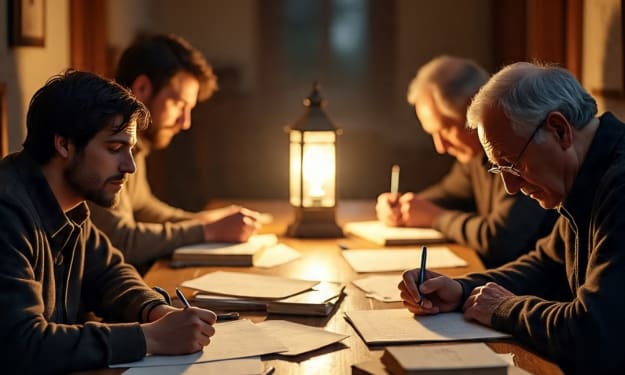
In a town where voices whisper More than anyone ever shouts, There stands a hall of quiet verses Tucked between houses and cobblestone routes. Not a theater with roaring echoes, Not a market where traders rhyme, But a hearth where hidden lines awaken, Slowly rising, one word at a time. Here, the community of poets gathers Without banners, noise, or fame, They come with notebooks worn and folded, Each page carrying untitled flame. Some bring metaphors like folded letters, Some bring tears no one has read, Some bring laughter packed in stanzas, Some with rhymes still half-unfed. No trophies wait upon the table, No judges sit with sharpened gaze, Just a lamp, its yellow softness Painting ink in golden haze. Pens rest gently like sleeping sparrows, Waiting for the skies of thought, And silence hums a steady rhythm For every poem yet to be taught. A boy arrives with shaky fingers, Holding paper bent at spine, He fears the letters may betray him, He fears his heart may not align. Yet the poets smile without asking, Inviting him to take his seat, For poetry is not performance, It is presence, warm and sweet. A teacher walks in, still uncertain If her words are far too small, She hides sonnets underneath her jacket Like secret paintings on the wall. But someone nods, as if to whisper, “Art is never loud to grow.” And from her notebook slips a couplet, Like a petal falling slow. An old man places down a journal Stained by rain on many nights, He opens it like opening windows, Letting breezes touch the lights. His poems speak of silent rivers, Of memories carved in wood and grain, Of a life that held more questions Than a tongue could once explain. None apologizes for stutters, None competes for louder tone, For in this hearth, the poets learn that language Is kinder when it’s grown. They do not chase applause or medals, They do not paint words just to impress, They only let their souls translate, Through images that softly press. One poet reads of hope as raindrops, Another writes of stars that stray, One builds bridges from old scriptures, One hides sunshine in the clay. Each voice different, yet connected By a thread no one can see— A fabric woven out of meanings, A quilt of quiet poetry. The lamp flickers, pages flutter, As if worlds are being stirred, The room becomes a field of stories Harvested through every word. The wind outside becomes a listener, Moon leans close as if to hear, And all of nature seems to linger Just to hold each line sincere. They end not with thunderous clapping, But with hands upon the heart— A silent greeting of respect For every fragile work of art. They know that poems bloom in stillness, That voices grow when gently heard, That the world transforms a little deeper With every carefully chosen word. So they leave with pockets filled with stanzas, With metaphors tucked near their chest, Carrying alphabets like lanterns, Lighting journeys yet unexpressed. In the hearth of hidden lines and letters, They return to life with lifted sight— For the community of poets teaches That quiet words can still ignite.
By Muhammad Saad 10 months ago in Poets
The Room of Shared Questions
There is a small room at the top floor of the city’s communication center. It is not crowded, not decorated with glamorous posters, and not filled with busy noise. Instead, it is filled with something more powerful—curiosity. People here do not come to shout their opinions; they come to share their voices, and sometimes even discover them for the first time. This place is known by the community as The Room of Shared Questions, where interviewers and interviewees meet with open ears and honest hearts. Every week, voices from different fields step inside—writers, teachers, mechanics, small business owners, doctors, students, and artists. They all sit in front of the interviewer, uncertain about what will be asked, but ready to unfold who they truly are. For the interviewer, the task is not simply to ask questions; it is to listen deeply, respond wisely, and guide respectfully. One such interviewer, Zayyan, believes interviews are not investigations but journeys of understanding. He once said, “A good interview is like opening a door. You don’t force it—you turn the handle gently.” To him, every person sitting across the table carries a universe of experiences, and each question acts like a key, unlocking hidden stories, unspoken feelings, and forgotten dreams. One evening, a guest arrived who had never been interviewed before: an elderly bookseller named Umar. He seemed nervous, carrying a notebook filled with quotes written in faded ink. When asked to introduce himself, he smiled shyly and said, “I don’t know how to talk about myself. I only know how to talk about books.” Zayyan didn’t rush. He gently asked, “Why do books matter to you?” Umar paused for a moment, opened his notebook, and read a line: ‘Books are houses that hold people’s memories long after their voices disappear.’ His voice trembled, but his eyes sparkled. Zayyan realized the interview had just begun. The conversation slowly unfolded. Umar shared how he started collecting second-hand books when he had no money to buy new ones; how he learned life lessons from authors he had never seen; how he once repaired a torn book for a child who cried because it was her favorite story. With every answer, his nervousness faded, replaced by pride—not the loud pride of ego, but the quiet pride of passion. The interview was not just revealing a bookseller’s story; it was reminding everyone listening that ordinary lives carry extraordinary wisdom. At the end, Zayyan asked, “What message would you give to young people?” Umar closed his notebook gently and said, “Do not rush to make your life big. First, make it meaningful.” The recording ended, but the room was silent with admiration. People who had entered as audience members felt they had read a human book. In The Room of Shared Questions, nothing spectacular happened; yet everything important did. A humble man discovered the strength of his voice, and a community remembered the value of listening. The interviewer smiled as Umar left the room. Another story had been unlocked. Another voice had been heard. Another ordinary life had become an inspiration—not because someone shouted, but because someone asked, listened, and cared. This is the power of the interview community. They create a space where every person matters, every story counts, and every question builds a bridge between hearts. Interviews are not just sessions of speaking; they are moments of shared humanity, where a question is not a demand, but a gift, and where answers are not performances, but truths.
By Spotlight stories 10 months ago in Poets
The Gentle Society of Ink
In the heart of a quiet village, beside a dusty road that curved like a forgotten sentence, stood an old banyan tree. Its branches stretched wide like arms welcoming tired souls. Under that shade, every evening, men gathered not to gossip, not to argue, but to write poetry. They called themselves The Gentle Society of Ink. They were not famous. They did not care for applause or medals. They wrote because words were their breath, their calm, their unseen courage. The world outside might chase money, noise, and speed. But under this tree, time slowed like a humble student of literature. The youngest poet, Haaris, was new to writing. His notebook had more torn pages than words. He often scribbled half-sentences and scratched them out impatiently. He believed poetry had to sound grand. His voice trembled each time he read. There was Kabeer, a quiet man who worked as a carpenter. His poems were shaped like the furniture he built—simple, strong, useful. He wrote of struggles without fear, of hope without shouting, of life without pretending. He never tried to impress, and yet his lines always impressed everyone. Beside him sat Yawar, a school librarian with thick glasses. He collected poems like fireflies—each captured moment glowing softly. His verses were smooth, like rivers unbothered by stones. He had read more books than he had spoken words. Every evening, they sat with pens dipped in patience and hearts wide open. One day, a traveler named Arham arrived with dusty clothes and a bag full of books. He had wandered from town to town searching for poets who wrote with sincerity instead of fame. When he saw the men beneath the old tree, writing without competition, without vanity, only with peace, he sat down silently and listened. Haaris hesitated that day. “I cannot read. My poems are unfinished,” he murmured. Kabeer smiled and said, “A poem is never finished. It only stops when it has said enough.” Yawar nodded. “Read. Even broken lines can build strong feelings.” Trembling, Haaris read his short poem about rain that came too late for a farmer. His voice cracked. His words were simple. Yet the silence afterwards was heavy with meaning. Arham wiped a small tear. “Young poet,” he said, “water does not need perfume to be precious. Your words are water.” Haaris’ heart widened. He realized poetry was not decoration—it was truth. The Gentle Society of Ink began to grow stronger, not in numbers, but in spirit. They shared tea without price, stories without fear, and ideas without ego. When one wrote, the others listened like roots listening to rain. Some wrote about sorrow like it was a guest. Some wrote about love like it was daylight. Some wrote about hardship like it was a teacher. And every poem, no matter how small, was welcomed under that ancient tree. Weeks passed. Arham decided to leave and continue his journey. Before going, he said: “You men have something the world has forgotten. You write with humility. You read with respect. Protect this society—not with walls, but with honesty.” They bowed their heads, not in sadness, but in gratitude. The banyan tree rustled as if blessing them. And so, the Gentle Society of Ink continued, beneath leaves that listened, under skies that nodded, writing not for the world, but for the soul.
By EchoVerse Poet10 months ago in Poets
The Hall of Echoed Voices
In a quiet corner of the town, beyond the marketplace of noise and beyond the restless rush of streets, stood a hall as modest as a whisper and as wise as a century. The people called it The Hall of Echoed Voices, but poets called it home. Every night, when the lantern was lit and shadows began to speak on the walls, the poets arrived carrying paper, stories, silence, and dreams still unformed. It did not matter who they were outside—some were tailors, some were teachers, one even sold tea in a wooden cart—but once they stepped into the hall, they became keepers of words. The youngest among them was Azeem, a boy of seventeen with questions more than answers and verses more than rules. He wrote with excitement, messy and sincere, like a river discovering its own path. The oldest was Baqir, his beard white as a forgotten winter, his voice soft like an old book. He wrote slowly, carefully, as though every word had to be respected before it was allowed to exist. There was Rafi, who spoke less and listened more. He believed silence had rhythm and believed deeply that poems were simply silent songs given names. He wrote poetry on the backs of receipts, sometimes on walls, sometimes on his own palms, because inspiration never waited for paper. Lastly, there was Sultan, a man of strong build and quiet observation. While others wrote, he would sit, watch, and sketch lines of poetry with the calm of a craftsman shaping wood. He said poems were carved, not written. Each night, they gathered around the lantern, and the hall became a living heartbeat of ink. They read aloud their verses—some trembling, some bold, some broken, some whole. No one mocked, no one competed. They listened with reverence, because here, poetry was not a show; it was truth being uncovered. Azeem once asked, “Master Baqir, how does a poet know if his poem is good?” Baqir smiled the slow smile of someone who had watched many words grow wings. “A poem is not good because others clap,” he replied. “It is good when it refuses to leave your heart after you write it.” The hall echoed with understanding, with nods, with shared silence. Some nights, they wrote about the moon that kept them company. Some nights about unseen pain. Some nights about hope that stubbornly refused to die. They wrote for the farmer who could not sleep, for the laborer who hummed songs of hunger, for the children chasing kites of forgotten dreams, and for themselves—broken, healing, learning. The Hall of Echoed Voices became more than a place; it became a bridge of souls, built by lines of poetry. The community that gathered there did not write to become famous; they wrote because they felt alive only when words breathed through them. And one night, after years of meeting, Baqir said, “One day, my friends, this building may fall, but our echoes will not. Poets do not live in halls. They live in hearts that feel.” The lantern flickered as if agreeing. So the poets continued, night after night, carrying not just ink and paper, but the power to turn silence into gold, and ordinary life into endless poetry.
By Muhammad Saad 10 months ago in Poets
The Brotherhood of Ink
The Brotherhood of Ink Along the quiet edge of an evening street, Where footsteps of day and moonlight meet, A circle of poets, shoulder to shoulder, Brothers of ink, hearts growing bolder. With notebooks opened like windows wide, And pens like rivers at rising tide, They gathered not to boast or compete, But to lift each voice, to make words complete. No stage, no fame, no noisy applause, Only verses formed from unwritten laws, That poems are bridges, not walls to divide, And true art lives when ego steps aside. One wrote about dreams turning into gold, Another of stars the sky could barely hold, A third wrote hope for the tired and weak, A fourth wrote courage no silence could break. They shared their lines like shared bread and tea, No envy, no rush, no jealousy— For poetry was bigger than any single name, And a poet grows stronger when others do the same. They offered advice like lanterns in night, Not to dim a voice, but to help it shine bright, They tuned each verse, like strings of a lute, Not to change its soul, but to help it speak truth. “Write what heals,” one whispered with grace, “Write what makes the world a kinder place.” “Write the struggle,” another replied, “But end every battle with hope on your side.” No poet there wrote for money alone, Though success is sweet, like fruit when grown— They wrote to serve hearts who needed light, For every poem is a small torch against night. And when they parted, beneath the evening air, They left not just words, but wisdom to share. For each poet carried a piece of the rest, Like a verse that fits perfectly inside a chest. And so grew the circle, from ten to a hundred, Their impact rose as their unity thundered, Because poetry is power when given, not stored, Like rain that gives life, not treasure to hoard. O reader, if your pen feels heavy someday, Find poets who lift, not those who betray. For the Brotherhood of Ink still waits for you, With space in the circle, a chair, and a view. Bring your struggles, your hope, your voice that’s unique, Write bold, write true, let your purpose speak. Join the poets who build, who uplift, who begin— Welcome, dear writer… to the Brotherhood of Ink.
By Muhammad Saad 10 months ago in Poets
Crave
Conversations, day after day, at all hours without end Every life experience, we’ve shared it together We’ve never crossed the line. Never dared to take it further Our friendship was so easy; there’s no one else I trust I was there for all your breakups, as you were there for mine We’ve always had this best-friend kind of love, never lust Thought nothing could ever divide us, so what has changed this time?
By Alexandra Grant10 months ago in Poets