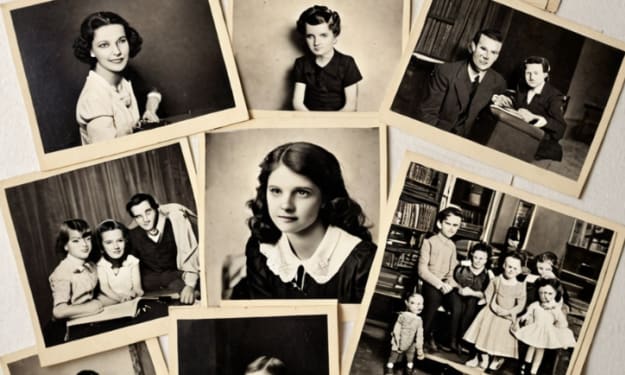
fact or fiction
Is it fact or merely fiction? Fact or Fiction explores the myths and beliefs we hold about what makes a good poem and the poetry rules that were made to be broken.
Why My Quiet Matters
I didn’t learn silence in the soft way. It wasn’t handed to me like a folded blanket or a warm cup of tea. My quiet was shaped in the echo after doors slammed, in the spaces where people spoke over me, in the long pauses where I waited for someone to see I was hurting. For years, my quiet felt like a bruise I couldn’t point to. It wasn’t peaceful. It wasn’t chosen. It was just where I went when the world didn’t leave room for me. I grew up thinking noise was proof of existing. The louder people were, the more they seemed to belong. My friends filled rooms with laughter that spilled into hallways, conversations that overlapped like waves. I admired that—how they carried their voices like lanterns. Me, I carried mine like a matchstick: small, flickering, uncertain whether it deserved to be struck at all. So I stayed quiet, and everyone assumed it was my nature. But quietness born from fear is not a personality trait. It’s a survival tactic. It took me years to understand that difference. Years of sitting in circles where everyone spoke but me. Years of being told I was “so calm” when really I was trying not to shake. Years of letting people decide who I was simply because I didn’t correct them. My silence wasn’t serenity. It was surrender. And for a long time, I didn’t know how to reclaim it. The turning point was small, almost unremarkable. It was a morning with sunlight sliding through my curtains in thin, golden lines. I was sitting on the edge of my bed, listening to the hum of the world outside—cars, footsteps, someone’s distant laugh. It all felt too loud, too fast, too demanding. I reached for my phone to type a message I didn’t want to send, to agree to something I didn’t want to do, simply because the thought of saying no out loud felt heavier than the act itself. And then, as if my own hand belonged to someone braver, I put the phone down. It sounds simple, almost childish, but that pause was the first time my quiet felt like mine. Since then, I’ve been learning that silence can be a form of strength—not the brittle kind that cracks when touched, but the deep, rooted kind that grows quietly beneath the soil. I learned that saying nothing is different from having nothing to say. I learned that choosing not to speak can be as powerful as raising my voice, as long as it comes from intention, not fear. And most importantly, I learned that my quiet has value, not because it makes me easy to handle, but because it teaches me to see the world more softly. People don’t always understand it. They think quiet means weak, shy, unsure. They don’t see how much courage it takes to hold still in a world that rewards noise. They don’t know the way I listen—to the inflection behind someone’s words, to the tremble in their breath, to the things they don’t even realize they’re telling me. They don’t see how quiet can be a sanctuary when the world grows too sharp. They don’t see how quiet people carry whole landscapes inside them, entire cities of thought and memory and feeling. My quiet matters because it is where I meet myself. In the still moments, I hear my own thoughts without them being swallowed. In the spaces between conversations, I discover truths I didn’t have language for. In the calm after a long day, I find the courage to exist without apologizing. There is a softness in silence that the noise of life often forgets to honor. But I’ve learned to honor it. I’ve learned to choose it. And I’ve learned to protect it. Quietness doesn’t mean I don’t feel deeply; it means I feel so deeply that I need time to understand the shape of my feelings. Quietness doesn’t mean I don’t care; it means I care so much that I pause before I speak, wanting my words to land with honesty. Quietness doesn’t make me less; it makes me different. It makes me observant. It makes me thoughtful. It makes me me. What matters most is that I finally stopped waiting for someone to grant me permission to exist at my own volume. I stopped forcing myself to be louder just to prove I could be. I stopped treating my quiet like a flaw to overcome. Instead, I began treating it like something I could grow into—a room with soft light, a slow morning, a place inside myself where I don’t have to perform. There are days I still struggle. Days when I wish my voice came easier. Days when the world feels like a storm and I’m a candle fighting to stay lit. But even on those days, my quiet holds me. It reminds me that I don’t have to shout to be here. I don’t have to explain myself to exist. I don’t have to be loud to be whole. My quiet matters because it tells my truth in a world that often speaks too quickly to hear itself. And for the first time, that feels like enough.
By LUNA EDITH12 months ago in Poets
The Bench Beside the River
Every afternoon, the riverside park welcomed different faces—children playing, friends talking, strangers jogging. Yet among the noise and movement, one person always remained still. His name was Mr. Haroon, an elderly man who sat quietly on the same wooden bench near the flowing river. His presence was a part of the park, like the leaves or the wind. He did not speak. He did not smile. He simply watched the water pass as if waiting for something. Many assumed he was just an old man seeking fresh air. No one knew his story. One day, a young boy named Sami arrived at the park holding a sketchbook. He liked drawing the river, the birds, and the bench. For him, the world became art, and happiness rested in paper and pencil. When he saw Mr. Haroon, he noticed something unusual—there was a deep silence in the old man’s eyes. A silence that felt heavier than stones. After several days of seeing him alone, Sami thought, Maybe I should talk to him. But before he could gather courage, something strange happened. Sami forgot his sketchbook on the bench where he had been sitting earlier. When he realized it, he ran back, hoping it was still there. There he found Mr. Haroon, holding the sketchbook gently as though it were delicate treasure. “You draw well,” the old man said, breaking his week-long silence. Sami shyly smiled. “Thank you, sir.” Instead of handing the book immediately, Mr. Haroon opened it again and studied the pages. “You draw this bench often,” he said. “I like how peaceful it looks,” Sami replied. “It feels honest.” Mr. Haroon’s eyes softened. “Honest,” he repeated slowly, as if tasting the word for the first time in years. After a quiet pause he asked, “May I sit with you while you draw?” That small request opened a door neither had expected. From that day onward, they met at the bench every afternoon. Sami drew while Mr. Haroon shared stories, not always pleasant, but always sincere. He told the boy he once had a son who loved drawing too, but life and distance took them apart. The river reminded him of time—always moving forward, never returning anything it carried away. Sami listened carefully, not trying to fix the sadness, just being there. His presence was not a solution, but it was company. And sometimes, company itself heals more than solutions. Weeks passed. The park, once indifferent to the old man, now held two figures. Laughter began to replace silence. Hope returned where loneliness once lived. Then one afternoon, Sami arrived and noticed the bench was empty. No hat, no old man. Only the sound of the river. He waited, thinking maybe Mr. Haroon was late. Minutes turned into hours, but the seat stayed empty. The next day, a park caretaker approached Sami. He handed him a carefully folded note. “The old gentleman asked me to give you this,” he said. With trembling hands, Sami opened it. > “Thank you for bringing color back into an old memory. You reminded me that kindness has no age. Keep drawing. Let the world see what hearts often forget. — Haroon” Sami didn’t shed a tear. Instead, he sat on the bench, opened his sketchbook, and began to draw—this time not the river, not the trees, but the bench with a hat resting on it. And for the first time, the park felt silent in a beautiful way. Not empty—just peaceful. The river kept flowing, but now it carried something new: the quiet warmth of friendship that asks for nothing but presence.
By Muhammad Saad 12 months ago in Poets
Is My Time a Privilege, or a Perk for Everyone?
Remember, you yourself are a luxury. Your time, your attention, and your energy are all high-value resources. Not just anyone can come and go as they please; not just anyone can get close. Being able to reach you is a privilege, not a perk for everyone.
By Emily Chan - Life and love sharing12 months ago in Poets