childrens poetry
Nostalgia-inducing poetry inspired by our earliest favorites; from Dr. Seuss to Mother Goose, children’s poetry is all grown up.
The Poetry Within Us: Unlocking the Human Mind Through Verse
It started with a whisper. Not from another person, but from within—the kind of whisper that stirs at the edge of sleep, that makes you pause mid-step and wonder if you’ve forgotten something vital. For Maya, a neuroscience student drowning in textbooks and lab reports, that whisper came on a rainy Tuesday afternoon. She had spent the past four years immersed in facts—studying neurons, brain scans, dopamine pathways. Everything had to be measurable, repeatable, explainable. Yet, despite her academic success, she felt detached from herself, like a satellite orbiting her own life. Then came the elective course: The Psychology of Poetry. She enrolled reluctantly, needing the credits, expecting little more than historical analysis and a few stanzas of Shakespeare. What she didn’t expect was to cry in class. The poem was “Having a Coke with You” by Frank O’Hara. The professor read it aloud—gently, deliberately, with reverence. Maya didn’t understand why her chest tightened or why her eyes stung. She had never met the poet, had never experienced his world, but somehow, in those lines, she felt seen. That was the moment everything changed. --- The human brain, Maya would later learn, doesn’t distinguish sharply between real and imagined emotion. When you read a poem that evokes sadness, joy, or awe, your brain often responds as if you’re living the experience. The same neural circuits activate—the limbic system lights up, oxytocin is released, and connections strengthen. Poetry, she realized, was a neurological symphony. And yet, it was more than chemistry. It was a bridge. In class, students shared poems that had shaped them. One read about their father’s death; another about coming out. A quiet classmate, who never spoke during biology lectures, recited a piece they had written about anxiety—each metaphor a map to a place they’d never shown anyone. For the first time, Maya understood the quiet power of shared vulnerability. Poetry didn’t just unlock the mind. It softened it. --- Maya began writing her own verses. At first, they were clumsy and overly structured, like her lab reports. But slowly, the lines loosened. Rhyme gave way to rhythm. She wrote about her mother’s silence, her childhood fear of thunderstorms, the pressure to be “smart” and composed. Each poem was a key, unlocking memories she hadn’t realized were sealed away. More importantly, it made her a better friend, sister, and researcher. She started noticing emotional subtleties in conversations, listening not just for content but for cadence, for pauses, for what went unsaid. Her empathy deepened, and so did her curiosity—not just about how the brain worked, but about how it felt to be alive. --- Scientific studies began to echo what Maya felt intuitively. A 2023 research article revealed that reading and writing poetry could significantly reduce symptoms of anxiety and depression, especially in adolescents. Another found that poetic language activated regions of the brain associated with reward and memory more intensely than ordinary speech. Even patients with dementia, when exposed to familiar poems, displayed improved communication and mood. Poetry, it turned out, could tap into neural pathways long after others had deteriorated. Maya started volunteering at a memory care center, reading poems to elderly residents. One woman, who rarely spoke, began reciting lines of Emily Dickinson, her voice frail but steady. For a moment, her eyes sparkled with recognition, as if time had folded in on itself and brought her home. It was more than therapy. It was resurrection. --- Years later, with a PhD in neuroscience and a poetry collection published, Maya stood at a TEDx stage. Her talk was titled “The Poetry Within Us: Unlocking the Human Mind Through Verse.” She spoke not just of neurons and scans, but of silence broken by verse, of people finding their voices, of science meeting soul. She ended with her favorite line from Mary Oliver: > “Tell me, what is it you plan to do with your one wild and precious life?” And then she answered, in a quiet voice: “To listen. To write. To feel. To remind others that within every brain—no matter how scarred or silent—there lives a poem waiting to be heard.” --- In a world obsessed with speed, productivity, and logic, poetry reminds us to slow down, to sit with discomfort, to find beauty in ambiguity. It sharpens cognition, enhances emotional literacy, and deepens connection. The poetry within us is not a luxury. It is a necessity. And when we unlock it, we unlock each other.
By Muhammad Saad 11 months ago in Poets
The Ink That Found Its Sunrise
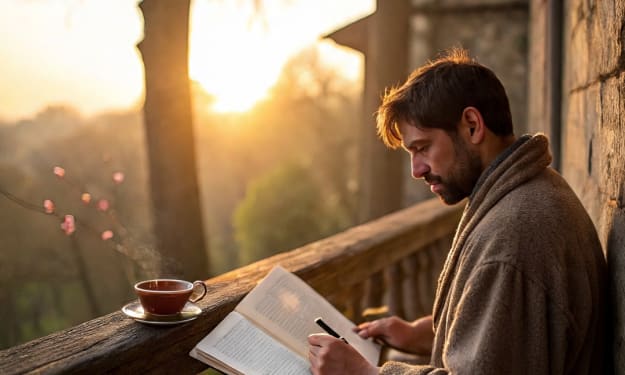
Mira had always believed that morning light carried its own kind of poetry. It slipped into the world quietly, softening everything it touched. But lately, she felt no connection to those first rays of the day. Her pen lay untouched, and the blank pages in her journal seemed to echo her uncertainty. For years, writing had been Mira’s companion—her way of expressing what she couldn’t speak aloud. She wrote about seasons changing, about laughter drifting between doorways, about the invisible threads that link people to one another. But as life became busier, and worries accumulated like unopened letters, her creative spark dimmed. One morning, she sat on her small balcony with a cup of warm tea. The sun was rising, turning the rooftops into softened shapes of gold and pink. The air smelled of dew and quiet beginnings, but the beauty felt distant, as though she were watching her life through a window. “I can’t feel anything to write about anymore,” she whispered. At that moment, her neighbor, Mr. Haleem, stepped onto his balcony. He was an elderly man known for tending to his flowers and humming old songs that carried across the courtyard. “You’re up early, Mira,” he called gently. “Everything alright?” She hesitated, then nodded politely. But something in her expression must have given her away. He smiled kindly. “You look like someone searching for something.” Mira sighed. “I used to write poetry every day. Now I hardly recognize the person who wrote those words.” Mr. Haleem leaned on his railing. “Tell me something,” he said. “When you look at that sunrise, what do you see?” Mira blinked. “I… don’t know anymore.” He chuckled softly. “Then perhaps you’re looking too hard.” She turned toward him, curious. “You know,” he continued, “people think poets need grand inspiration. Lightning moments. Extraordinary stories. But the truth is simpler. Poetry grows from noticing small things—things that most people walk past without seeing.” He gestured toward the potted jasmine plant beside him. “This little flower bloomed today. Just one. The rest are still waiting. But this one decided to open anyway. Isn't that something?” Mira looked at the jasmine. Its single white bloom glowed in the sunlight, gentle but confident. Before she could respond, Mr. Haleem added, “Sometimes we expect ourselves to bloom every day. But even flowers take their time.” The words settled into her like warm rain. After he went back inside, Mira stayed on the balcony, listening to the distant calls of vendors and the sound of early birds darting between rooftops. The world was waking up, soft and unhurried. She opened her journal—not to write a masterpiece, but just to write something true. She wrote: Today, a jasmine bloom reminded me that growth can be slow, and still be beautiful. For the first time in weeks, her hand didn’t tremble. She continued writing small observations—the sound of her neighbor’s humming, the warmth of her tea, the way sunlight softened the edges of her fears. Her words felt simple but sincere, like the first steps of someone learning to walk again. Later that day, she took a walk to the local market. Children were laughing, old women bargaining cheerfully, a young man sketching portraits near a tea stall. Life was unfolding in dozens of tiny stories, each one a poem waiting to be noticed. Mira paused beside a stall selling handmade notebooks. One had a sunrise painted on the cover. She held it in her hands, feeling an unexpected spark of joy. She bought it—not because she needed more pages, but because she wanted to celebrate this small return to herself. That evening, she sat by her window and wrote again, letting her thoughts flow gently, without judgment. Poetry doesn’t disappear, she realized. It simply waits for the heart to slow down enough to hear its voice again. As the sun dipped below the horizon, Mira closed her notebook, feeling steady and hopeful. She knew her creativity would rise and fall, just like the sun—but it would always come back, carrying light with it.
By Muhammad Saad 11 months ago in Poets
Where the Quiet Words Bloom
Where the Quiet Words Bloom A Story of Finding Hope Through Poetry Mira had always believed that poetry lived inside everyone—hidden in the pauses between thoughts, in the soft sighs at the end of long days, and in the small moments that the world rushed past. Yet she herself hadn’t written a single line in months. Her notebook sat untouched on her desk, its pages blank, mirroring the silence she felt within. Life had been too loud lately. Too many responsibilities, too many expectations, too many moments demanding strength when all she wanted was gentleness. She told herself she was simply busy, but deep down she knew the truth—she had forgotten how to listen to her own heart. One quiet Saturday morning, Mira decided to visit the old park near her neighborhood. It was a place she had loved as a child, a place where she had written her very first poem under a tall banyan tree. The air was cool, and the rising sun painted the dew-covered grass with a soft golden glow. As she entered the park, something new caught her eye. A small group of people sat in a loose circle near the central fountain, each one holding a notebook. Some were sharing softly, others simply listening. A handwritten banner taped to the fountain read: “Poets’ Morning Circle – Everyone Welcome.” Curiosity tugged gently at her. Before she could convince herself to walk away, her feet carried her closer. A cheerful woman with silver-streaked hair noticed her. “Here for the poetry circle?” she asked with a warm smile. Mira hesitated, then nodded slowly. “I haven’t written anything in a long time… but I’d like to listen.” “Listening is also poetry,” the woman said kindly, patting the empty space beside her. “I’m Salma. Please, join us.” The circle began with simple introductions. There was an elderly man who loved rhyme, a teenager who wrote to soothe her anxiety, a baker who scribbled lines between customers, and a teacher who wrote about constellations. Some had been writing for years; others had written only a few scattered lines in their lives. But each one carried a story in their notebook—and in their heart. When the sharing began, the poems were gentle, honest, and deeply human. Some spoke of tiny joys. Others carried quiet sadness. But all of them felt real. When it was Mira’s turn, she shook her head shyly. “I didn’t bring anything to share.” “That’s perfectly alright,” Salma said softly. “Let me ask you this—what brought you here today?” Mira looked around the circle. For a moment, she felt something open inside her. “I think… I missed feeling connected. I missed the part of me that writes.” Salma nodded with understanding. “Sometimes our words hide when life feels heavy. They don’t leave us—they wait for us to return.” A soft hum of agreement drifted through the group. Then Salma handed Mira a small slip of paper. “Write one sentence,” she said gently. “Not a poem. Just a feeling.” Mira closed her eyes and let the moment settle. Leaves rustled overhead, a bird sang somewhere in the distance, and slowly the weight inside her eased. On the paper, she wrote: “I am learning to hear myself again.” Salma read it, and her eyes sparkled. “Mira,” she whispered, “that is poetry.” Encouraged by the warmth around her, Mira opened her old notebook—the one she had brought without thinking. Her pen hovered for a moment, then began to move. Not perfect lines. Not polished metaphors. Just honest words flowing freely. As she wrote, the heaviness she had carried for so long began to lift, little by little, like clouds parting after weeks of gray skies. By the time the circle ended, Mira had filled three whole pages. Before she left, the group invited her to return the following week. She smiled—truly smiled—feeling a spark she thought she had lost forever. “I’ll be here,” she promised. Walking home, she realized something profound: poetry had never abandoned her. It had simply waited patiently for her to slow down, breathe, and listen again. And now, with her notebook open and her heart awake, she knew her quiet words would bloom once more.
By Muhammad Saad 11 months ago in Poets
Whispers Under the Silver Sky
In every poet’s life, there comes a moment when the familiar rhythm of words suddenly quiets. What once flowed like spring water begins to hesitate, and silence grows where imagination used to bloom. Ayaan knew this feeling too well. For weeks, his pen rested still, and every blank page felt heavier than the last. Poetry had always been Ayaan’s way of understanding the world. He wrote to celebrate moments, to heal invisible wounds, and to reveal beauty hidden in ordinary days. But lately, even beauty felt out of reach. No matter how long he waited or how deeply he searched inside himself, inspiration refused to appear. One evening, when the sky softened into a shade between lavender and dusk, Ayaan walked to the lakeside near his home. It was a place he trusted—a quiet corner where the world felt calm enough to listen. The soft ripples of the water usually stirred his thoughts, but tonight the lake remained silent, matching the silence inside him. He sat on a smooth stone and opened his notebook, hoping the surroundings might help. “Just one line,” he whispered to the empty page. “Just one.” But nothing came. Ayaan sighed, closing his eyes. “What if I’ve lost my voice?” he wondered aloud. As the breeze brushed past him, a warm glow approached from the path behind. An elderly woman holding a lantern walked slowly toward the lake. Her presence felt peaceful, as if she belonged to the evening itself. “You look troubled,” she said gently, sitting a few steps away from him. “I used to write poetry every day,” Ayaan admitted. “But now the words won’t come. I don’t know why.” The woman studied the shimmering water. “Ah,” she said softly. “You’re chasing your words. No wonder they’re hiding.” Ayaan blinked. “Chasing them?” She nodded with a quiet smile. “Poetry isn’t something to capture. It’s something to welcome. When you try too hard, words become shy. But when you breathe, listen, and let the world speak first, they find their way back.” Her voice held a calm certainty that eased something in his chest. “Look up,” she said. Ayaan lifted his eyes. The sky above him glittered with countless stars, each one steady, patient, unhurried. The reflection in the lake doubled the view, making it feel as though he was surrounded by a universe of tiny lights. “Every star,” the woman continued, “is a story waiting for someone who’s willing to notice. Poets are not meant to force stories—they are meant to feel them.” Ayaan let the words sink in. The night air smelled faintly of jasmine, and crickets sang a soft, rhythmic song. Slowly, the heaviness he had carried for weeks began to fade. “When was the last time you wrote something only for yourself?” she asked. “Not for approval. Not for an audience. Just for your own heart.” He thought about it and realized he could not remember. “Then start there,” she said warmly. “Begin with something small. Something true.” She stood, her lantern casting circles of warm light across the path. “Your voice isn’t gone,” she added. “It’s simply resting.” With that, she slowly walked away, leaving Ayaan alone with the sky and the water. He opened his notebook again. This time, he didn’t beg for a perfect line. He didn’t demand inspiration. He simply looked at the world around him—the lake, the stars, the gentle night—and let himself feel grateful for the moment. His hand moved. The night holds quiet miracles, And I am learning to listen again. Even silence has a heartbeat, If the heart is patient enough to hear it. More words followed—soft, honest, imperfect, but alive. They flowed without pressure, each sentence lifting a bit of weight from his spirit. When he finally closed the notebook, Ayaan felt something he hadn’t felt in a long time: lightness. He walked home beneath the silver sky, knowing the truth every poet eventually discovers— Inspiration never leaves us. It waits calmly until we return to ourselves.
By Muhammad Saad 11 months ago in Poets
“Whispers of the Ink”
In the heart of a quiet town stood a small, sunlit studio. It wasn’t fancy—just four wooden walls, shelves filled with books, and a round table at the center. But for the people who gathered there every Friday evening, it was a sanctuary, a place where ordinary moments transformed into poetry. They called themselves The Circle of Ink, a community of poets who believed that words could change the world, even if only one heart at a time. Among them was Fariha, a young woman whose shyness often held her back from sharing her writing. She had been writing poetry since childhood, but her notebook had always been her safest place. The idea of letting others hear her words felt like opening her heart too wide. Yet she came to the studio every week, quietly observing, listening, and learning. The group was led by Saif, an older poet with silver hair and a voice as calm as morning rain. He believed every person carried a poem within them—some in their joy, others in their wounds. His mission was simple: to help people find their voice. “Poetry,” he often said, “is just truth wrapped in rhythm.” One Friday, Saif announced that the group would hold its first “Open Mic of Light,” a gathering where each poet would share a piece that brought hope. The purpose was to celebrate the power of words in a world that often forgot gentleness. Everyone cheered at the idea—everyone except Fariha, whose heart suddenly raced. That night, she returned home and sat with her notebook open, her pen resting between trembling fingers. She knew she wanted to share something. She wanted to step into the light. But doubt whispered louder than courage. She shut her notebook and told herself she wasn’t ready. The following week, the studio buzzed with excitement. Poems were being polished, rehearsed, whispered again and again. Even the shy members were preparing to speak. When Saif noticed Fariha sitting silently, he walked over and placed a gentle hand on her notebook. “Every poet,” he said, “starts by thinking their voice is too small. But remember—light doesn’t ask permission to shine.” His words lingered in her heart like the slow bloom of dawn. The night of the Open Mic arrived. The studio glowed with strings of soft lights, and more people came than anyone expected. The Circle of Ink sat proudly at the front, each holding a poem ready to share. Fariha sat near the back, hands twisting nervously. Her notebook felt heavy, as if every page carried a piece of her soul. One by one, the poets read. Arif read about the courage to keep going; Nida shared a poem about healing; Zoya spoke of love in all its forms. The audience applauded after every piece, not because the poems were perfect, but because they were honest. Then Saif stepped forward. “Before we close,” he said, “there is someone here whose voice the world needs. Someone who has been writing quietly, beautifully.” His eyes found Fariha’s. “If she is willing, we would be honored to hear her words.” The room turned softly toward her. Her heart beat like a drum, but something inside her—something she had long ignored—rose gently to the surface. She stood. Walking to the front felt like walking through mist, uncertain and trembling. But when she opened her notebook, the words looked back at her with familiarity, like old friends urging her on. She took a breath and began to read. Her poem was simple but powerful—a quiet reflection on how even the smallest acts of kindness can turn an ordinary day into something bright. As she spoke, her voice steadied. The room softened around her, and for the first time, she felt her words truly belong to the world. When she finished, the audience didn’t just clap—they smiled. Some had tears in their eyes. Saif’s eyes shone with pride. From that night onward, everything changed. Fariha became an active voice in the Circle of Ink, encouraging others the way she had once needed encouragement. The community grew stronger, bound not just by poetry, but by courage, connection, and the shared belief that words—like people—carry light. And in that small studio, the poets continued to gather, week after week, turning their whispers into sparks that warmed the world.
By Muhammad Saad 11 months ago in Poets
The Voices That Paint the Air
In a small town where the nights felt longer than the days, there stood an old community hall that many people had stopped visiting over the years. It had once been a center of laughter, celebrations, and shared dreams. But slowly, as life became busy and routines became heavier, fewer feet crossed its creaking wooden floor. That changed the day a young poet named Ayla decided that silence was too heavy for such a beautiful place. She believed that words had power—power to heal, to connect, to remind people that they were never alone. So, she printed a simple sign and hung it on the hall’s front door: “Poets’ Circle — All Dreamers Welcome.” At first, she didn’t expect much. Maybe one or two people would show up. But on the first evening, as the sun dipped behind the hills, five strangers walked in, each carrying a small piece of their heart wrapped in words. There was Haroon, a retired teacher who had written poems all his life but never shared them out loud. Mina, a shy teenager whose notebook was filled with metaphors that danced like fireflies. Jibran, an office worker tired of routines who wrote poetry during lunch breaks to feel alive. Dania, a mother who wrote late at night to ease the weight of her thoughts. And Ayla, the dreamer who brought them all together. They sat in a circle, unsure at first, each waiting for someone else to begin. The silence stretched, gentle but uncertain, until Ayla smiled and broke it. “Here,” she said, holding her notebook close, “we don’t read poetry to impress anyone. We read to express ourselves, to breathe, to connect. So, whoever feels ready, start whenever your heart wants to speak.” Slowly, Haroon lifted his trembling hand. His voice, though soft, carried a lifetime of emotions: “I write not because the world listens, I write because my heart refuses to stay silent.” The others listened with such attention that Haroon felt warmth rise in his chest. For the first time, he felt heard—not as a teacher, not as a parent, but simply as himself. One by one, the poets shared their words—some hesitant, some bold, some shy, some full of fire. But every poem felt like a window opening, letting light flow into the room. By the end of the night, something magical had happened: five strangers no longer felt like strangers. They decided to meet every week. The Poets’ Circle grew slowly, beautifully. People who had forgotten how to dream found themselves writing again. Those who carried heavy stories found comfort in releasing them. Ideas, friendships, and emotions filled the hall like colorful lanterns. One evening, Mina, the quiet teen, shared a poem she had never shown anyone: “In a world that runs too fast, I walk with words. They hold my hand, so I don’t fall behind.” Everyone clapped softly, respectfully, but Ayla noticed something more—a spark of confidence blooming in Mina’s eyes. Inspired by moments like this, the group began organizing Poetry Nights open to the whole town. They decorated the hall with tiny lights, placed cushions and chairs in a circle, and invited anyone who wished to express themselves. To their surprise, dozens of people came—students, elders, shopkeepers, even children. Some read, some listened, but everyone felt part of something bigger than themselves. It didn’t matter if the poems were short, long, simple, or complex. What mattered was the courage to speak and the kindness to listen. The Poets’ Circle became more than a gathering—it became a community of understanding. People found healing in the rhythm of words. They discovered friendships through metaphors. They learned that poetry wasn’t just lines on a page; it was a mirror of the human soul. Months later, the old community hall was no longer quiet. It was alive again—buzzing with creativity, laughter, and hope. Ayla often stood at the back and watched the poets share their hearts with pride. She realized something beautiful: It only takes one brave voice to start a chorus. One poem to open a door. One community to remind the world that art still matters. And so, the Poets’ Circle continued—painting the air with words, lighting the town with stories, and proving, every week, that poetry wasn’t just written… It was lived.
By Muhammad Saad 11 months ago in Poets
US military planning for divided Gaza with ‘green zone’ secured by international and Israeli troops
The US is planning for the long-term division of Gaza into a “green zone” under Israeli and international military control, where reconstruction would start, and a “red zone” to be left in ruins.
By AHMED KAZEKA11 months ago in Poets
Poet Emotions
The evening sky was painted in gentle shades of orange and gold as Arham sat beneath the old banyan tree in his backyard. A notebook rested on his knees, and his pen tapped lightly against its corner. The world around him was calm, yet his mind swirled with a thousand thoughts — emotions he couldn’t explain, but always tried to write down. He was a boy of few words, not because he didn’t have thoughts, but because he felt them too deeply. Every emotion — joy, sorrow, wonder, or pain — echoed louder inside his heart than it did in the outside world. And so, he found refuge in poetry. It was his way of turning chaos into calm, and silence into expression. That day, as a light breeze passed through the leaves, he began to write: “Some hearts don’t speak in sound, They whisper in verses, soft and profound.” Arham smiled faintly. Poetry wasn’t something he planned; it was something that happened to him. It came from somewhere deep — like a spring of emotion hidden beneath his soul. When others talked about their day, he wrote about the sunlight dancing through the window, or the rain that carried memories. For him, words were not just letters; they were feelings wearing clothes. He remembered how his teacher once asked the class to describe happiness. Some said it was ice cream on a hot day, others said it was winning a game. When his turn came, Arham had quietly said, “Happiness is when your heart smiles even before your lips do.” The whole class had fallen silent. That was the moment he realized — emotions had their own language, and poetry was his way of speaking it. At home, his parents often found him lost in thought, staring at a blank page. They wondered if something was wrong. But Arham wasn’t sad — he was listening to his own heartbeats, waiting for them to turn into rhythm and rhyme. One rainy afternoon, as he wrote near the window, his younger brother peeked in. “Why do you always write alone?” he asked curiously. Arham smiled. “Because when I write, I meet myself.” The boy didn’t understand then, but Arham knew — poetry was his mirror. It showed him what words couldn’t say out loud. Sometimes, when he felt lonely, he wrote about hope — not the loud kind, but the quiet kind that keeps you going. He believed every emotion had a voice; it just needed the courage to speak. And poetry was that courage. One day, his English teacher announced a poetry contest. Arham hesitated at first — he never wrote for praise, only for peace. But that night, he looked at the blank page and decided to share a piece of his soul. He wrote a poem titled “The Silent Voice.” When the results came, Arham didn’t expect anything. But when his name was called as the winner, the applause felt like music. For the first time, he realized that when feelings are pure, they reach hearts beyond words. That evening, standing on the stage, he said softly, “I never thought my emotions could speak for me. But now I know — poetry isn’t about writing; it’s about feeling. Every word I write carries a heartbeat.” From that day, Arham continued to write — not just for himself, but for everyone who ever felt something too deep to explain. His poems began to appear in school magazines and local journals, each line filled with honesty and warmth. He learned that emotions are not weaknesses; they are colors of the soul. Some people paint, others sing, and some — like him — write. And every time he looked at his notebook, he smiled, knowing that poetry wasn’t simply about words. It was about turning feelings into art — capturing the invisible and making it eternal. Because in the end, Arham believed one truth above all: A poet doesn’t create emotions. He only reveals the ones that were already there — waiting to be understood.
By Muhammad Saad 11 months ago in Poets