childrens poetry
Nostalgia-inducing poetry inspired by our earliest favorites; from Dr. Seuss to Mother Goose, children’s poetry is all grown up.
The City Where Poets Heal the Dawn
The City Where Poets Heal the Dawn Story-Poem of the Psychological Poets Society In a quiet hidden corner of the world, There lived a city woven not with bricks but with words— A place where the poets of the Psychological Society walked, Each carrying a lantern lit with thoughts, And a heart that tried every day to understand the soul. They called themselves Healers of the Dawn, For every morning was a beginning, A page that waited for the soft ink of hope. They believed— that poetry was not merely art, but a bridge from the mind’s storms to the sunlight waiting just beyond. Under tall whispering trees, The poets met in gentle circles, Their books resting like dreaming birds on their laps. No voice was loud, No thought was small— They spoke like rivers meeting the sea. One poet, Rayan, wrote with quiet fire: “A broken mind is not an ending, It is a page torn out— but still part of the book.” His words lifted the others, reminding them that healing begins when a single person understands. Another poet, Hamid, carried a notebook filled with questions instead of answers. He believed that the mind blooms not when everything is known, but when curiosity replaces fear. He said: “The soul is a house with many rooms. Visit them all, and you will never feel homeless again.” The society loved this truth. As the sun rose each day, golden light spilled like honey across the city’s pathways of stone. The poets walked barefoot, believing their feet should touch the earth to stay honest, grounded, real. They wrote of shadows not to fear them, but to understand them— for every shadow, they said, proves that a light is near. In the evenings, they sat beside a small lake where the water reflected the colors of their thoughts. Some thoughts were blue with sorrow, some green with healing, some bright red with courage. They shared their verses like warm bread, each line feeding another poet’s strength. One night, the youngest poet, Saif, stood up with trembling hands. He had always been silent, a listener more than a writer. But now he spoke: “I was afraid of my own mind,” he whispered. “I thought my worries made me weak. But now I see— they are the reasons I search for peace.” The poets placed their hands on his shoulders, and the lake glowed brighter, as if approving his truth. Their leader, the elder poet Arif, smiled beneath his silver beard. He said to them all: “A poet is not one who escapes life. A poet is one who walks into life’s heart and listens to its quietest beat.” These words became the motto of the society, written on every doorway, sung at every sunrise. And the city continued to grow— not upward like towers, but inward like understanding. Each poem was a seed, each voice a branch, each mind a tree learning to face the wind. By the time night folded its dark blanket, The poets rested, knowing they had healed a little corner of the world, and a little corner of themselves. In the City Where Poets Heal the Dawn, hope was not a visitor— it was the home they built with ink, heart, and courage.
By Muhammad Saad 10 months ago in Poets
“Mindscapes of the Silent Poet”
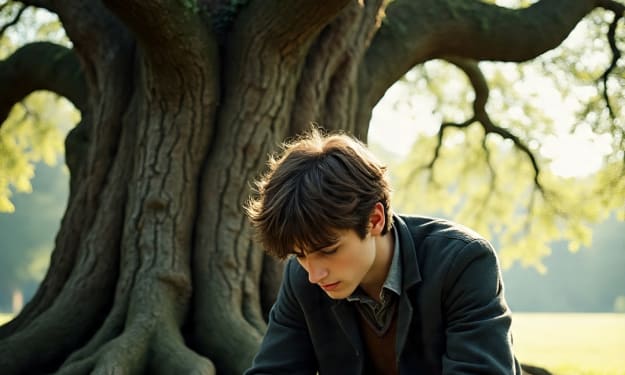
Beneath an ageless banyan’s crown of wide-spun shade, A quiet poet rested, where whispered memories played. His pen was not of silver, nor dipped in rivers deep, But born of silent thinking where hidden feelings sleep. He was a man of mindscapes — a traveler of thought, Exploring every shadow that the restless psyche brought. Others roamed through mountains, some through oceans far, But he journeyed through emotions like a wandering northern star. He listened to the tremors that stirred beneath the chest, The ones people never mentioned but felt within their breast. He studied how a heartbeat speaks the truths we rarely say, And how a sigh becomes a message when the world feels far away. He wrote of inner battles, the wars no eye could see, Where courage grows in silence, where fear learns how to flee. He penned the quiet storms that break without a sound, And the victories of kindness that rarely are renowned. The villagers called him Psychology Poet, wise in gentle art, For he mapped the soul’s geography like scholars map the heart. He could read a trembling gesture, a pause between two lines, Feel the hidden sorrow masked by someone’s practiced signs. Yet he wasn’t born with wisdom; he learned it day by day, Through failures stitched with patience, through thoughts that lost their way. A boy once filled with questions— a river without shore— He sought to understand himself before he knocked on others’ doors. He learned that wounds of thinking are deeper than of skin, For the mind can build a prison and lock its keeper in. But he also learned that healing begins with just one spark— A whisper of acceptance in the middle of the dark. So in his poems he painted hope, not false or bright alone, But hope with human texture — imperfect, real, and grown. He wrote of broken spirits that found the strength to rise, And broken dreams remembered beneath forgiving skies. One day a weary traveler, a man of troubled mind, Came to the poet’s resting tree seeking peace he could not find. His eyes were full of stories his voice refused to share, His footsteps heavy shadows of unrelenting care. The poet offered silence — the purest kind of gift — A space where hurting hearts could breathe and slowly lift. He listened without judgment, without the urge to speak, For sometimes what the broken need is presence, calm and meek. Then softly, like sunrise unveiling hidden dawn, He recited words of healing the traveler could lean upon: “Your thoughts are not your failures, Your fear is not your fate; The mind can be a tempest, But storms will dissipate.” “You are the soul beneath it — The ocean, wide and deep; You are not the passing thunder, Nor the nights you couldn’t sleep.” The traveler felt a warmth rise where emptiness had grown, As though the poet’s verses unlocked a truth he’d always known: That every mind is layered, a mystery vast and bright, And even in its shadows lives the possibility of light. Word of his healing poetry spread far across the land, Men seeking understanding came to sit beside his hand. He taught them how their thoughts could shift like clouds above, And how to rewrite sorrow with gentleness and love. The Psychology Poet stayed beneath his ancient tree, A keeper of inner stories, a guide to what minds could be. Through his poems he kept reminding the world in quiet ways: That strength begins in thinking, and hope in honest days. And so his legacy traveled like wind through open skies — A soft, uplifting message for hearts and seeking minds: That the greatest journey ever taken is the one within, Where poetry meets psychology — and healing can begin.
By Muhammad Saad 10 months ago in Poets
Whispers of the Rising Dawn
When dawn begins to rise, it carries a secret that only the early world hears. It is the sound of hope stretching its wings, the whisper of possibilities brushing against the horizon, the gentle promise that every day is a new chance to begin again. In the valley of Edenbrook, where hills curve like sleeping giants and rivers hum ancient lullabies, the rising dawn is celebrated not as a moment but as a miracle. Each morning, the valley awakens with slow, intentional beauty. The first light touches the peaks, painting them with faint strokes of amber and rose. Dewdrops tremble on the petals of wildflowers, reflecting the newborn sun like tiny mirrors of joy. The cool breeze carries the fragrance of blooming jasmine—soft, sweet, and reassuring, as if nature itself is whispering, “You are not alone. You are part of something vast and beautiful.” On the northern side of the valley stands an old wooden lantern post. It has no name and no storyteller knows when it was built, but everyone knows its meaning. The lantern is lit each night and allowed to glow until morning. For generations, it has symbolized guidance and warmth for anyone wandering, searching, or simply needing a reminder that light does not abandon those who seek it. Legends say that the lantern was once lit by a traveler who arrived in the valley during a difficult time. He had lost his way, his strength, and nearly his hope. In the depths of his despair, he lit the lantern as a final prayer—an attempt to call light back into his life. By dawn, he discovered that the valley had answered. Birds sang around him, the river sparkled as if greeting an old friend, and the first sunlight fell upon the lantern with unusual brilliance. The traveler felt a new courage rise within him, and from that day forward, the lantern was never left unlit. The people of Edenbrook kept it glowing as a symbol that even in the deepest night, light exists—and it waits for morning. One such morning, gentle clouds drifted lazily across the sky, forming soft shapes like feathers and cotton castles. The valley stirred with life. Leaves rustled in harmony, water rippled, and the earth exhaled warmth. The lantern flickered, giving its final greeting before the sun took over its work. In the heart of the valley was a meadow where a quiet miracle took place daily. Here, butterflies gathered in large numbers. When the sun rose high enough, they opened their delicate wings together and took flight. Shades of blue, gold, and violet danced in the air, painting the space with living colors. Children of the valley believed these butterflies carried dreams upon their wings—dreams that travelled to the sky to be blessed by the morning light. And so, the valley thrived on these small wonders. Each element—wind, water, earth, sunlight, lantern, and butterfly—became a reminder that life is filled with countless gentle gifts. Even the smallest moment could hold the seed of a miracle. Every sunrise in Edenbrook whispered the same message: “No matter how long the night has been, morning will always return.” It was a place where hope lived naturally, where light felt like an old friend, and where the rising dawn was not just a beginning, but an invitation. An invitation to keep going, to keep believing, and to recognize the quiet beauty woven into every new day. For in Edenbrook, the dawn never simply rises. It lifts the world.
By Muhammad Saad 10 months ago in Poets
“The City Where Poems Wake”
“The City Where Poems Wake” In a valley between two mountains, Where dawn walks slowly like a shy traveler, There stood a strange and wondrous city— A city where poems woke before the sun did, Where words had wings And silence knew how to sing. The people of that place were not builders, Not merchants, not warriors, not kings. They were poets, Men who carried gentle storms inside their hearts, Men who believed that even a single line Could mend a broken sky. They lived in small houses made of folded pages, And every roof had a quiet heartbeat— The sound of stories waiting to be told. At night the windows glowed softly, As if the dreams inside were lanterns Willing to guide the lost. One of these poets, A quiet boy named Rahim, Walked through the alleys every morning With a notebook tucked under his arm. He was young, unsure, Still learning how to hold the weight of feelings Without letting them spill. He wondered if his voice was too small, If his words were just shadows Following the footsteps of others. But the community of poets around him Never let doubt settle on his shoulders. They spoke to him with kindness, Mending him like a torn page. “Every poet begins as a whisper,” Said the oldest among them, A man with snow-white hair And eyes that held a thousand dawns. “But even whispers can bloom into winds If they believe they have a direction.” So Rahim listened, And with each sunrise He traced lines across his notebook, Little rivers of thought Flowing toward a distant sea. The city had a place called The Bridge of Quiet Voices, A long wooden path above a river black as ink. Every evening, poets gathered there— Not to read aloud, But to release paper boats carrying their day’s writings. The river carried them away, Promising to deliver each poem To a heart somewhere that needed it. Rahim watched them, The soft glow of sunset painting their faces, Men who knew the world was heavy But still chose to add beauty to it. He wondered if he had beauty inside him too. One night, when the sky was stitched with stars, He walked to the bridge alone. The river murmured like an old friend waiting. Rahim tore a page from his notebook— His hands shaking As if he were touching the edge of a dream. He wrote only one line: “Let my small voice be enough to light someone’s night.” He folded it carefully into a little boat And placed it upon the river. For a moment it trembled, Unsure like he was. Then the current caught it gently And carried it forward Into the glowing darkness. The next morning the city woke brighter, As if the sun itself had read Rahim’s line And decided to rise with extra care. Poets gathered around him, Warm hands on his shoulders, Smiles soft as morning clouds. “Your poem reached someone,” The old poet said. “We found your line carried far downstream, Pinned against a rock— But the rock was shining. Your words made even stone feel lighter.” Rahim felt something open inside him, A door he had been afraid to touch. He realized then that poetry Was not about being the loudest voice Or the most brilliant mind— It was about offering something honest To the vast and waiting world. And from that day onward, Rahim wrote not to be great, But to be true. And the city of poets— That quiet, glowing place— Held him as one of its own, A light among many, A voice among hundreds, A poet whose story had finally learned How to fly.
By Muhammad Saad 10 months ago in Poets