Acrostic
The Room I Locked Away from Time
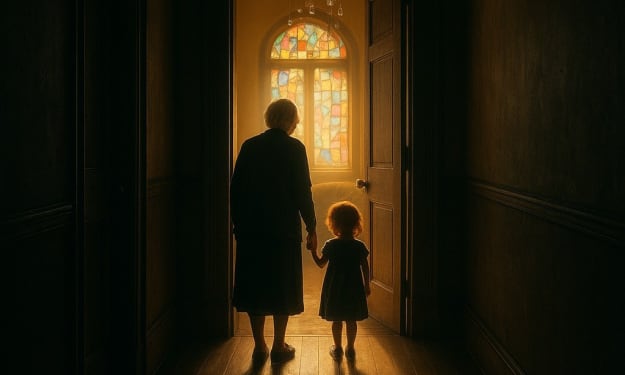
At the very end of the upstairs corridor, where the light gives up and the floorboards grow quiet, there is a door no one notices anymore. It’s plain, swallowed by dust and shadow, its edges blurred into the wallpaper as if the house itself has tried to forget it exists. I rarely walk that far. Still, sometimes—while turning into one of the rooms I still use—I feel my gaze tugged toward it, the way a half-remembered dream tugs at waking thought. The moment never lasts. My eyes tire easily these days, and memory has learned to stay silent. The house and I have aged together, fading in tandem. Colors that once announced themselves proudly—the buttery yellow walls, the sharp blue of my eyes, the copper brightness of my hair—have dulled into the same tired gray. Cracks spread across plaster and skin alike, fine and branching. The stairs complain under my weight, my knees answering them with their own brittle music. There is a heaviness here, a stale stillness that smells faintly of endings. We wait together, the house and I. Not for anything specific—just for what always comes eventually. My days follow a well-worn path. I wake in the bedroom nearest the stairs and cross the hall to the bathroom, where the pipes groan like old men stretching stiff joints. I shuffle down to the kitchen for toast and tea, settling in front of a small black-and-white television where familiar voices tell stories that never surprise me. It passes the time. The climb back upstairs feels steeper every day. I spend the late morning in what used to be my workroom, maneuvering between stacks of yellowed pages and unopened boxes to reach the oak desk where my typewriter still waits. There was a time when inspiration arrived easily—when sunlight spilled through tall windows and the street below offered endless characters. I used to watch the world and then race to the keys, eager to capture it. Now the curtains stay closed, and when I type, the words arrive tangled and thin. Still, the sound of the keys comforts me. It reminds me who I was. At five o’clock sharp, the doorbell rings. The days are marked by who stands on the other side. Groceries twice a week. A nurse with polite concern and practiced cheer. Bags of pills delivered with solemn efficiency—some meant to keep me here, others meant to make it easier when I’m not. On Saturdays, neighborhood boys linger awkwardly on my step, pretending to want chores. Their mothers hover nearby, ready to insist. I grumble, but I let the boys rake leaves or pull weeds. It’s easier than arguing. Sundays are the worst. That’s when the church women come—smiling too brightly, armed with casseroles and good intentions. They clean, they cook, they fold my laundry with a familiarity I never invited. One sits with me while I eat, telling me how loved I am. I nod and imagine being forgotten entirely, the way some people are found long after the world has moved on without them. When they finally leave, I close the door with relief and count the days until I must endure it again. Each night ends the same way: a slow bath, a careful climb, and a whispered plea to a God I’m told cares deeply for me—to please, finally, let this all be over. Until one Sunday, something changes. One of the women arrives late, breathless, apologizing for bringing her daughter along. The child perches at the table, barely tall enough to see her plate, staring at me with fearless curiosity. Her hair is a vivid red. Her eyes are bright and searching. I scowl. She laughs. I bare my teeth. She mirrors me, tongue out, delighted. Her mother scolds her just as the girl bolts from the room, laughter echoing up the stairs. I stop the woman before she can follow. “I’ll get her.” The climb feels longer than usual, but I follow the sound of giggles down the dark hallway. The child stands before the forgotten door, her small hand hovering near the knob. She looks at it the way one looks at something familiar but unnamed. Then she turns to me, and the breath leaves my chest. I have stood here before. Not as I am now—but as a child, tugging at my mother’s hand, begging to be let inside. I remember sealing that room shut after grief hollowed me out, after love was lost faster than I could understand. I had told myself it was easier to lock happiness away than risk losing it again. The door resists, stiff with disuse, but I turn the knob anyway. Light explodes into the hallway. Sunset pours through stained glass, scattering rainbows across pristine walls. Crystal mobiles sway gently from the ceiling, chiming softly as we step inside. The room is untouched by time—bright, warm, alive. My childhood couch waits in rosy velvet. The air hums with memory. The girl slips her hand into mine. I lift her without effort, laughter bubbling up from somewhere deep and forgotten as she brushes the crystals and sends them singing. The sound that joins them startles me. It’s my own laugh. The women find us there later—me on the couch, reading aloud, the child curled happily at my side. They hesitate in the doorway, unsure. “I forgot this room existed,” I tell them. “It was where I was happiest.” I never closed the door again. Light returns to the hallway. The boys come inside instead of staying in the yard. The women help me sort my stories, the good ones, the ones worth sharing. I open the curtains. I write again—not out of habit, but joy. And now, when sleep comes, my prayer has changed. It is no longer a plea to be released—but gratitude, whispered softly, for the stubborn kindness that led me back to myself.
By LUNA EDITH11 months ago in Poets
The Poet Who Spoke to Shadows
M Mehran In a city that never slept, there was a street that seemed invisible unless you were looking for it. The locals called it Whisper Lane, a narrow cobblestone alley lined with shuttered shops and flickering lanterns. At the very end, hidden behind a curtain of ivy, was a small bookstore and café called Ink & Echoes. People said it was a place where poets went to lose themselves—and sometimes, to find something entirely unexpected. No one knew exactly when Eli had arrived at Ink & Echoes. He appeared one rainy evening, leaning against the doorway with a notebook clutched under his arm and eyes that seemed too old for his twenty-five years. He had a habit of observing the city as though it were a poem itself, noticing the rhythm in footsteps, the music in sighs, the metaphors in streetlights. The café welcomed him immediately—not with words, but with an atmosphere. The shelves were stacked with books that smelled like forgotten dreams, and the air carried a quiet energy, the kind that made your thoughts feel like they belonged somewhere. Behind the counter, a woman with a silver streak in her hair named Liora greeted him. “First time here?” she asked, pouring a cup of dark roast. Eli nodded, fingers tracing the edge of his notebook. “I heard poets come here.” “They do,” she said. “And sometimes, they bring the shadows of the city with them.” Eli didn’t understand what she meant, but he sensed it immediately. On his first night, he watched other poets fill the room—not just with words, but with something deeper, something almost tangible. A man whispered verses to the candle flames, as if they were listening. A young woman scribbled poems on scraps of paper and pinned them to the walls. The air seemed to hum with the weight of unspoken confessions. He started writing. At first, his poems were quiet, shy attempts to capture the city’s pulse. But one night, as the rain pounded on the windows and the café emptied to a handful of loyal poets, Eli wrote something different. He wrote to the shadows. The words flowed as if from another voice entirely, describing corners of the city no one else noticed, streets where forgotten memories lingered, lampposts that glowed with lost hopes. When he read it aloud, the café seemed to pause. The candle flames flickered as if in acknowledgment, the shadows along the walls stretching toward him like hands. Even Liora, who had seen countless poets come and go, looked at him with something close to awe. “You… you hear them, don’t you?” she whispered. Eli swallowed, heart racing. “Hear who?” “The shadows. The stories that don’t get told. Only poets like you can speak to them.” From that night on, Eli became a fixture of Ink & Echoes. He arrived every evening, notebook in hand, and wrote about the invisible city, the lives brushing past one another without noticing, the secret moments of beauty and despair. People began to notice the change in the café—the walls themselves seemed to absorb his words, the shadows bending closer, listening. But not all attention was welcome. One night, a critic came—a sharp, impatient man in a tailored coat who claimed to write about art and literature. He watched Eli for an hour, smirking at the quiet devotion of the other poets, and then asked him to explain his work. Eli tried. Words failed. How could he explain the language of shadows to someone who had never listened? The critic left, dismissive, and the other poets murmured words of sympathy. Eli, however, felt a flicker of doubt. What if he was imagining it all? Then, as if to answer his fears, a shadow detached itself from the corner of the room, sliding across the floor toward him. It was not frightening; it was patient, like a waiting friend. The shadow whispered without sound, and Eli understood: the poetry was never for the critics. It was for those who would listen in the quiet, for the forgotten corners, for the spaces between breaths. Months passed, and the city outside moved on. But inside Ink & Echoes, Eli’s poems became legendary. People traveled from blocks away, not just for the coffee or the books, but for the chance to hear a poet who could speak to the shadows of the city, who gave voice to what others ignored. One evening, Liora approached him, carrying a stack of letters left by visitors. Each one contained a poem inspired by Eli’s words—short verses, long reflections, sketches of the city’s unseen life. “They’re multiplying,” she said, eyes sparkling. “You’ve started something.” Eli smiled, but he knew the truth. He hadn’t started anything. He had simply listened. The city had always been full of stories; he had just given them a voice. Years later, when Eli finally left the café, the shadows of Ink & Echoes still followed him, stretching across streets and alleys, whispering in corners and empty rooms. And wherever he went, poets—some old, some new—followed, drawn to the quiet magic of words that could speak to what others refused to see. In the end, the city itself became a poem, stitched together by unseen threads, by voices that listened, by a poet who knew that some of the most powerful stories are told not in light, but in shadow.
By Muhammad Mehran11 months ago in Poets
The Last Café for Poets
M Mehran In the heart of the city, tucked between a crumbling bookstore and a neon-lit record shop, there was a café that seemed almost forgotten by time. Its windows were streaked with the fingerprints of dreamers who had come and gone, leaving whispers of their stories behind. The faded sign above the door read simply: The Last Café for Poets. It was the kind of place where the air tasted like coffee and old paper, where the walls wore verses like wallpaper, and the chairs creaked under the weight of countless confessions. Every night, poets gathered there, not to perform or impress, but simply to exist among others who understood the quiet ache that lived in words. On a rainy Tuesday, Mara slipped through the café’s door, shaking off her umbrella and the weight of the world. She was new to the city, new to its rhythm, and desperately new to the life she was trying to build. She had heard rumors of this place from a friend who had once called herself a poet but gave it up for the security of a nine-to-five. “It’s a sanctuary,” her friend had said. “Even if no one else gets it, you’ll find people here who do.” The café smelled of espresso and honey, and the soft hum of a piano filled the background. Mara’s eyes roamed the room, catching fragments of conversation and half-finished poems scribbled on napkins. A man in a tattered blazer recited a verse to no one in particular, while a young woman with ink-stained fingers laughed at her own lines. It felt like stepping into another world, one where words had gravity and silence was respected. Mara ordered a chai latte and sat in a corner, notebook in hand, pretending to be invisible. But invisibility was hard to maintain here. A man with glasses thicker than the lenses themselves approached her. “First time?” he asked, voice rough like gravel. Mara nodded. He smiled, a little crooked, and nodded toward the notebook. “You write?” “I try,” she admitted, unsure why her voice felt so small in a room full of poets. “Try?” he echoed. “Here, we don’t try. We spill.” That night, Mara learned what it meant to spill. The poets spoke in metaphors that caught in the throat and rhymes that tasted like home. They read about love lost in subway stations, about rain that fell in patterns only the heart could understand, about mornings that smelled like burnt toast and regret. Each poem was a confession, a rebellion, a revelation. One poet, an elderly woman named June, wrote on scraps of paper she kept in a tin box. “These poems are my ghosts,” she said softly, her voice quivering like the flame of a candle. “They remind me of who I was, who I wanted to be, and who I might have hurt along the way.” She handed one to Mara. It was a short poem about forgetting. Mara read it slowly, feeling a strange warmth and ache all at once. Mara began to write too, hesitantly at first, then with growing urgency. She wrote about the city she had just arrived in, about the loneliness that shadowed her footsteps, about the dreams she hadn’t dared to speak aloud. With every word, she felt herself loosening, unraveling, and somehow becoming whole. Weeks turned into months, and the café became Mara’s home. The poets were her constellation—each unique, scattered across the universe of the room, yet bound by the gravity of language. They celebrated the small victories: the perfect line captured after a sleepless night, the laugh shared over a particularly absurd metaphor, the silence that followed a poem so raw it demanded quiet. But the café itself was fragile, like the poems it nurtured. One day, a notice appeared on the door: Closing in 30 days. The news fell like a stone in the stomach of everyone who had found refuge within those walls. Mara felt a strange panic, a fear of losing not just a place, but a community, a heartbeat that had become her own. On the final night, the café was packed. Every poet, past and present, came to give the place its last tribute. June brought her tin box of ghosts. The young woman with ink-stained fingers wrote a new poem on the spot, and the man in the tattered blazer recited verses that made the walls weep. Mara read aloud, her voice trembling but strong, her words a bridge between the ephemeral and the eternal. As the clock ticked toward midnight, the café fell silent. Mara looked around at the faces, each etched with memory and love for this strange, sacred space. She realized that the café itself was not just a building—it was the poems, the poets, and the courage to spill oneself into the world. And though the door would close forever, the words would not. When the lights finally dimmed, Mara walked out into the cold night, notebook clutched to her chest. The rain had stopped, and the city looked the same, yet different, as if it had absorbed the last echoes of the café and now held them quietly in its streets. She knew that poets would always exist, in coffee shops, in parks, in lonely apartments, and in the hearts of those brave enough to spill. And maybe, just maybe, she would be one of them. The Last Café for Poets was gone, but the poetry remained—wild, persistent, and uncontainable, like a river carving its way through the cracks of a city that thought it could forget.
By Muhammad Mehran11 months ago in Poets