
See No Evil

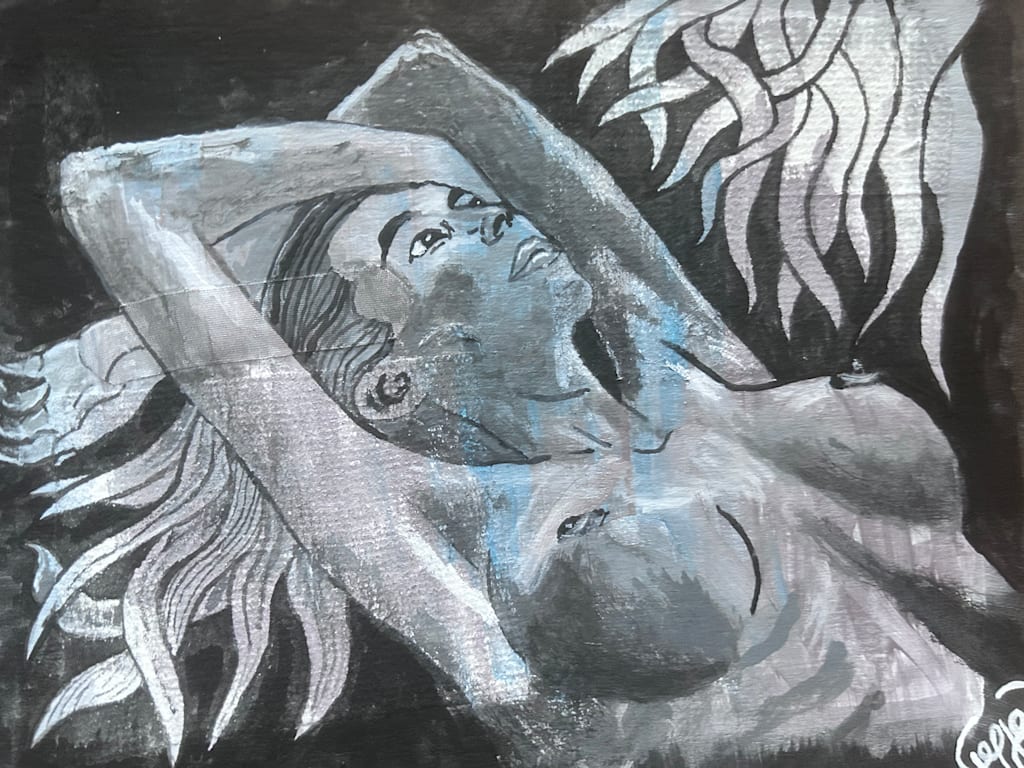
While her body sings, waking without asking permission from the day,
she moves toward herself as one returns from a long exile,
Rigorberta on the other side of the mirror, a name of rain and border without shame,
her name trembling in the wood of a house that no longer knows how to hide desire.
She opens the curtains as one breaks an ancient pact with shadow,
and light finds her without judgment, her skin luminous, unrestrained,
and the entire city breathes with her, without fear, as if everyone had finally remembered they are free.
From outside, the street belongs to no one and to every gaze unfiltered,
eyes that celebrate, eyes that ignite,
presence turning into shared pulse within a crowd no longer divided.
And in that river of faces, he appears—
as if destiny had learned to walk among multitudes.
He says nothing.
He does not need to.
The distance between them breaks the way inevitable things break,
the way waiting breaks when it can no longer hold itself together.
The great window stands firm like a mast,
and something within them opens toward the vast unknown of connection.
The door opens.
And the world, which moments ago was only spectator,
becomes silence.
Silence in lips.
Lips in promises.
Promises that tremble into truth.
Outside, people continue as if the city itself had learned a new language of breathing—
not order, not chaos, but something between recognition and exposure.
And in that unfolding world, Rigorberta and Teresito find each other again,
not as characters of prohibition or permission,
but as two fragments of a system trying to understand what it means to feel.
The city still does not know whether it is sick or merely shedding its old skin.
Before the rabbit masks, before the bars where desire and spectacle blurred into one another,
Rigorberta already felt the world shifting—
as if reality itself was waiting for a signal to loosen.
Teresito entered her life in that time when everything still had rules,
though no one fully believed in them anymore.
Not order—only inertia.
Things were forbidden by habit, not conviction.
And beneath that surface, the city was already boiling.
He appeared like an error no one chose to correct.
He looked at the world as if it were a misunderstood experiment,
and at people as variables constantly changing state.
Rigorberta did not understand him at first.
Only later did she realize he rearranged her sense of time.
Two years later, she still could not tell whether that was love
or a system malfunction.
Meanwhile, the country was already speaking of change.
First a rumor: expanded emotional expression.
Then a proposal: reducing social shame as public health policy.
Finally, a phrase repeated with uncertainty and nervous laughter:
regulated freedom of desire.
News screens explained it gently, with soft colors and calm voices.
Loneliness was described as an epidemic.
Human isolation as a national crisis.
The body, they said, needed to leave silence behind.
Rigorberta listened while trying to remain afloat in her own life.
Teresito, on the other hand, seemed fascinated—
as if the world was finally preparing to stop lying to itself.
One night, he disappeared.
No clear note remained. Only fragments: new work, new people,
“a shift of era.” Then silence.
That was when the president appeared on national broadcast.
The speech was not solemn.
It felt like a tired conversation with an entire country.
“For too long,” he said,
“we have treated human desire as something that must be hidden in order to be accepted.”
He paused, as if weighing the sentence against the room.
“This has produced distance, confusion, and loneliness.
We have mistaken intimacy for isolation.”
Behind him, no flags. No grand symbols.
Only simple moving images: people walking, speaking, touching shoulders
as if connection had become statistical.
“Today we begin a new stage.
The State recognizes public emotional expression as part of the social fabric.
Not obligation. Possibility.”
And then, softly, almost dangerously:
“What was once private will no longer be called hidden.
What was hidden will no longer be called shameful.”
The broadcast ended without applause.
Rigorberta stared at the dark screen,
as if waiting for the world to explain itself.
Somewhere in the city, Teresito lit a barroom light
where people were beginning to learn new ways of appearing to one another—
still unsure whether this was freedom
or only a different form of habit.
And the world, without noise,
began to reorganize the way it desired.
About the Creator
Stephen Betancourt
poems have different melodies, which shapes their theme; they are meant to be read soft or in a strong voice but also as the reader please. SB will give poetry with endless themes just to soothe and warm the heart.
Enjoyed the story? Support the Creator.
Subscribe for free to receive all their stories in your feed.
Comments
There are no comments for this story
Be the first to respond and start the conversation.