
Exploring Chūya Nakahara’s Poem “Circus” Through Its Background and Language
Essay, Poetry Translation, Interpretation, Analysis

Essay and translations originally published on Medium in Found Worlds by editor Yuri Minamide
Introduction
This essay is about a specific poem, Circus, how I found it, approached working on its translation, and the world that opened to me as a result. As a student of the Japanese language, one of the ways I learn is by listening to Japanese music, such as children’s songs, slow pop songs, and folk songs that I can easily translate and sing.
On one excursion into YouTube, I found a rare album which has since become one of my favorites. At first, I would only listen, picking out words here and there, since my linguistic ability can only be categorized as advanced beginner, but I was drawn in with curiosity. The album is Nakahara Chūya Sakuhinshu by Tomokawa Kazuki-The Collected Works of Chūya Nakahara. Circus is the first track on the album. Though Tomokawa arranged the stanzas differently to fit his musical view of the piece, the rhythm of his composition greatly influenced how I read the poem after I realized it was more than a song.
In translation, the words chosen to paint a poem’s world influence how it is viewed by an audience that may be unfamiliar with the original language and culture. Translation is not just a word-for-word copy of the work. There are many things to consider. Does the translator keep to the literal meaning? Are there observances of structure, rhythm, and sound? Are there meanings or ideas of cultural significance that might not translate easily? Can the translator make the poem accessible? Can the translator express the intention of the author in each line? And in the case of Japanese, should a translator consider the symbolism and history of written characters that were chosen by the author, in places where he could have chosen a synonym?
I hope that you, as readers, will take away the desire to learn more about Chūya Nakahara and his poetry. He has fascinated me and many others in his native Japan and across the globe. From this point, when writing his name, I will use the author’s chosen family name, Nakahara, or write his name as it would be found in Japanese, Nakahara Chūya. I will use written Japanese kanji only to explain how they pertain to my view of the poem.
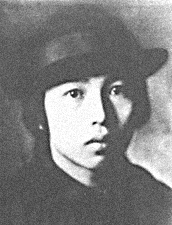
Nakahara Chūya began his writing career composing traditional tanka poetry — 5 lines of 31 syllables arranged with lines of 5,7,5,7,7 syllables similar to the more familiar haiku structure to Westerners of 5,7,5. During his short career, he studied French and translated the work of French poet Arthur Rimbaud into Japanese. For Nakahara, this opened a new world of Dada and Symbolist poetry from the Swiss and French movements that was also circulating among his peers. This combination of influences, along with the writing structure inherent in the Japanese language, allowed him to forge a unique writing style.
A Short Life
Nakahara, born Kashimura Chūya (April 29, 1907- October 22, 1937), wrote using the family’s adopted maternal family name as his pen name. Most of his poems were written during the early years of Emperor Hirohito’s Shōwa era (December 25, 1926- January 27, 1989). He was the son of Kashimura Kensuke, a decorated army doctor, and Nakahara Fuku. He is reputed to have been a brilliant but wayward student who balked at his parents’ expectations, often butting heads with his father. He eventually found a path to university and is known in Japan for his translations of the French poet Rimbaud’s works. He married and had two children, but died young after contracting tubercular meningitis and after the death of a child from the same illness. He left a body of work containing approximately 300 poems.
Nakahara’s first book of poetry, originally published in 1934 in a self-published edition of 200, is called Yagi no Uta (Goat Songs). His poems were also often published in smaller cutting-edge literary journals of the day. His second volume was published posthumously by Kobayashi Hideo. Nakahara’s work has gradually gained in popularity. It is available in several English translations, including a comprehensive side-by-side Japanese/English volume, The Poetry of Chūya Nakahara: Japan’s Modern Master by Christian Nagle, from Tuttle, a respected American publisher of Japanese-language materials. Poems in the original Japanese and new individual poem translations by Jeffrey Angles, who also published an essay on translating Nakahara’s work, can be found at the Poetry Foundation (links at the bottom of this essay). His work is characterized as falling into the Dada and Symbolist schools of writing.
Characteristics of Dada and Symbolist Work
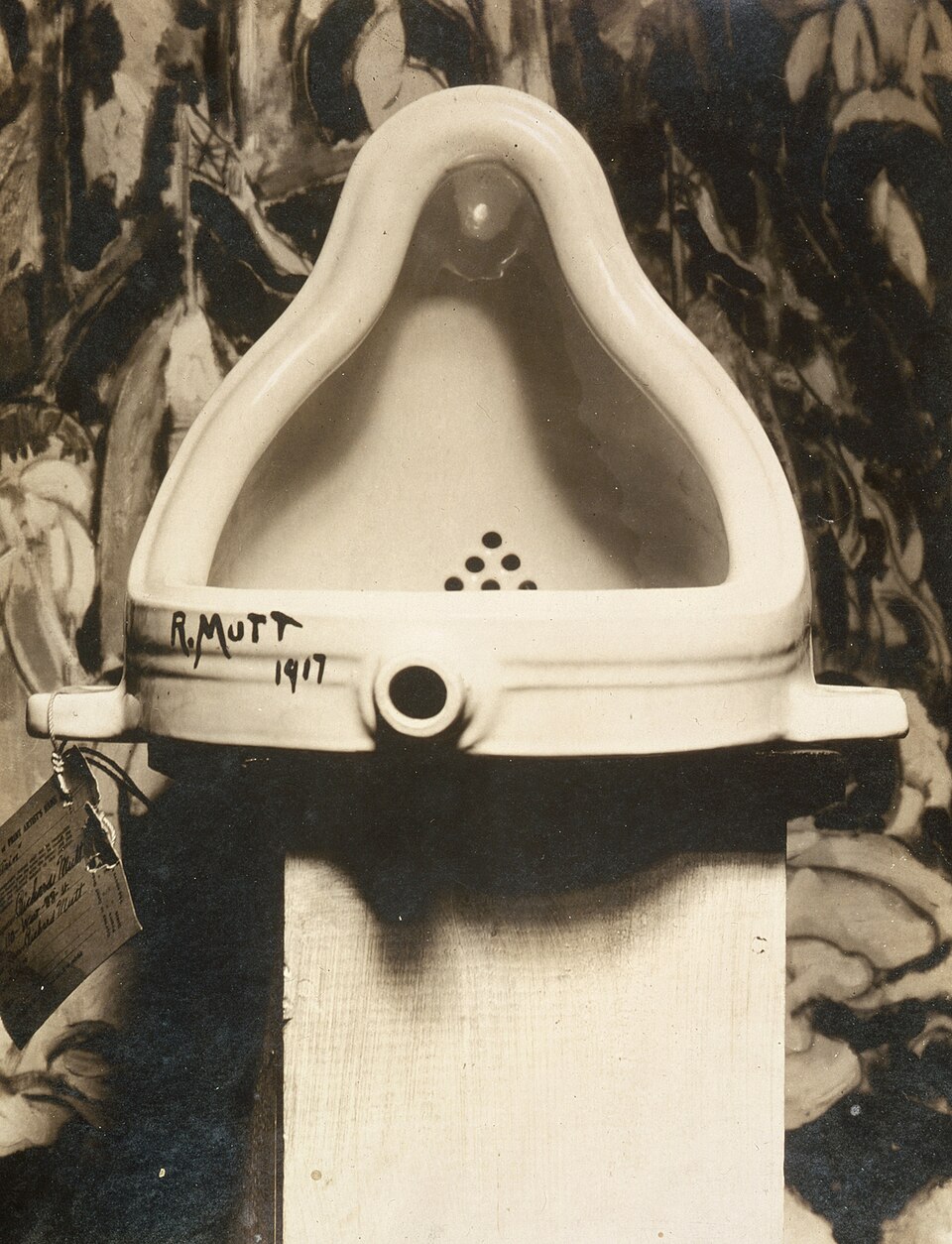
Although Nakahara at first worked within the confines of traditional Japanese poetry, especially the five-line, 31-syllable tanka form (5/7/5/7/7), he was also influenced by the Dada movement, which originally began in Switzerland. Most familiar to us in the West in this art form would be the Marcel Duchamp piece entitled Fountain — which was, in fact, a urinal signed R. Mutt (1917), or his found object pieces. Dada intended to shock.
The Dada movement, however, was not confined to the visual arts. Written work included artist manifestos, plays, and stories. Dada poetry was known for incorporating abstract sounds and onomatopoeia. It also conveyed the idea of an unchangeable thing- if something is one way, it does not become something else. It delved into speech on a subconscious level and attempted to release the writer’s and the viewer’s or reader’s minds from their customary religious, social, and moral constraints.
Dada poetry typically did not follow the conventions of traditional European forms, dismantling the way language was spoken. This influence has come down to us today in poems where words printed on a page are crossed out until the remainder creates a new, unintended meaning from the original. In song, David Byrne of the Talking Heads uses a method he calls “free writing” to create songs by using disparate lines from newspaper articles. He also employs non-word sounds to bridge parts of his songs, such as in the tracks “Psycho Killer” and “She Was”.
Another characteristic of Dada poetry is that the narration issues from the mind of the speaker or viewer. It does not pretend to be in someone or something else’s head. We can assume an internal narration by the author.
Poets including Rimbaud, whose work Nakahara translated into Japanese, worked within the Symbolist movement. Symbolist poets variously focused on using language to connect the dream world with ideas, pairing the tangible natural world with symbols, creating new kinds of poetic rhythm and structure, including using music and musicality, and creating a visionary realm through unconnected dream-state topics.
Characteristics of Tanka Poetry
Tanka, which Nakahara also wrote, is less familiar than haiku to most of us in the West. They are composed of five lines rather than three, and traditionally contain a musical pattern of 5/7/5/7/7 syllables. The third line is written as a bridge between ideas contained in the first two lines, called the upper poem or kami-no-ku, and the final two lines, or lower poem called the shimo-no-ku, weaving the whole together as a string or possibly as a ribbon. A string or ribbon can also be used as a metaphor for tying several tanka or a related theme together. Because this form was originally used for communication between lovers in the Japanese Imperial Court, the Academy of American Poets likens the tanka form to the sonnet.
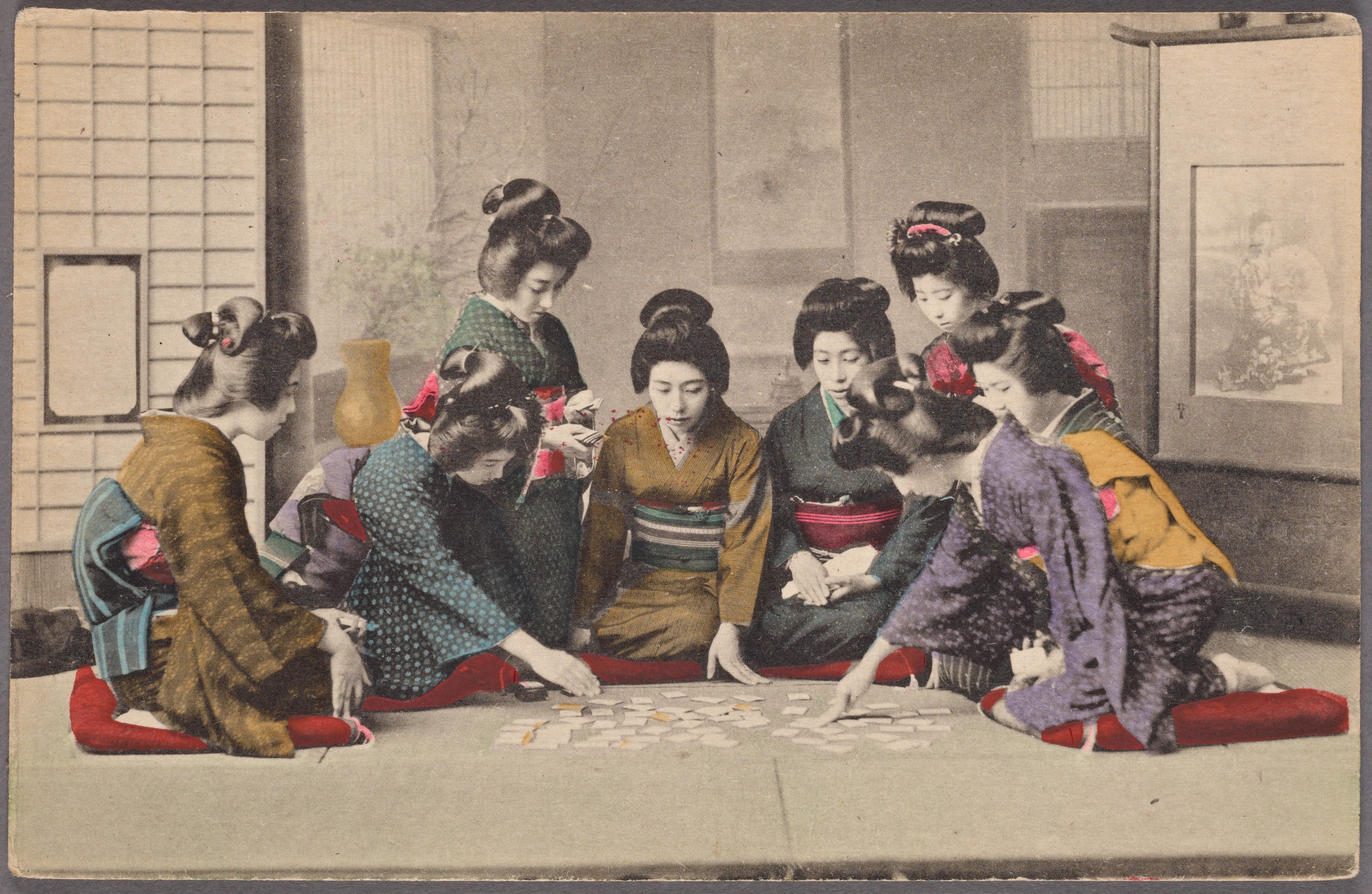
In Japan, a competitive card game known as Uta-garuta was developed using the tanka published in a famous volume titled Ogura Hyakunin Isshu(1235AD). This volume contains 100 collected poems, each by a different poet. Westerners may be familiar with this game from the anime Chihayafuru, which follows several young people as they learn the poems and compete in the sport.
Text Analysis of Circus, Original Japanese
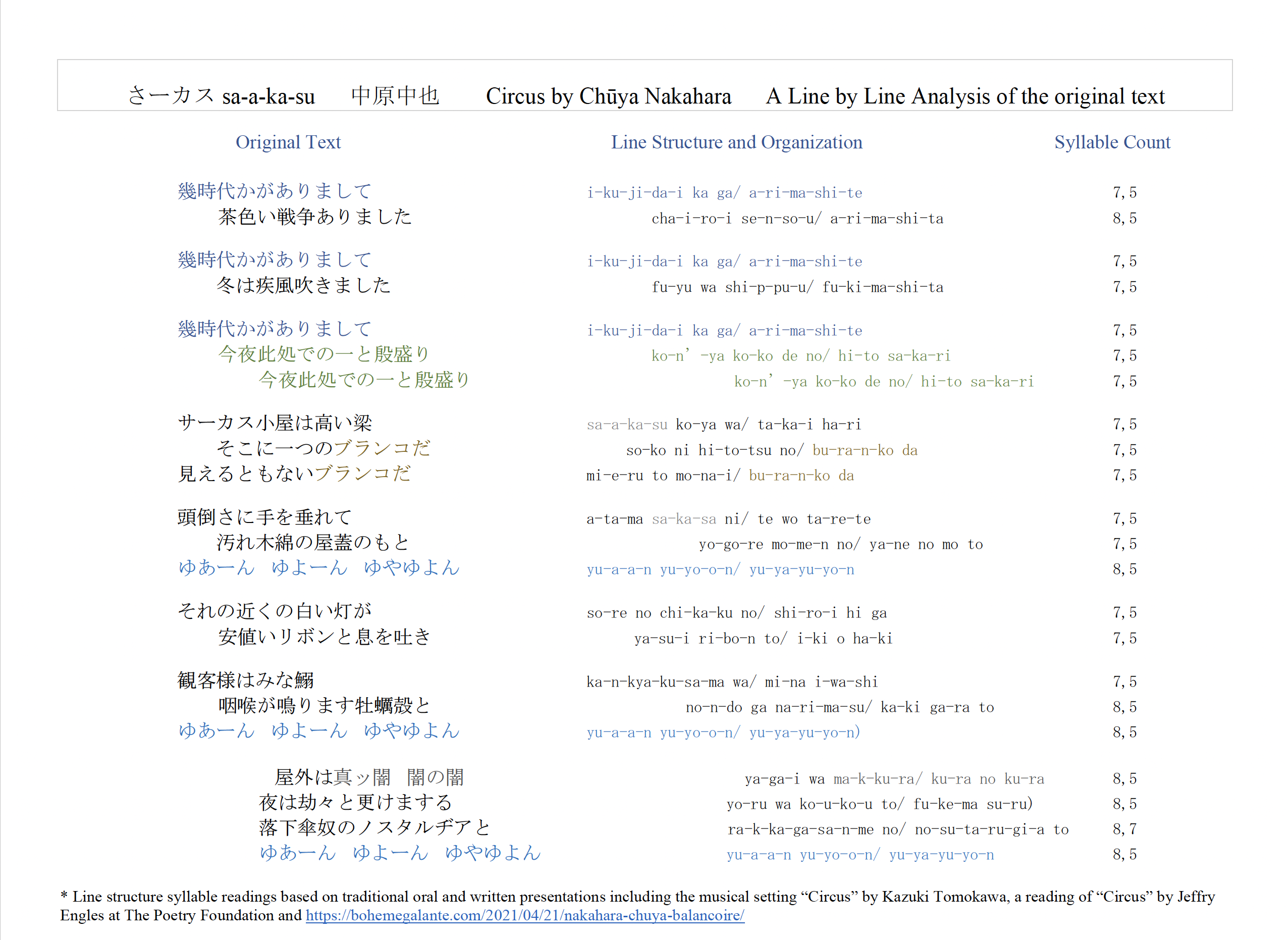
While diving into the thoughts that eventually helped generate three English translations, I began to examine the poem’s structure, illustrated in the image below. A small amount of Japanese-language ability was needed for this, but I have color-coded the points and broken down the syllable count, which I hope will help explain some of my English choices to Japanese and non-Japanese speakers. The poem is composed of 22 lines written in groups of 7–5 or 8–5 syllables. Lines 1, 3, and 5 repeat, each positioned at the beginning of the first three stanzas. These are mirrored by a three-line repeat of sounds at the end of the poem. In lines 6 and 7, repetition creates an emphatic statement, and further word repetitions or alliteration are present, which are also highlighted in color. I spent time listening to various readings of the poem and based my romaji (English-equivalent syllables) on both written and aural versions I accessed.
I would also like to highlight the “loan” words Nakahara used. The Japanese language, like English, has borrowed words from many other languages. These are written phonetically in a distinguishing text so that they can easily be identified and pronounced as non-native words. Nakahara used several of these in his poem, including the title Circus (sa-a-ka-su). Because Nakahara chose loan-words rather than using somewhat equivalent Japanese words, I believe he intended to set them apart. Buranko, bu-ra-n-ko (from the Portuguese for “swing”), was used twice to highlight its importance to the theme. Ribbon, ri-bo-n, from the English ribbon, could be used to refer to its position as a tie within the bridge between two ideas. Nostalgia no-su-ta-ru-gi-a, from the English nostalgia, was used instead of the Japanese natsukashii, highlighting the difference between a painful longing to rejoin the past in the former, and a grateful recognition of the past in the latter.
I believe Nakahara also chose the Chinese characters in the poem deliberately, to create pictures of ideas he intended people to absorb. Some of these are highlighted in my translation variations to explain my English language choices.
My Translations
Variation 1: Narrative
In this version, I kept the feeling of other translations I have seen, where the writer is an outside observer of all of the events. He does not seem to belong to any one place or time. I have also kept to lower-case lettering. Japanese does not use capital letters, and the poem has no punctuation, though I have added commas where I think they help rhythmically, when translated into English.
I also chose to use traditional line breaks that end on an important word, as we would in English, rather than keeping to the original Japanese, which is bound by its grammar. For instance, in the 1st, 3rd, and 5th lines, the lines end in て (te), an equivalent of “and”. In Japanese, this syllable is tacked onto every verb in a related string, except the final verb, which indicates the tense of the sentence. In English, for instance, we would say “He walked and talked.” The Japanese version of this would look something like “He walk(te) talked”. So the “and” actually falls on the lines preceding the 2nd, 4th, and 6th.
Some translators choose to alter the three lines of sound line, yuaan yuyo-on yuya-yuyon. Because I believe these sounds can be recognized universally without creating a language barrier, I translated them into English syllables exactly as written.
For me, these sounds indicate not only the creaking of the trapeze ropes but also possibly the sound of parachute straps during a descent, which may tie into the nostalgia. It also lends itself to the poem’s musical structure. Several of Nakahara’s poems were set to music during his lifetime by the composer Moroi Saburō, and Nakahara himself felt a strong connection to the structure of Japanese folksongs.
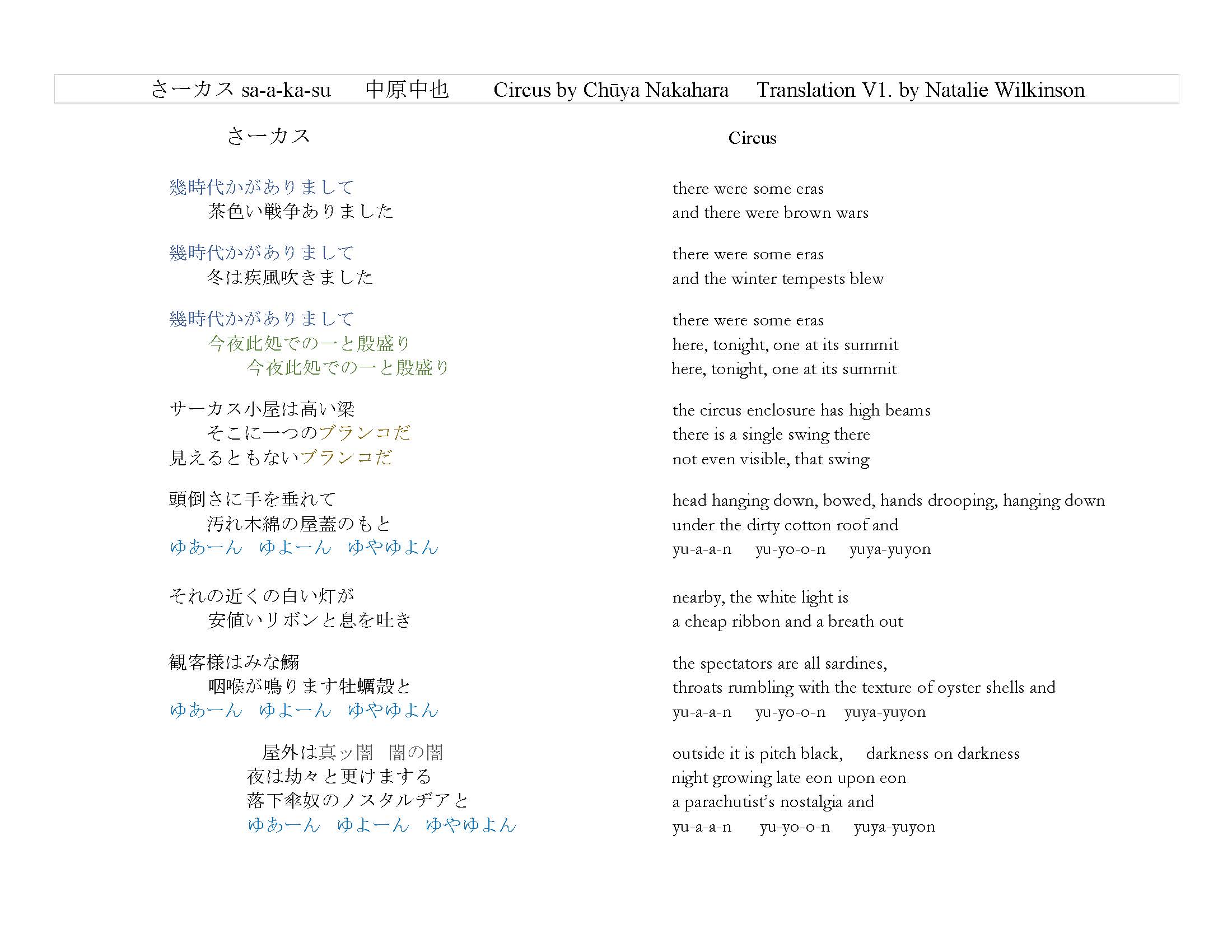
Variation 1:
Circus by Nakahara Chūya translated and interpreted by Natalie Wilkinson
there were some eras
and there were brown wars
there were some eras
and the winter tempests blew
there were some eras
here, tonight, one at its summit
here, tonight, one at its summit
the circus enclosure has high beams
there is a single swing there
not even visible, that swing
head hanging down, bowed, hands drooping, hanging down
under the dirty cotton roof and
yu-a-a-n yu-yo-o-n yuya-yuyon
nearby, the white light is
a cheap ribbon and a breath out
the spectators are all sardines,
throats rumbling with the texture of oyster shells and
yu-a-a-n yu-yo-o-n yuya-yuyon
outside it is pitch black, darkness on darkness
night growing late eon upon eon
a parachutist’s nostalgia and
yu-a-a-n yu-yo-o-n yuya-yuyon
Variation 2: Narrative
The narrator is a member of the audience, or spectators. I chose to keep spectators, which is the usual translation of kyakusama, as the word spectators highlights the idea of viewers, whereas audience stresses listening. Also, the comment about the swing barely being visible could be construed as that the speaker can barely see it, or that it is not clear to him. Even though the white light in the poem isn’t identified as such, I used a spotlight, which is the way I am used to thinking of a circus light in the rafters, along with a haze from the motes of dust swirling through it from the sand floor.
In this variation, I began by keeping the “and” (te) syllable on the line where it appeared in the Japanese. I have also made decisions about incorporating individual meanings of the kanji characters Nakahara chose to use. Because much of the Japanese language is written using characters that can convey multiple meanings, it is uniquely suited to this type of wordplay.
In some parts of the poem Circus, I used this aspect of Dada poetry to inform possibilities of translation. For instance, the two characters 疾風, when used together, denote a storm, gale, or tempest. Taken individually, however, we have the idea of sickness, disease, or illness with 疾 and the character for wind 風. I believe Nakahara was a master of choosing characters that could deepen the reader’s understanding.
A second example of this is the first character 幾 in his poem. In this context, it is pronounced iku. When used as a prefix in the phrase 幾時代, the character causes the second two characters -generation, era to mean several, some eras, a few eras. The fourth character, a hiragana “ka”, makes the time hazy or uncertain, so one translation of the line could be: “There were some eras and”. In looking at 幾, its parts appear as a weaving loom, dressed with threads (糸,機).
Therefore, applying a Dada sensibility to the characters, I believe the construction of the line could contain some element of times woven together or intertwined or that they were threads of time drawn together, connected by “and”. Nakahara had other words to choose from which convey the sense of “some” or “many”, but he chose this particular character, which I do not believe was accidental or undetermined.
In the written text, I also kept close to the original line spacing at the beginning of each line to allow room for the reader’s breath.
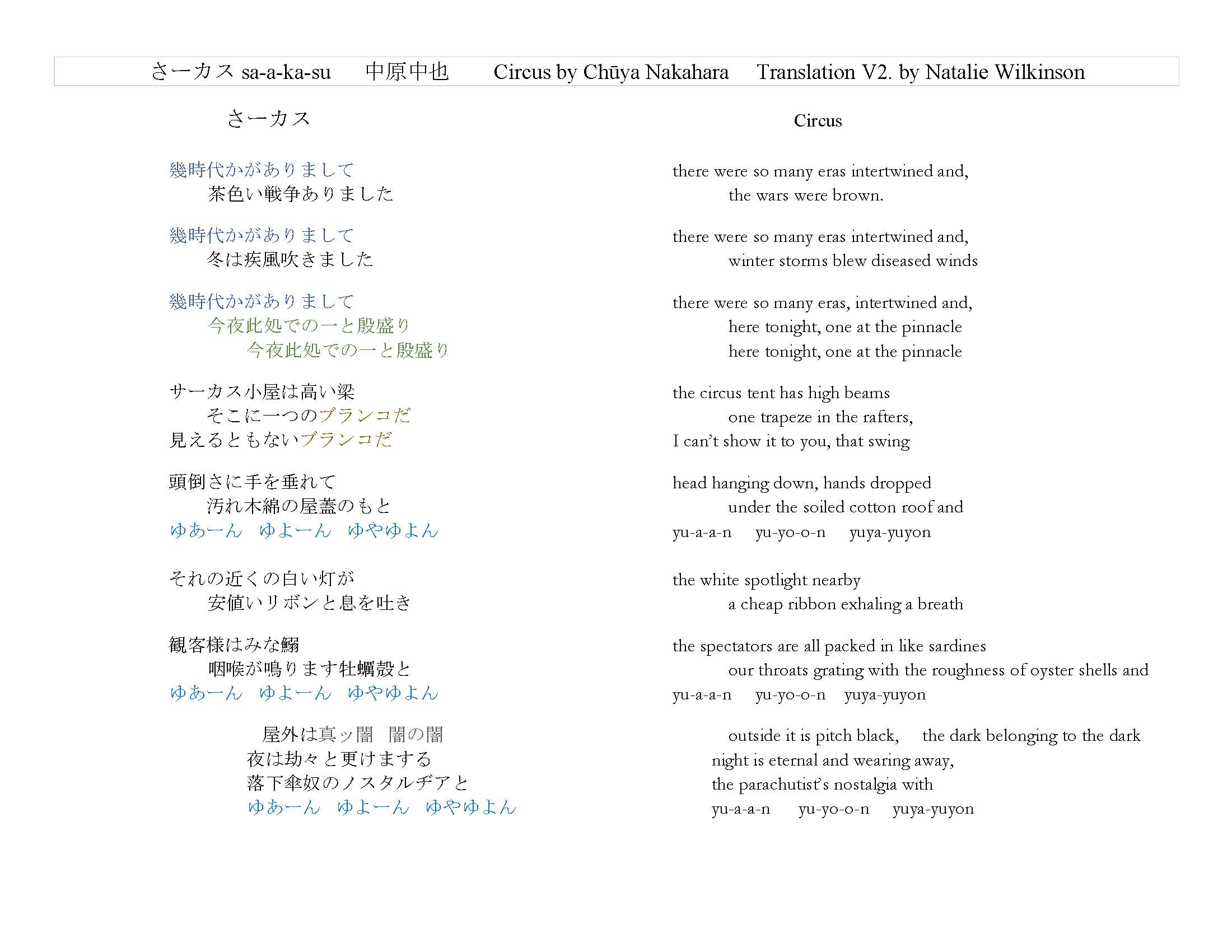
Variation 2:
Circus by Nakahara Chūya translated and interpreted by Natalie Wilkinson
there were so many eras intertwined and,
the wars were brown
there were so many eras intertwined and,
winter storms blew diseased winds
there were so many eras, intertwined and,
here tonight, one at the pinnacle
here tonight, one at the pinnacle
the circus tent has high beams
one trapeze in the rafters,
I can’t show it to you, that swing
head hanging down, hands dropped
under the soiled cotton roof and
yu-a-a-n yu-yo-o-n yuya-yuyon
the white spotlight nearby
a cheap ribbon exhaling a breath
the spectators are all packed in like sardines
our throats grating with the roughness of oyster shells and
yu-a-a-n yu-yo-o-n yuya-yuyon
outside it is pitch black, the dark belonging to the dark
night is eternal and wearing away,
the parachutist’s nostalgia with
yu-a-a-n yu-yo-o-n yuya-yuyon
Variation 3: Narrative
In this variation, the observer is also a soldier of the “brown wars”, the trapeze artist high in the rafters, viewing the audience packed in like sardines in a can, upside down under his tent, like a parachutist in reverse, thinking about gliding down.
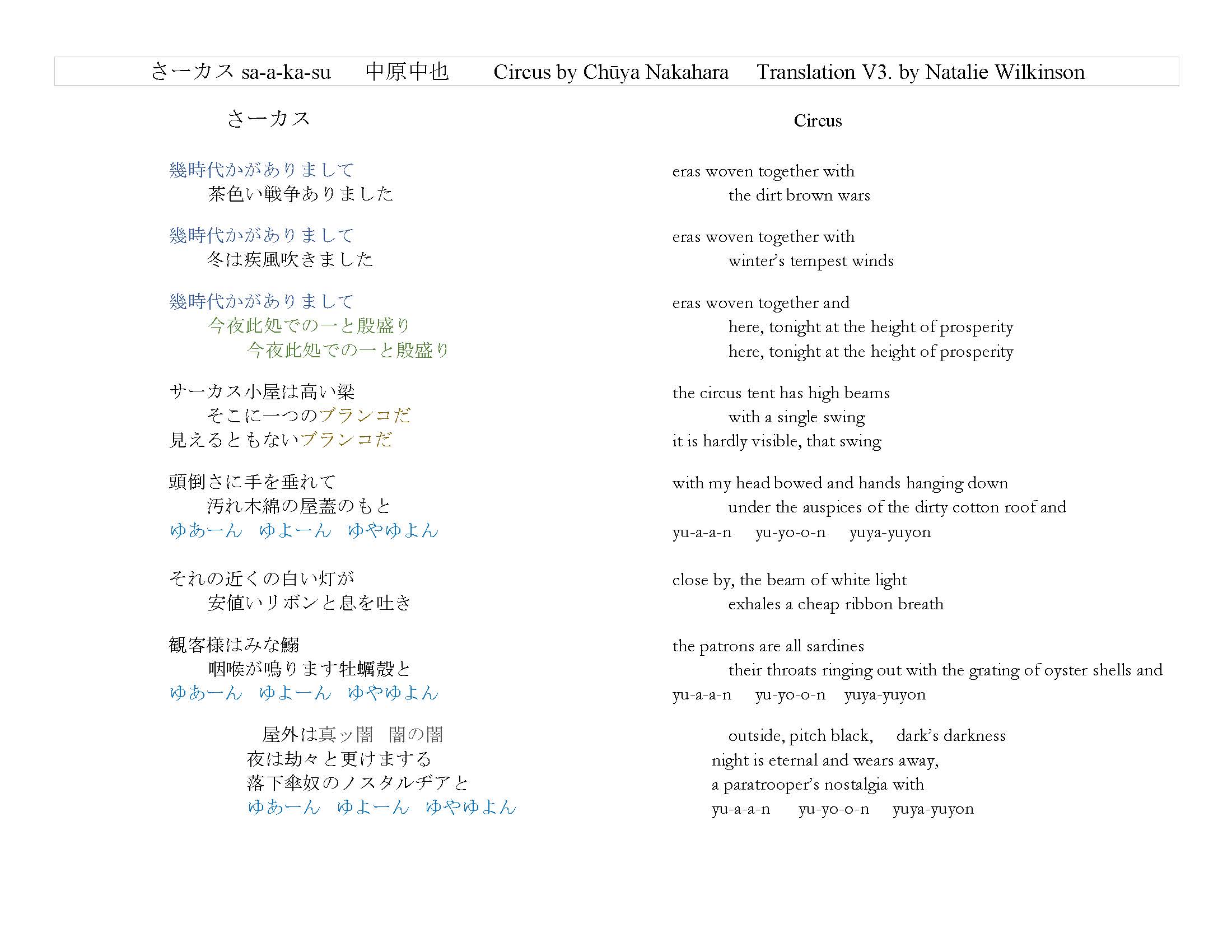
Variation 3:
Circus by Nakahara Chūya translated and interpreted by Natalie Wilkinson
eras woven together with
the dirt brown wars
eras woven together with
winter’s tempest winds
eras woven together and
here, tonight at the height of prosperity
here, tonight at the height of prosperity
the circus tent has high beams
with a single swing
it is hardly visible, that swing
with my head bowed and hands hanging down
under the auspices of the dirty cotton roof and
yu-a-a-n yu-yo-o-n yuya-yuyon
close by, the beam of white light
exhales a cheap ribbon breath
the patrons are all sardines
their throats ringing out with the grating of oyster shells and
yu-a-a-n yu-yo-o-n yuya-yuyon
outside, pitch black, dark’s darkness
night is eternal and wears away,
a paratrooper’s nostalgia with
yu-a-a-n yu-yo-o-n yuya-yuyon
Of Nakahara’s work, Circus was a lucky first poem for me to latch onto. I have never spent so much time thinking about a poem, its rhythm, and its meaning before. There is still room for more exploration, room to read the poet’s work and translations of it, to think about the life of the poet or “the poetry life” as he called it, room for more study of Rimbaud, of Japanese, of Dada and Symbolism, of translation in general. If my translations are useful to others, it will make me happy, but that they gave me a deeper understanding of poetry and ways to write has benefited me by creating a ribbon of connection through eras.
Bibliography
Introduction:
Kazuki Tomokawa The Collected Works of Nakahara Chūya (YouTube)
https://en.wikipedia.org/wiki/Chūya_Nakahara
https://en.wikipedia.org/wiki/Shōwa_era
https://www.tuttlepublishing.com/japan/the-poetry-of-chuya-nakahara-9784805318973
https://note.com/sirius_041011/n/n6f34fea3a4e4?hl=en
https://www.poetryfoundation.org/poetrymagazine/articles/1684848/on-translating-nakahara-chuya
https://www.poetryfoundation.org/poetrymagazine/poems/1682874/sakasu
https://www.poetrepublik.com/poet-republik-nakahara-chuya/
https://tsukiyonokarasu.com/echoes-of-ink/nakahara-chuya-circus/#google_vignette
Circus
There have been so many eras So many wars fought in brown There have been so many eras So many quick winds of winter…
Characteristics of Dada and Symbolist Work:
https://en.wikipedia.org/wiki/Dada
https://en.wikipedia.org/wiki/Symbolist_Manifesto
Characteristics of Tanka Poetry:
https://www.tankasocietyofamerica.org
https://poets.org/glossary/tanka
https://www.ahapoetry.com/RICHTANK.HTM
https://tankatuesday.com/24-forms/#
Text Analysis of Circus, Original Japanese:
Variation 1: Narrative
The music of silence https://note.com/rose_yoshimoto/n/n8111216d65d9
https://www.theregoesnihongo.com/post/__one
“A cheap ribbon and a white light”-could it be referring to protection?https://www.tsunagujapan.com/omamori-physical-well-wishes/
Exploring Chūya Nakahara’s Poem “Circus” Through Its Background and Language on Medium
About the Creator
Natalie Wilkinson
Writing. Woven and Printed Textile Design. Architectural Drafting. Learning Japanese. Gardening. Two poems are featured in a new print anthology-POETICS: Grain available at Bainbridge Island Press.
IG: @maisonette _textiles
Enjoyed the story? Support the Creator.
Subscribe for free to receive all their stories in your feed. You could also become a paid subscriber, letting them know you appreciate their work.
Comments
There are no comments for this story
Be the first to respond and start the conversation.