
After the House Learned to Burn
An out-of-sequence poem

Before the match,
there is ash.
Before the sirens,
my mother is already standing in the yard
with her hands full of photographs
that have not yet curled black at the edges.
She keeps saying
we forgot the baby pictures,
though I am thirty-seven
and childless
and the baby in the frame is my father,
who has been dead for nine years
and will call tomorrow
to ask if I have checked the smoke alarm.
Tomorrow, I will say yes.
Yesterday, I said nothing.
Somewhere in the middle,
the kitchen clock survives,
its hands stopped at 2:13,
which is not when the fire started,
not when the roof gave way,
not when the insurance man wrote
total loss
as if loss could be counted honestly
by square footage.
2:13 is the time my brother left the voicemail
I will not listen to
until after the funeral
that happens before the fire
in every version my mother tells.
In one version,
I am ten years old
and hiding under the dining room table
while my parents argue over money.
In another,
I am carrying a wet towel
through a hallway full of smoke,
heroic and useless.
In the true version,
I am across town
buying oranges
because they were on sale,
because life continues performing
its small humiliations
even while everything important
is learning how to disappear.
The oranges roll around the trunk
while I drive home.
One splits open.
The car smells bright and sweet.
Years earlier,
my mother teaches me
that you can test a peach for ripeness
by pressing gently near the stem.
Years later,
I press my thumb
into a softened beam
and it gives way
like fruit.
The fireman says,
You can’t go in there.
But I have already gone in.
I go in every time I close my eyes.
I go in before the door is unlocked,
before the walls turn wet and blistered,
before the smoke stains the ceiling
into weather.
I go in on the morning
we moved there,
when my father carried the couch backward
through the front door
and laughed so hard
he had to set it down.
I go in on the night
my brother punched the pantry wall
and left a dent
we covered with a calendar
from the bank.
I go in after the calendar burns.
I go in before the punch.
I go in when the house
is only a drawing on a napkin
my parents are too young to doubt.
My mother says
the worst part is the smell.
Then she says
the worst part is the silence.
Then she says
at least no one was hurt.
Then she asks where the dog is.
The dog died in 2004.
Still, for one terrible second,
we all turn toward the house.
That is how time works
after disaster.
It opens every door at once.
In the future,
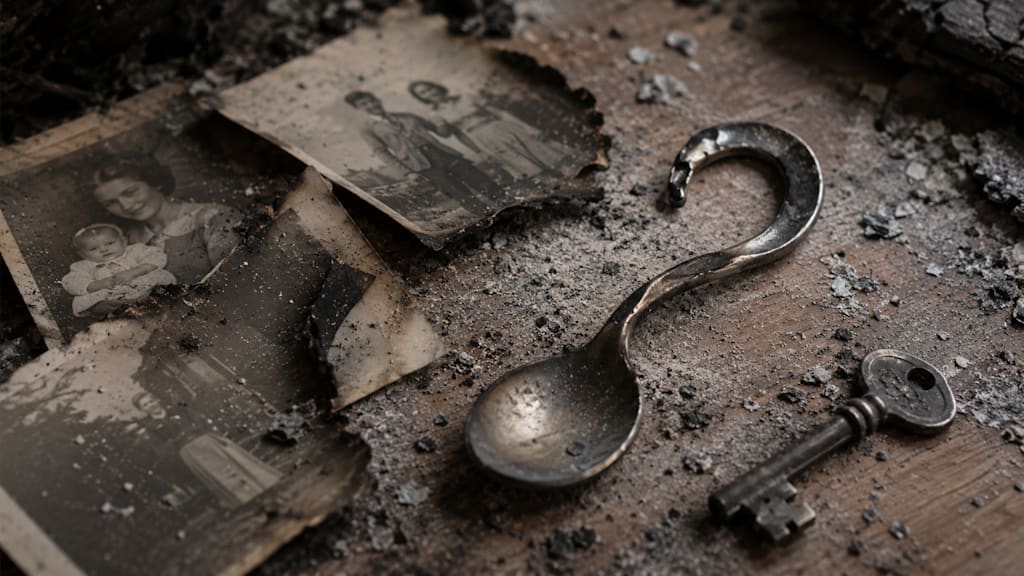
I will find a spoon
melted into the shape
of a question mark.
In the past,
my father will stir sauce with it
and tap the wooden handle twice
against the pot.
In the present,
there is no present.
There is only my mother
holding photographs
that smell like rain and smoke.
There is only the officer
asking if she has somewhere to stay.
There is only my phone
lighting up with my brother’s name,
though he is alive,
though he is dead,
though I answer,
though I don’t.
The voicemail says:
Call me when you get this.
I get it too late.
I get it too early.
I get it every day.
After the fire,
people bring casseroles.
Before the fire,
people bring matches.
Not literally.
Usually.
Someone says
everything happens for a reason,
and suddenly I understand
why houses have doors.
To keep certain comforts out.
My mother sleeps on my couch
with her shoes on
for three weeks.
Or maybe one night.
Or maybe she is still there.
Sometimes grief stretches
like taffy,
sometimes it snaps shut
like a trap.
She wakes at 2:13
and asks if I smell smoke.
I say no.
I am lying.
The smoke lives in our hair,
our coats,
the cardboard boxes marked
SALVAGE,
the pages of books
that open now
with a soft gray cough.
My childhood Bible survives,
though none of us
has believed properly
in years.
So does a chipped mug
from Niagara Falls,
a ceramic angel
with no head,
three forks,
my father’s hammer,
and one Christmas ornament
shaped like a house.
The ornament is ridiculous.
The ornament is holy.
The ornament hangs
from my rearview mirror
until July,
swinging above the dashboard
while spring arrives
with its offensive green confidence.
Months from now,
my mother will say
she is ready to start over.
Minutes ago,
she said she wanted to die.
Both are true.
Neither stays true long enough
to become a plan.
Before the rebuild,
there is the argument
over wallpaper.
Before the argument,
there is the blueprint.
Before the blueprint,
there is the empty lot.
Before the empty lot,
there is the house.
Before the house,
there is a woman
holding a key
in her open palm
as if someone has just handed her
the future
and she believes
she knows what to do with it.
I want to warn her.
I want to say:
The oven will spark.
The attic will catch.
Your husband will die first.
Your sons will stop calling enough.
You will keep too much.
You will lose it anyway.
But she is laughing.
The key shines.
My father is beside her,
young and impossible.
Behind them,
nothing is burning yet.
So I say nothing
Or I say everything.
Or I am not born.
The ash lifts.
The match waits.
My mother steps backward
through the smoke
and into the kitchen,
whole again,
wearing the blue dress
she will be buried in
twenty years before she dies.
She turns to me.
She says,
Don’t forget anything.
Then the house becomes a house.
Then the fire becomes a light
left on by mistake.
Then the voicemail unrecords itself.
Then my brother is calling.
Then I answer.
Then there is nothing to fix.
Then everything is still ahead of us,
lined up neatly,
waiting to happen
in the wrong order.
About the Creator
Jason Hair-Wynn
Theatre artist, director, choreographer, and arts leader writing on accountability, equity, and culture in the performing arts, with a deep belief in storytelling, truth, and spaces rooted in care. And some travel content along the way
Enjoyed the story? Support the Creator.
Subscribe for free to receive all their stories in your feed. You could also become a paid subscriber, letting them know you appreciate their work.
Comments
There are no comments for this story
Be the first to respond and start the conversation.