
A study claims that 500 years before science, Dante's Inferno mapped a planetary impact.
The Handwritten Notes of Dante Found 700 Years After His Death

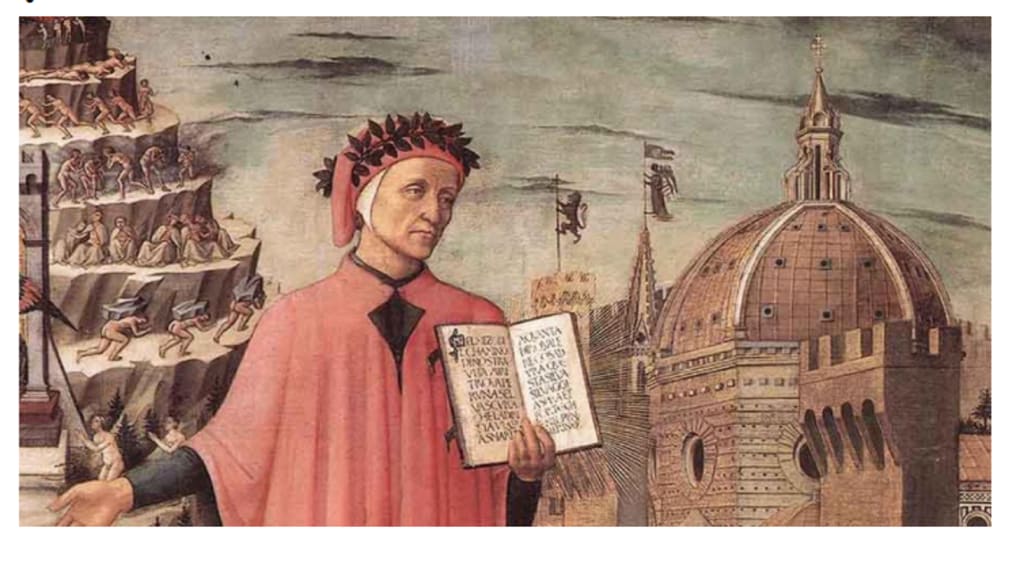
The geometry of Hell as portrayed in Dante Alighieri's Inferno closely resembles the physical structure created by a massive planetary impact event, according to a new study presented at the European Geosciences Union (EGU) General Assembly in Vienna in April 2026.
According to research headed by Dr. Iain Stewart of the University of Plymouth, the mediaeval poet may have incorporated actual geophysical information into his masterpiece from the 14th century—roughly five centuries before contemporary science had the means to explain such events.
The Science of Craters and the Geometry of Hell
Dante's Inferno presents Hell as a large, inverted conical pit beneath the Earth's surface, narrowing downward through nine concentric rings into a freezing core. The study claims that this geometry corresponds to what planetary scientists today refer to as a "complex impact crater," which is the kind created when a large asteroid collides with enough force to compel rock to behave like a fluid.
Terraced inner walls, a central elevation, and a wide, comparatively flat floor are characteristics of these craters that translate very accurately onto Dante's multi-layered underworld. Drawing from Aristotle and the Arabic intellectuals who brought classical knowledge to mediaeval Europe, the researchers observe that Dante was thoroughly involved with the natural philosophy of his day.
According to the current research, whether intentionally or not, this model nailed the fundamental morphology of a huge impact structure—a description that geologists would not fully describe for another 500 years.
The Chicxulub Relationship
The Chicxulub impact crater, a 66-million-year-old scar left beneath the Gulf of Mexico by the asteroid that terminated the dinosaur era, is of particular interest to the researchers. One of the most well-researched complicated impact craters on Earth, Chicxulub's internal structure, with its core basin, terraced walls, and peak ring, offers a practical counterpart to the geometry Dante described.
The study contends that Dante developed a mathematically correct picture of what a big impact structure looks like using the physical intuitions ingrained in ancient natural philosophy, rather than asserting that he had direct knowledge of Chicxulub.
Although the authors admit that this may be a coincidence rather than proof of direct knowledge, the scale of Dante's Hell—roughly the size of the Mediterranean basin—is comparable with the scale of a very big terrestrial impact structure. According to Heritage Daily, the study "raises the intriguing possibility that Dante's vision of Hell was not purely theological but also reflected an intuitive grasp of planetary physics."
A Pioneering Poet?
Scholars have previously searched writings from antiquity and the Middle Ages for proof of advanced natural understanding. Scholars have previously contended that myths from many cultures maintain memories of catastrophic impact events and that ancient peoples were monitoring cometary activity at locations like Göbekli Tepe.
This larger legacy of "archaeo-geophysics"—the hunt for scientific information contained in pre-modern cultural artifacts—is where the new Dante study falls in. At the EGU General Assembly, one of the biggest assemblies of earth and planetary scientists worldwide, Dr. Stewart presented the results. The authors admit that their hypothesis is still theoretical, and the study has not yet been published in a peer-reviewed journal.
They contend that the Divine Comedy is a work that may be as notable for its science as its poetry because of Dante's extraordinary spatial imagination and the physical intuitions of classical philosophy, which resulted in a description of Hell that closely resembles the structure of a large impact crater.
The Handwritten Notes of Dante Found 700 Years After His Death
Dante Alighieri, a writer from the 13th and early 14th centuries who wrote during Europe's worst crises, is a national treasure of Italy and one of the finest poets and authors to come out of the Italian Middle Age—indeed, ever. With works like Divine Comedy and The New Life, he made such a significant contribution that it has influenced many aspects of the modern Italian language. After centuries of no one seeing his handwriting, a researcher from Florence is said to have discovered a sample of his handwritten work.
Brunetto Latini's Role in the Divine Comedy
Julia Bolton Holloway, an eighty-year-old British researcher, thinks it demonstrates the renowned author's brilliance. Before becoming a nun and managing the English cemetery in Florence, Holloway taught mediaeval studies at Princeton University in New Jersey.
The Tuscany regional government has recently published her results in a book. According to a report in The Times, these samples were discovered concealed in plain sight in two libraries in Florence and at the Vatican. They date to the late 13th century, when Dante was a student and scholar in Florence.
During this period, Dante was being taught by Brunetto Latini, an Italian statesman, philosopher, politician, and scholar from the thirteenth century who was also serving as Dante's mentor. Latini was dictating works on the art of governance to Dante, who was copying beside him.
Latini is renowned, among other things, for explaining the teachings of the ancient Roman philosopher Cicero as instruction in public affairs. Interestingly, Ms. Holloway has spent nearly fifty years researching Latini, also referred to as Latinos.
According to Holloway, "the early manuscripts have schoolboy-like handwriting, but the writing is in excellent Tuscan, which later served as the blueprint for Italian and covers the ideas of ethical government which later appeared in the Comedy."
Holloway emphasises, "Dante reports that Latino was his former teacher, but he really tarred and feathered him in his work, and as a result he has been overlooked." She teasingly continued, "Maybe it took a woman to pay attention to him." Latini, incidentally, can be found in an area of hell designated for sodomites in the Divine Comedy.
The Divine Comedy is a lengthy narrative poetry in Italian that is divided into three sections: Inferno, Purgatario, and Paradiso. It depicts the state of the soul after death and shows divine justice administered as appropriate punishment or reward.
It focuses on Dante's journeys into the three realms stated above, symbolising the soul's metaphorical journey towards God. Even today, Italian pupils study the Divine Comedy in considerable depth despite its spiritual and metaphysical subject matter.
Latini and Dante: A Match Made in Heaven
According to Holloway, "Latini was steeped in the classics and learned about astronomy and Aristotle's work on ethics during a period of exile in Spain, all of which feeds into the Comedy." When he got back to Florence, he would dictate his work on politics, eloquence, and ethics to his students.
He and Dante shared a similar mindset, as seen by the numerous instances of his remarks in the Comedy, she remarked. Holloway thinks that Dante either wrote or copied these notes in his own hand.
Holloway claims that the notes she has found "are the only ones on cheap parchment, which makes sense given Dante was poorer than his fellow pupils, and are the only ones written in the so-called cancelleresca script, which Dante was likely taught by his father."
Dante's original, handwritten form of the Divine Comedy has not yet been found. However, according to Ms. Holloway, "Leonardo Bruni, a later Renaissance scholar who saw Dante's handwriting, described it as being similar to the manuscripts I have found."
An increasing body of evidence seems to support Julia Bolton Holloway's astounding revelation. Two of the manuscripts include a hand-drawn square superimposed on a circle, which further suggests that Dante wrote them. Dante described God in Divine Comedy using this idea of juxtaposition, which is still prevalent in modern culture.
About the Creator
Enjoyed the story? Support the Creator.
Subscribe for free to receive all their stories in your feed.
Comments
There are no comments for this story
Be the first to respond and start the conversation.