

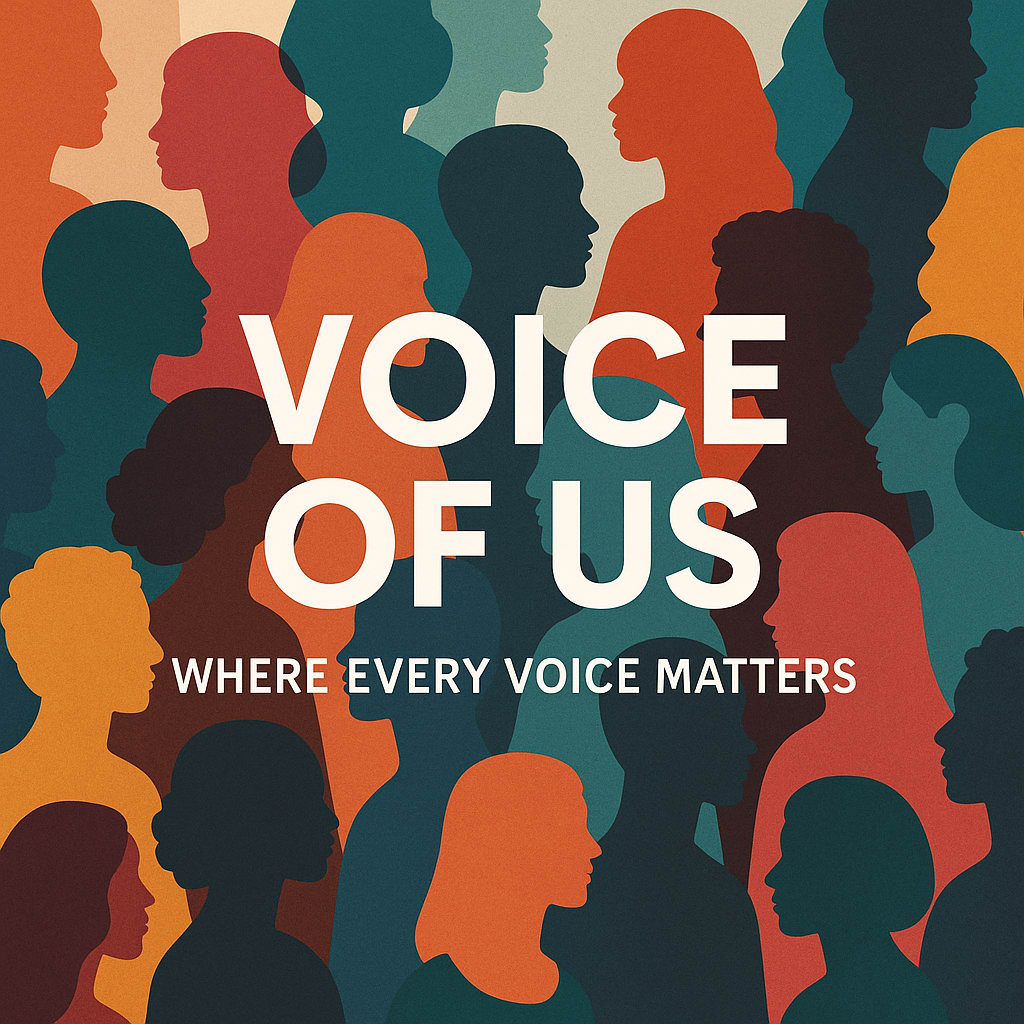
The Power of Voice: A Human Right, Not a Privilege
In every era, from ancient storytelling firesides to today’s podcast platforms and protest marches, one thing has remained constant: the human need to be heard. Our voices carry not just words, but emotions, histories, and identities. They are how we express joy and pain, how we question power, how we affirm our existence. Yet throughout history, not all voices have been granted equal space or value.
The title “Voice of Us” speaks to that imbalance. It challenges the systems that prioritize some narratives while silencing others. It insists that every individual, regardless of background, ability, identity, or circumstance, deserves to speak and be heard. And it makes clear that our collective story — our truth — is incomplete without each person’s contribution.
“Where Every Voice Matters” is more than a slogan. It’s a radical declaration in a world where voices are often lost in the noise, drowned out by dominance, or dismissed by design. It’s a call to action: to listen more deeply, to speak more bravely, and to create spaces where those at the margins can move to the center.
In this long-form exploration, we will journey through the silenced, the courageous, the creative, and the evolving landscape of vocal expression. We’ll hear from activists and artists, everyday people and visionaries, who are using their voices to shape their communities and the world. We’ll examine not only the triumphs of being heard but also the deep costs of being silenced.
This is not just about literal voice — though that’s vital. It’s about metaphorical voice: representation, influence, agency, story. In a world divided by lines of race, class, gender, language, and ability, voice can be the bridge that connects us. It can be the difference between invisibility and empowerment, between oppression and liberation.
So let this be more than words on a screen. Let this be a shared breath. A moment of recognition. An invitation to rise, speak, and listen. Because this is the Voice of Us — and yes, your voice matters too.
History Doesn’t Always Speak for Everyone
Throughout the centuries, history books have been written by victors, leaders, and those in power. But what about the countless others who lived, breathed, dreamed, resisted — yet left no record because they had no platform? The voiceless are not voiceless by nature; they are made voiceless by systems that deem their stories unworthy of attention.
1. The Margins of History
Women, enslaved peoples, colonized communities, indigenous nations — all have endured long periods of enforced silence. For many, literacy was restricted, languages were erased, and storytelling traditions were dismissed as “primitive.” Oral histories were often ignored by Western academics, yet these were the heartbeat of entire cultures.
For example, during colonization, indigenous languages across Africa, the Americas, and Oceania were systematically suppressed. Speaking one’s native tongue became a punishable offense. With language went stories, names, spiritual knowledge — entire ecosystems of identity.
Similarly, enslaved Africans in the Americas were stripped of their native languages and cultures. Yet they resisted through spirituals, coded songs, and rhythmic storytelling. Even in bondage, they found ways to assert voice — and that voice became the root of blues, jazz, hip hop, and more.
2. Women’s Voices: A Long Battle for Expression
For centuries, women’s words were confined to the private sphere. Public speaking was seen as inappropriate or even dangerous. Women writers often had to use male pseudonyms — like George Eliot or Currer Bell — to be taken seriously. In many parts of the world, girls are still denied the right to speak freely, let alone lead or publish. The silencing of women is often enforced through both culture and violence.
Despite this, women have always found a way to speak. In diaries, in secret meetings, through coded language, and now, increasingly, through digital platforms. The rise of feminist media has disrupted centuries of erasure — but much work remains.
3. Disability, Neurodivergence, and the Fight for Accessibility
Being unable to speak does not mean having nothing to say. Nonverbal and neurodivergent people have long been overlooked in discussions about voice. Yet through tools like AAC (augmentative and alternative communication), text-to-speech, and sign languages, millions are finally being included in conversations.
Still, ableism persists. People are often judged for the way they speak rather than what they say. Those who “communicate differently” face bias, infantilization, or outright dismissal. Making space for all voices means recognizing that expression takes many forms — all of them valid.
4. The Politics of Language
Accent. Dialect. Code-switching. These are not just linguistic quirks; they are loaded markers of identity. People are often judged — and silenced — based on how they sound. From African American Vernacular English (AAVE) to regional indigenous dialects, entire communities are pressured to “neutralize” their speech to be accepted.
This erasure is a form of violence. When someone is told they must sound a certain way to be professional, intelligent, or trustworthy, their voice is being reshaped by systemic bias. True equality requires linguistic freedom — the right to be understood as we are.
About the Creator
Sudais Ali shah
I’m a content creator and a writer since 3 year and also lawyer
Enjoyed the story? Support the Creator.
Subscribe for free to receive all their stories in your feed.
Comments
There are no comments for this story
Be the first to respond and start the conversation.