
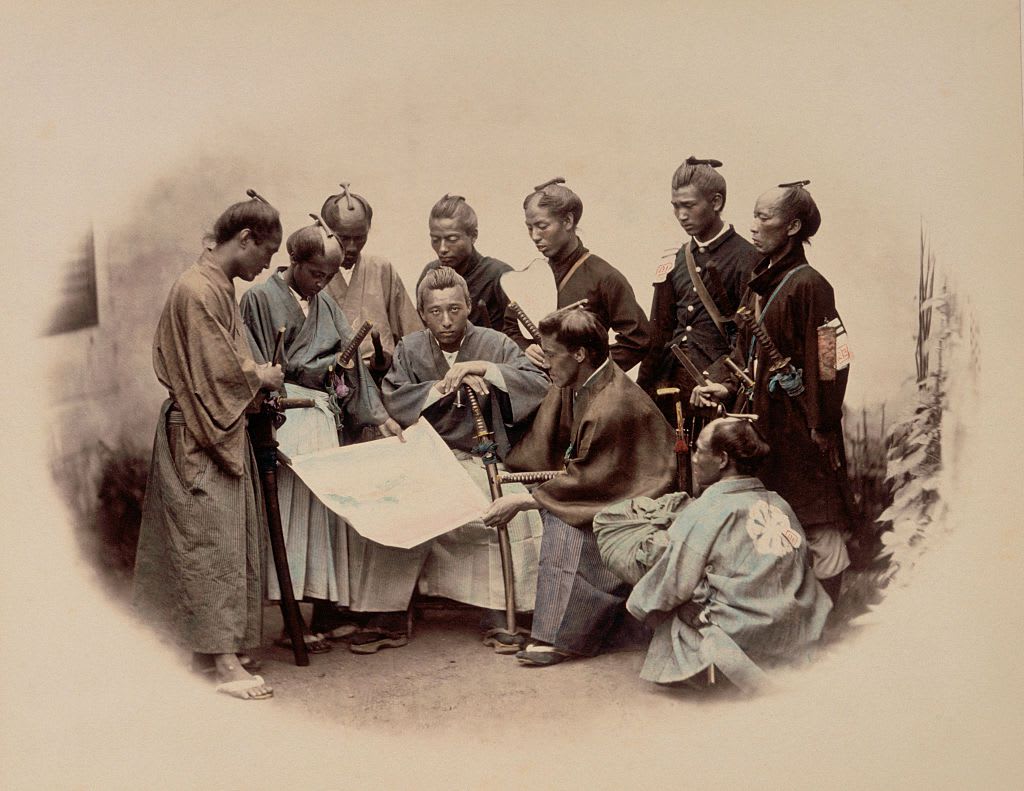
Chivalry is neither a dried-up example of an antiquated virtue kept in the herbarium of our history, nor is it a flower any less native to the soil of Japan than its emblem, the cherry blossom. Even while it doesn't take on a physical form, it still lingers among us as a living object of beauty and force, scenting the moral atmosphere to remind us that we are still in its grip. The social factors that gave rise to and supported it have long vanished; But just as distant stars that were once and are no longer continue to shine on us, so does the light of chivalry, which was born out of feudalism and has survived its mother institution, illumine our moral way. It gives me joy to think about this topic in Burke's words, who famously delivered a moving eulogy for the forgotten grave of the European prototype.
It argues a sad defect of information concerning the Far East, when so erudite a scholar as Dr. George Miller did not hesitate to affirm that chivalry, or any other similar institution, has never existed either among the nations of antiquity or among the modern Orientals. Such ignorance, however, is amply excusable, as the third edition of the good Doctor’s work appeared the same year that Commodore Perry was knocking at the portals of our exclusivism. More than a decade later, about the time that our feudalism was in the last throes of existence, Carl Marx, writing his “Capital,” called the attention of his readers to the peculiar advantage of studying the social and political institutions of feudalism, as then to be seen in living form only in Japan. I would likewise invite the Western historical and ethical student to the study of chivalry in the Japan of the present.
Even though it would be fascinating to compare European and Japanese feudalism and chivalry historically, that is not the focus of this essay. My goal is to describe the history and sources of our chivalry, as well as its character and teachings, the influence it has on the general public, and the persistence and continuity of that influence. More than ten years later, around the time that our feudalism was nearing its end, Carl Marx, in his book "Capital," drew readers' attention to the peculiar benefit of studying feudalism's social and political institutions, which were at the time only visible in living form in Japan. The study of chivalry in contemporary Japan is something I would also like to invite the historical and ethical student from the West to do.
The Japanese word for "chivalry," which I have interpreted roughly, is more emotive in its native language than "horsemanship." The term "Bu-shi-do" roughly translates to "Military-Knight-Ways," or the "Precepts of Knighthood," the noblesse oblige of the warrior class. These are the methods that fighting nobles should adhere to in both their daily lives and their line of work. I may now use the word in its original form as I have explained its exact meaning. The use of the original term is also recommended for this reason: some words have national tones that are so expressive of racial characteristics that even the best translators can only do them scant justice, let alone positive injustice and grievance. Furthermore, some words have casts of mind and characters that are so peculiar, so local, that the badge of their singularity must be worn on their faces. Who is capable of improving the meaning of the German word "Gemüth" through translation, or who is unable to distinguish the differences between the two words despite their verbal similarity to the English gentleman and the French gentilhomme?
Bushido is the set of moral guidelines that the knights were expected or trained to follow. It is not a written code; at best, it is a collection of a few sayings passed down orally from one warrior or sage to another. More often than not, it is an unspoken, unwritten code that is even more potently sanctioned by real action and by a law inscribed on the physical tablets of the heart. It was not established on the creativity of one mind, no matter how talented, or on the life of one individual, no matter how well-known. It was the organic result of centuries and decades of military service. It may occupy the same space in political history as the English Constitution does in the history of ethics, but it cannot be compared to the Magna Charta or the Habeas Corpus Act. Although the Military Statutes (Buké Hatto) were published in the early seventeenth century, just a few of their thirteen brief articles—which were primarily about marriages, castles, leagues, and other matters—covered the didactic rules. Because of this, we cannot declare, "Here is its fountain head," and point to a certain time or location. Its beginning in terms of time can only be associated with feudalism once it reaches consciousness in the feudal age. But Bushido shares the complex nature of feudalism, which is weaved together from many different strands.Similar to how feudalism's political structures in England can be considered to have originated with the Norman Conquest, we can claim that Yoritomo's ascent to power in Japan during the end of the twelfth century coincided with the emergence of feudalism there. However, just as in England, the social underpinnings of feudalism can be seen dating back much before William the Conqueror, so too can we find the seeds of feudalism in Japan dating back well before the time I have indicated.
When feudalism was legally established, the professional class of warriors inevitably rose to prominence, just as it did in Europe and Japan. These were referred to as samurai, which literally means "knights" in the old English cniht (knecht), guards, or attendants. They resembled in personality the soldurii that Caesar claimed to have mentioned in Aquitania, the comitati that Tacitus claimed followed Germanic chiefs in his time, or the milites medii that one reads about in the history of Medieval Europe. Additionally, the Sinico-Japanese phrase Bu-ké or Bu-shi (Fighting Knights) entered general usage. They belonged to a wealthy class and were likely born of a hardy race that made a living out of combat.During a protracted period of constant warfare, this class was inevitably recruited from the toughest and most daring individuals. At the same time, the timid and weak were weeded out, leaving only "a rude race, all masculine, with brutish strength," to borrow Emerson's phrase, to survive and join the samurai ranks. They quickly saw the need for a uniform code of conduct because they had come to profess high honor, great privileges, and consequently tremendous obligations. This was especially true considering that they were continually on the defensive and belonged to different clans. Warriors must have some recourse for final judgment on their misdeeds, just as physicians limit rivalry among themselves by professional civility and just as attorneys sit in courts of honor in cases of breached etiquette.
Good luck in the fight! What fertile moral seeds are buried in this primal experience of childhood and barbarism. It is the foundation of all military and civic qualities, isn't it? We chuckle (as if we've outgrown it!) at Tom Brown, a little British man, who has the innocent desire "to leave behind him the name of a fellow who never bullied a little boy or turned his back on a big one." And yet, who is unaware that this need serves as the foundation for moral systems with great dimensions? May I even go so far as to suggest that this goal is supported by the gentlest and most peace-loving of religions? It won't take us long to realize that Bushido does not occupy a position of inferiority to Tom's drive, upon which much of England's grandeur is based. Fighting is violent and immoral in and of itself, as Quakers accurately attest, but we may still agree with Lessing that "We know from what failings our virtue springs." The worst insults to those with wholesome, straightforward natures include calling them "sneaks" and "cowards".These beliefs and the chivalry are prevalent in childhood, but as life becomes more complex and multifaceted, the early faith seeks approval from more reasonable sources for its own justification, fulfillment, and growth. How far short of the ideal of knighthood would have operated military interests if they had worked independently and without higher moral support! Christianity was nonetheless imbued with spiritual information in Europe even though it was understood with chivalric concessions. "Religion, war, and glory were the three souls of a perfect Christian knight," claims Lamartine. There were numerous in Japan.
About the Creator
Enjoyed the story? Support the Creator.
Subscribe for free to receive all their stories in your feed.
Comments
There are no comments for this story
Be the first to respond and start the conversation.