
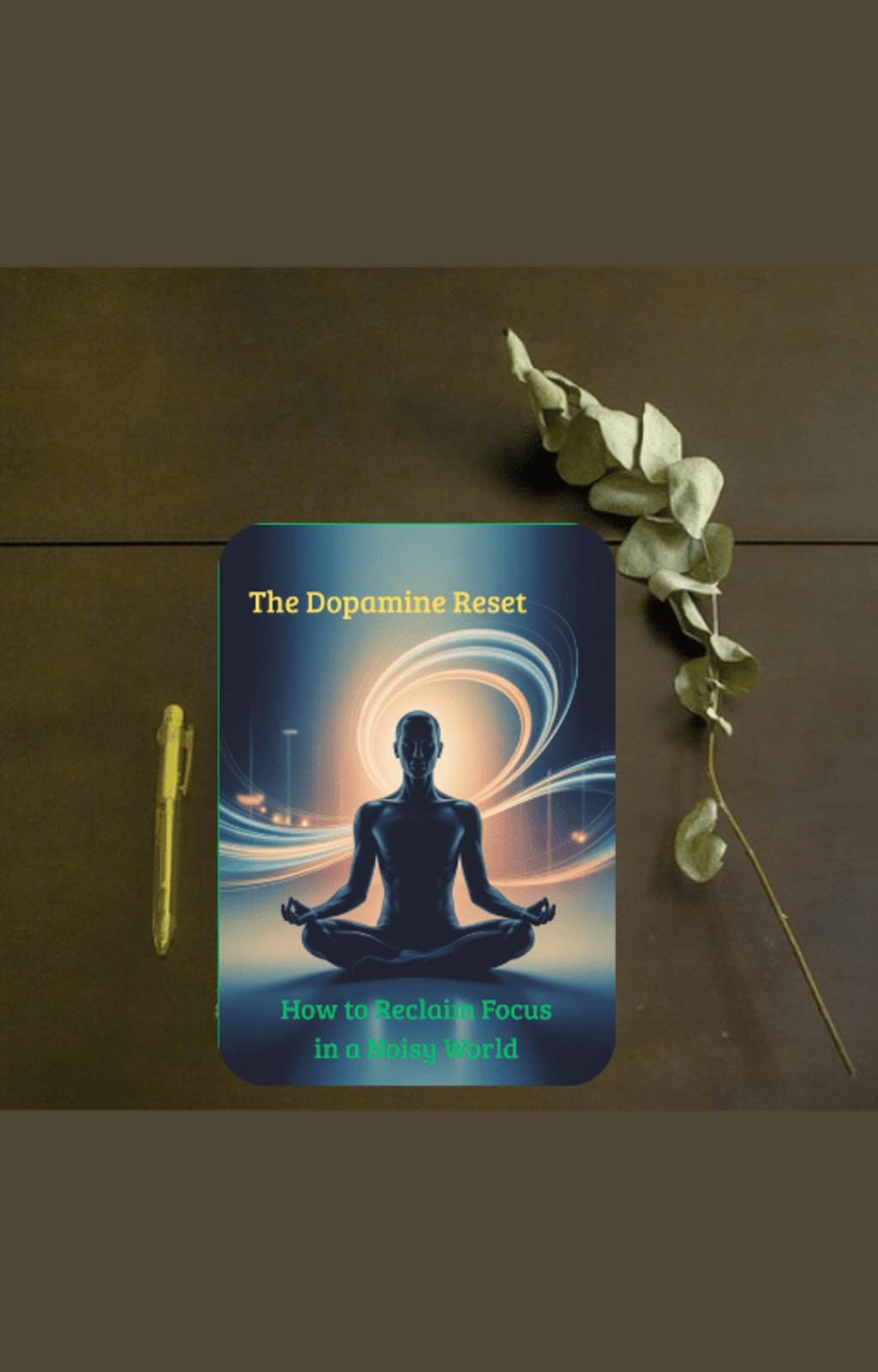
The Dopamine Reset: How to Reclaim Focus in a Noisy World
How to Reclaim Focus in a Noisy World

Introduction — The Overstimulated Mind
We live in a world that never stops.
Notifications flash. Videos autoplay. Messages pile up before we’ve even finished breakfast.
Our brains—once wired for survival in the wilderness—are now drowning in digital noise.
Every ping, scroll, and “like” releases a hit of dopamine—the chemical that fuels motivation, pleasure, and reward.
But just like sugar, too much dopamine can make us numb.
We chase stimulation instead of satisfaction.
We start a hundred things… and finish none.
This eBook is not about quitting technology.
It’s about resetting your brain’s reward system—so you can take back control of your focus, motivation, and peace.
In the next ten chapters, you’ll learn how to rebalance your dopamine levels, rewire your habits, and rediscover deep joy in the quiet moments again.
Take a deep breath. Let’s begin your reset.
Chapter 1 — Understanding Dopamine: The Brain’s Motivation Molecule
Dopamine isn’t just a “pleasure” chemical—it’s the anticipation of reward.
It makes you reach for your phone, check your messages, and scroll endlessly.
When dopamine spikes constantly, the brain’s receptors become desensitized.
What once made you excited—like a message from a friend—now barely registers.
You start needing more stimulation to feel the same spark.
Understanding this is power.
You don’t need to eliminate dopamine; you need to restore balance.
Awareness is the first step to control.
Chapter 2 — The Cost of Overstimulation
Our attention has become fragmented.
We can’t read a full article without checking our phone.
We multitask our way into exhaustion.
Studies show that constant stimulation reduces creativity, shortens attention span, and increases anxiety.
The brain is not built for endless novelty.
When every moment becomes entertainment, silence feels like pain.
Your goal is to make peace with boredom again—because boredom is where focus is born.
Chapter 3 — The Dopamine Loop: Why We Keep Checking Our Phones
Each notification acts like a slot machine.
Sometimes it’s rewarding, sometimes it’s not.
That unpredictability keeps you hooked—this is called variable reward.
Apps are designed to exploit this loop.
But the same mechanism can be used to your advantage:
You can create positive dopamine loops by linking your habits to meaningful goals.
For example:
Every time you complete a deep-focus task, reward yourself with something small—tea, sunlight, a song you love.
Train your brain to crave productivity, not distraction.
Chapter 4 — The 24-Hour Dopamine Fast
One of the fastest ways to reset your brain is through a Dopamine Fast—a 24-hour break from digital highs.
No social media. No notifications. No endless scrolling.
You’ll feel restless at first.
That’s your brain detoxing from overstimulation.
But by the end of the day, you’ll notice silence becoming peaceful again.
During your fast:
Go for a walk without music.
Journal your thoughts.
Breathe deeply and do nothing for five minutes.
You’ll start to remember what real presence feels like.
Chapter 5 — Reclaiming Your Focus
Focus isn’t about willpower—it’s about environment design.
You can’t win if your phone keeps buzzing.
Start by removing friction:
Keep your phone out of reach while working.
Block distracting sites during focus time.
Work in short, powerful bursts—25 minutes on, 5 minutes off (Pomodoro technique).
Each time you protect your attention, your brain learns that focus is safe again.
Slowly, your baseline dopamine stabilizes—and so does your mind.
Chapter 6 — Building the Deep Work Habit
Deep work is the art of doing one meaningful task without interruption.
It’s where creativity lives.
To rebuild deep focus:
Choose one high-value task each morning.
Eliminate everything else until it’s done.
End your session with gratitude for the process, not the result.
Deep work feels difficult at first, but soon becomes addictive—the good kind of dopamine.
Chapter 7 — The Role of Sleep and Nutrition
You can’t reset your dopamine if your body is exhausted.
Lack of sleep and poor nutrition directly lower dopamine levels.
To restore your brain chemistry:
Sleep 7–9 hours per night, in darkness and silence.
Eat whole foods: omega-3s, eggs, nuts, greens, and dark chocolate.
Avoid excess caffeine and sugar—they cause dopamine spikes and crashes.
Your mind is not separate from your body.
When you take care of one, the other heals too.
Chapter 8 — Mindfulness and the Art of Stillness
Meditation is the ultimate dopamine reset.
It teaches your brain to find reward in being, not doing.
Start small: two minutes a day of conscious breathing.
Watch your thoughts without judgment.
Notice how your mind constantly searches for stimulation—and gently return to stillness.
Stillness is where clarity begins.
Chapter 9 — Redefining Pleasure
Modern pleasure is fast and shallow.
True pleasure is slow and deep.
Read a book under the sun.
Cook something from scratch.
Talk to someone face-to-face, without checking your phone.
When you return to natural sources of joy, your brain stops needing constant novelty.
You begin to feel satisfaction, not just stimulation.
Chapter 10 — Designing a Low-Dopamine Life
Your environment shapes your brain.
Design your days to support balance:
Start mornings screen-free for 30 minutes.
Schedule deep work before digital input.
Take one full “offline day” each week.
Celebrate progress, not perfection.
This isn’t about deprivation—it’s about liberation.
You’re not escaping technology; you’re mastering it.
Conclusion — The Calm After the Storm
When you reset your dopamine system, life slows down.
Colors look richer. Music sounds deeper. Conversations feel real again.
You stop chasing noise and start enjoying silence.
You don’t need to quit the modern world—you just need to move through it consciously.
The dopamine reset isn’t a one-time event.
It’s a way of living with intention.
Each moment of stillness is a victory.
Each breath of awareness, a reminder:
You are no longer wired for chaos—
You are wired for peace.
About the Creator
Enjoyed the story? Support the Creator.
Subscribe for free to receive all their stories in your feed.
Comments
There are no comments for this story
Be the first to respond and start the conversation.